

From Long March to Majeed Brigade: Baloch Women and the Making of a Conflict that has Rattled Pakistan
This is not new and it’s certainly not accidental that women are participating in every sphere of the Baloch movement, from the streets of Quetta, the capital of Balochistan, to the suicide operations of the Majeed Brigade. It’s the most precise sociological indicator of how far this conflict has travelled in southwestern Pakistan. Mama Qadeer Baloch conducted 2,000-kilometre march from Quetta to Islamabad in 2013-14, under the banner of Voice for Baloch Missing Persons. It was largely sustained by women.
 May 22, 2026
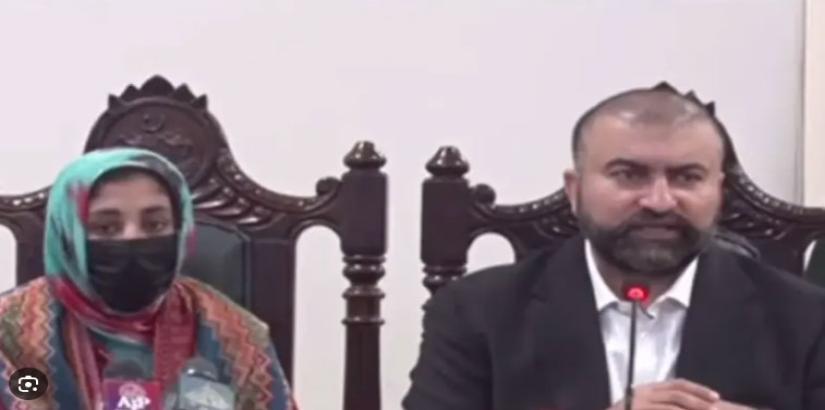
Balochistan Chief Minister Sarfraz Bugti held a press conference in Quetta alongside a detained girl On May 11, 2026. Her name was Khair-un-Nisa. She was a minor. Bugti announced that intelligence agencies had foiled a planned suicide attack on Islamabad, that she was recruited by the Balochistan Liberation Army (BLA). BLA threatened that her father would be killed if she declined to undertake the mission. The chief minister said she would be handed over to her father respectfully.
The statement is important to focus on. Not released. Not granted legal options. She would be handed to her father. The state’s representation of the Baloch woman as coerced, victimised, ensured that the only political solution it was prepared to provide her was a private one: within the family, under a man.
This was not the first press conference of such kind. Earlier, in September 2024, the provincial government of Pakistan presented the media with Adeela Baloch, another young woman. They claimed that she was brainwashed and forced into terrorism. These press conferences have a pattern and it is worth following. The 11th May announcement was significant and has larger implications. Ten days prior to that press briefing, insurgents carried out 27 attacks in Balochistan and that resulted the death of at least 42 military personnel. The State responded to that escalation by bringing a girl in front of the camera and a vow to reunite her with her father.
Previously, on January 31, 2026, the BLA had attacked 14 places of Balochistan - Pakistan's largest province by area - in Operation Herof-2. The BLA’s propaganda wing has aired videos of raids in military installations by female fighters. Meanwhile, Mahrang Baloch, Physician and leader of Baloch Yakjehti Committee (BYC), was making preparations to challenge her detention at the Supreme Court, which started in March 2025. Her bail had been rejected by the Balochistan High Court in February; her name added to the Fourth Schedule of Pakistan’s Anti-Terrorism Act. She had been nominated for the Nobel Peace Prize while sitting in Hudda District Prison.
Both of these scenarios seem to come from different stories. They don’t.
Growing Presence of Women Fighters
This is not new and it’s certainly not accidental that women are participating in every sphere of the Baloch movement, from the streets of Quetta to the suicide operations of the Majeed Brigade. It’s the most precise sociological indicator of how far this conflict has travelled in southwestern Pakistan. Mama Qadeer Baloch conducted 2,000-kilometre march from Quetta to Islamabad in 2013-14, under the banner of Voice for Baloch Missing Persons. It was largely sustained by women. Sammi Deen Baloch is one of the most recognised faces of a movement whose father Abdul Qadeer was forcibly disappeared. From its inception, the BYC has been led by women. These women were engaged in something specific. They were building a public record against a state that operates, in part, by erasing records, disappearing people, institutionalising the denial of facts.
Grief, in that context, was never passive. It had an evidentiary value.
The Pakistani state has a consistent reaction to these events. During December 2020, the prominent rights activist Karima Baloch was found dead in Toronto. Mahrang Baloch was arrested in March 2025 and was protesting against the way the bodies had been recovered from the attack on the Jaffar Express, following the long march she led in November 2023. An ophthalmologist, who had never handled a gun, was charged with anti-terrorism. The fact that it is the same law that is the tool of silencing and not a means of conflict resolution is not incidental. It shows where the state’s real fear lies.
Shari Baloch was a mother of two children and teacher. In April 2022, she attacked the Confucius Institute in Karachi University, killing three Chinese nationals, which was the first suicide attack of women belonging to the Baloch tribe. She was followed by Sumaiya Qalandrani Baloch in June 2023. Zinata Rafiq attacked the HQ of Frontier Corps in Nokundi in December 2025. Mahal Baloch’s attack was part of Operation Herof-1 in August 2024. They immediately became part of Baloch nationalist poetry and social media campaigning through BLA’s media apparatus.
So, what is going on here is a shift in the nature of the sacrifice that the movement is calling for and, importantly, that women are responding increasingly. It is not always a political question of agency. First recruitment to armed struggle is a process of compulsion, second one is a process of ideological formation, that is, organisations take out your grief and put it into their own organisation. The BLA’s project in portraying its female operatives as national martyrs plays a significant role in appropriating what in fact is a powerful and disruptive force that undermines a patriarchal social structure.
The presence of women fighters in the conservative culture of Balochistan has already attracted criticism from the public. It’s a society that has kept women’s mobility and speech tightly controlled and it’s now producing women to storm at the paramilitary’s headquarters. More careful analysis of the contradiction is needed than seeing them only as a propaganda poster.
Pakistan state’s simplistic narrative of ‘terrorism’ doesn’t shed light upon this complexity. This labelling closes all the important questions: why now, why the women and what the state may not want to explain about 20 years of institutional failure. The Pakistan Institute of Peace Studies (PIPS) reported 699 attacks in 2025 alone, up 34 per cent from 2024 with 254 of those attacks reported in Balochistan, which has been home to 419 of the fatalities. According to the Human Rights Commission of Pakistan, 5,000 plus enforced disappearances occurred in 2011-22, with a higher rate in Balochistan. What happens when a State takes men out of the household, then criminalises women when they complain about the removal of men from the household, it is not just the toleration of radicalisation. It’s producing it.
Lesson for Other Countries
This is not only an opportunity for those interested in South Asian domestic dynamics to remark on the dualities in Pakistan, but it should be a lesson for other countries in the region as well. The Baloch movement is the outcome of blocking each and every legitimate political voice. There is effective prohibition of civil society groups. Large protest marches are resisted. Under an ordinance created by the British to suppress dissent, activists are tried in anti-terrorism courts. When Mahrang Baloch’s lawyers challenged her detention in Balochistan High Court, the High Court transferred the case to the Interior Ministry and thus waived its jurisdiction. That institutional collapse, as is now clearly apparent, isn’t leading to silence.
The bail petition of Mahrang Baloch is pending in Pakistan’s Supreme Court. She has not been formally charged. Her hearings are continually delayed and her lawyers were denied formal documentation of charges.
Two women. One in prison for marching. One eulogised in BLA videos for dying. Both are the creation of Islamabad.
(The author is a researcher at the Centre for the Study of Social Systems, Jawaharlal Nehru University, New Delhi, India. He is working on political violence, social movements and contemporary democracies. Views expressed are personal. He can be reached at redpluck@gmail.com)





Post a Comment