

The Changing Face of Warfare and the New Definition of Victory
In earlier conflicts, victory was often measured by territory captured, armies defeated, or governments forced to surrender. In modern warfare, however, the outcome is far more complex. A nation may achieve battlefield success yet suffer demographic, economic, and infrastructural losses that take decades to recover from.
 Jul 17, 2026
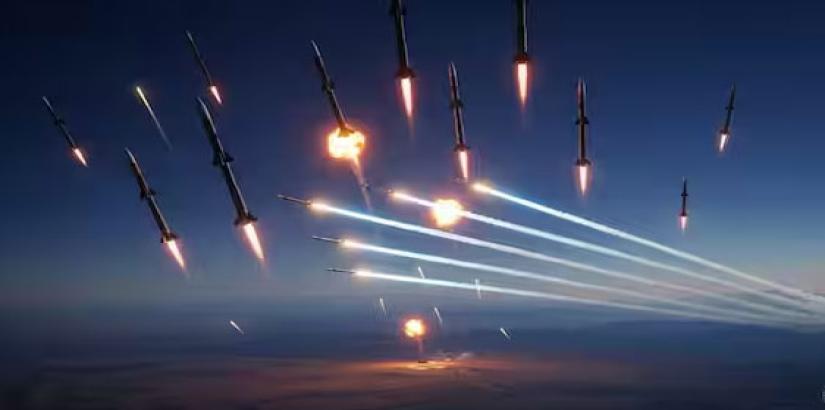
There is considerable discussion on the changing face of warfare in the context of the ongoing Russia–Ukraine conflict. Experts point out that the evolution of warfare has taken place across multiple dimensions—equipment, strategy, tactics, psychology, technology, and politics.
Ukraine has resisted the Russian offensive at a tremendous cost to the nation, even while receiving substantial economic and military assistance from the USA and Europe.
The following are broad independent estimates, based mainly on Western intelligence assessments, OSINT tracking, UN data, and economic assessments. Exact numbers will probably only be known years after the war.
1. Military personnel losses (killed, wounded, missing)

These figures are estimates and not confirmed counts.
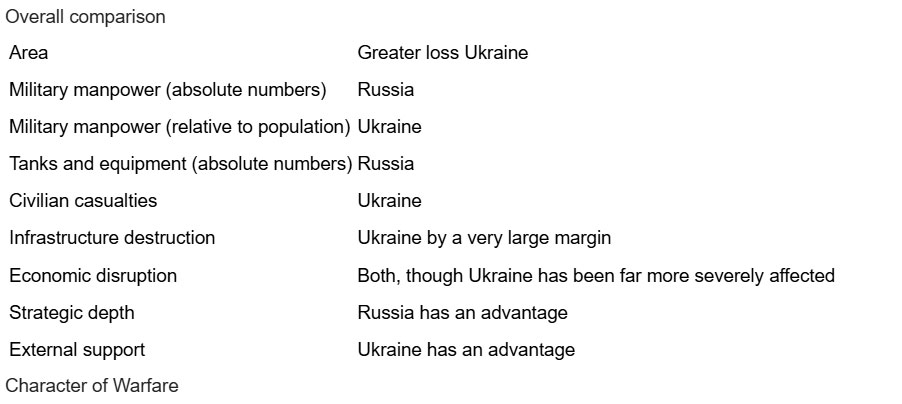
Russia, with a much larger population base, has relied heavily on manpower-intensive tactics. However, Ukraine has suffered a greater demographic burden relative to its population size.
The scale of these losses highlights an important aspect of modern warfare. Even with advances in precision weapons, drones, and technology, wars still ultimately depend on human resources, national resilience, and the ability of societies to absorb prolonged losses.
2. Military equipment losses
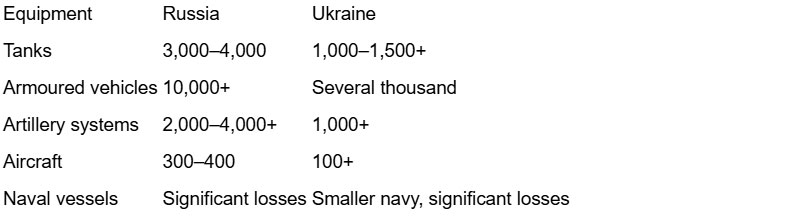
Both sides have also lost large numbers of drones, trucks, air defence systems, and support vehicles.
A complication in comparing equipment losses is that Ukraine has received thousands of Western systems. Therefore, simple loss counts do not fully reflect combat capability, as replacement and replenishment play an important role.
The conflict has also demonstrated that modern warfare is not simply about possessing advanced weapons. It is equally about integrating technology, logistics, intelligence, industrial production, and battlefield adaptation.
3. Civilian casualties and infrastructure damage
Ukraine has suffered overwhelmingly greater civilian casualties and physical destruction. Confirmed civilian deaths reported by international monitors are in the tens of thousands, though the actual figure may be higher.
Infrastructure damage in Ukraine is estimated at around US$150–200 billion or more, including:
- Hundreds of thousands of homes damaged or destroyed
- Repeated attacks on energy generation and transmission infrastructure
- Damage to railways, bridges, ports, airports, and industrial facilities
- Millions displaced internally or forced to seek refuge abroad
For Russia, physical destruction has been far smaller, although border regions have been affected. Ukrainian attacks have targeted oil refineries, fuel depots, air bases, and military infrastructure.
The economic impact on Russia has been felt more through sanctions, mobilisation, and disruption than through widespread physical destruction.
The changing character of warfare is also visible in conflicts such as the Iran–Israel–USA confrontation. Unlike the Russia–Ukraine war, which is largely a war of attrition involving mass mobilisation and territorial objectives, the West Asian conflict highlights another dimension of modern warfare.
Here, precision strikes, missile technology, drones, intelligence capabilities, air defence systems, cyber capabilities, asymmetric warfare, alliances, and the ability to impose costs on an adversary play a decisive role.
These conflicts demonstrate that technological superiority alone no longer determines outcomes. Increasingly, wars are shaped by asymmetric capabilities, political objectives, and strategic calculations.
Beyond the Battlefield
Together, these conflicts show that modern warfare is no longer decided solely by battlefield superiority. The decisive factors increasingly include technological capability, economic endurance, diplomatic support, societal resilience, and the ability to recover after conflict.
The eventual outcome may depend less on individual battlefield victories and more on sustainability—which side can continue absorbing the human, economic, and material costs for longer, and which side emerges capable of rebuilding after the war.
This is what defines modern warfare: not merely the weapons, tactics, strategies, or military might involved, but the changing nature of victory itself.
In the 21st century, the meaning of victory has evolved. It is no longer determined solely by territory captured, armies defeated, or battles won, but also by a nation's ability to preserve its people, sustain its economy, maintain its institutions, and rebuild after the conflict.
The Changing Face of Victory
The question, therefore, should not be limited to tactics and strategy, or simply to how a smaller nation has managed to resist a larger one. The larger issue is the extent of destruction and the generations it will take to rebuild.
The tragedy is that the Russia–Ukraine conflict has become a war of attrition, where both sides are losing a generation of people and enormous quantities of resources. Russia has greater reserves of manpower and industrial capacity, while Ukraine has greater motivation and external technological support.
This raises a fundamental question about the changing definition of victory in modern warfare.
In earlier conflicts, victory was often measured by territory captured, armies defeated, or governments forced to surrender. In modern warfare, however, the outcome is far more complex.
A nation may achieve battlefield success yet suffer demographic, economic, and infrastructural losses that take decades to recover from. Conversely, a country may fail to achieve all its military objectives yet still preserve its sovereignty, institutions, and national will.
The measures of victory today extend beyond the battlefield - to economic resilience, technological adaptation, demographic sustainability, societal cohesion, and, above all, the ability of a nation to rebuild.
(The author is an Indian Army veteran and a contemporary affairs commentator. The views expressed are personal. He can be reached at kl.viswanathan@gmail.com )





Post a Comment