

Patriotism not About Hating Another Country: South Asia's Shared Inheritance Deserves a Future Beyond Perpetual Hostility
I claim Tagore and Iqbal. I claim the music of Lata Mangeshkar and Mehdi Hassan.I claim the shared cultural inheritance of South Asia in all its richness and contradictions. History divided states. It could not divide memory. The food we eat, the stories we tell, the languages we speak, and the melodies that move us still carry echoes of a shared past.
 Jun 16, 2026

As one grows older, identity becomes a curious thing.
When I was young, the answers seemed obvious. I knew who I was: A Pukhtun, a Muslim, a Pakistani, a fighter pilot. A son of a particular family, tribe, and place.
Age, however, has a habit of complicating certainties.
The more I travelled, read, and met people from different walks of life, the more I realised that identity is seldom a single stream. It is many rivers flowing into the same sea.
I am Pakistani by nationality, Muslim by faith, Pukhtun by culture, Yousufzai by ancestry, and South Asian by civilisation.
And perhaps, after a lifetime of wandering through skies, countries, books, and ideas, I have become something else as well: a traveller of questions.
Every worthwhile journey changes the traveller. Every unfamiliar book, every distant city, every unexpected friendship leaves its mark. The older I grow, the less interested I become in choosing between my inheritances.
Cultural inheritance
I claim Mohenjo-daro and Taxila.
I claim Rahman Baba and Bulleh Shah.
I claim Tagore and Iqbal. I claim the music of Lata Mangeshkar and Mehdi Hassan.I claim the shared cultural inheritance of South Asia in all its richness and contradictions.
History divided states. It could not divide memory. The food we eat, the stories we tell, the languages we speak, and the melodies that move us still carry echoes of a shared past.
Yet I do not see this shared inheritance as being in conflict with my faith or my nationality.
Islam did not erase my older identities. It became one of them.
Nor did Pakistan require me to reject the civilisation that preceded it.
On the contrary, a confident nation should be secure enough to embrace the full breadth of its inheritance.
Perhaps that is why, as the years pass, I find another identity rising quietly above all the others.
I am Pakistani.
Not merely by passport.
By conviction.
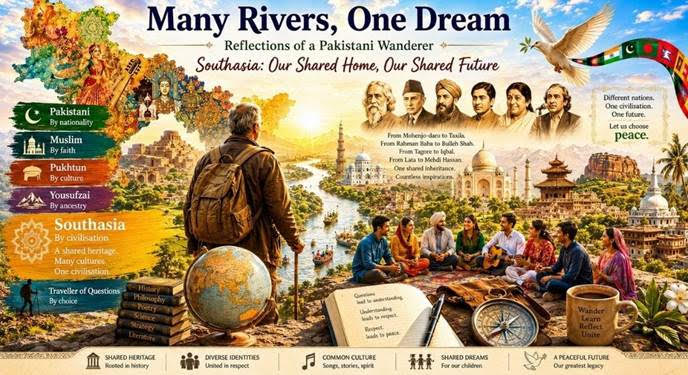
Many Rivers infograph. AI generated image by Pervez Akhtar Khan for Sapan News.
To me, the central idea behind Pakistan was never hostility towards another people. It was an attempt — however imperfect — to create a political order in which dignity, citizenship, and security would not depend solely upon numbers.
Whether we have succeeded is a matter for honest debate.
Like every nation, Pakistan remains a work in progress.
The creation of a state was never the destination.
It was just the beginning of a journey.
The destination was always a society governed by justice, protected by law, and respectful of the dignity of all its citizens.
Measured against that aspiration, we still have far to travel.
But then, so do many nations.
And so I find myself reflecting upon a final irony.
I share with my neighbours a civilisation stretching back thousands of years. We admire many of the same poets, laugh at many of the same stories, and inherit memories shaped by the same cultural landscape.
Yet we continue to confront one another across borders guarded by armies, missiles, and nuclear weapons.
As someone who spent much of his professional life studying conflict and strategy, I understand why nations seek security. The world is not always kind to the weak.
But age has also taught me something else.
Security is necessary.
It is not sufficient.
Sooner or later, every nation must answer a larger question:
What kind of future is all this security meant to protect?
The civilisation we inherited produced saints, scholars, poets, musicians, and dreamers. It produced ideas that travelled across continents and works of beauty that survived centuries.
Surely that inheritance deserves a future more imaginative than perpetual hostility.
Those who have studied war closely are often the least romantic about it.
They know that modern conflict rarely resembles the heroic myths nations tell themselves. They know that victory is usually more expensive than expected, and that loss is rarely confined to the battlefield.
And those who have contemplated a nuclear exchange know something even more sobering.
In such a conflict there would be no meaningful winners.
Only different degrees of tragedy.
I sometimes wonder what the great poets and sages of our civilisation would make of us.
Perhaps they would remind us that nations are necessary, but they are not ends in themselves.
They are instruments through which human beings seek security, dignity, justice, and the freedom to pursue their dreams.
That is why I remain unapologetically Pakistani.
Not because Pakistan is perfect.
Not because its journey is complete.
But because I still believe in the nobility of its original aspiration.
Pakistan was not the end of a dream.
It was the beginning of one.
And perhaps that is why I continue to wander.
From flying machines to philosophy.
From military strategy to novels.
From Khushal Khan Khattak to artificial intelligence.
From farm ponds to questions of civilisation and identity.
Somewhere along the way I acquired more questions than answers.
I no longer regard that as a problem.
At my age, certainty appears somewhat overrated.
Curiosity remains remarkably useful.
Looking back, I realise that the most interesting parts of my life were rarely planned.
They were wandered into.
Pakistan remains a work in progress.
So do I.
Yet despite all the noise of politics, the bitterness of history, and the anxieties of the present, I remain hopeful.
For all our divisions, the peoples of South Asia still laugh at many of the same jokes, weep at many of the same songs, and dream many of the same dreams for their children.
A parent in Lahore, Delhi, Dhaka, Kathmandu, Colombo, or Kabul does not wake up wishing for conflict. They wish for opportunity. For dignity. For safety. For a future a little better than the past.
Perhaps that simple truth is worth remembering.
Nations will continue to compete.
Governments will continue to disagree.
History will continue to cast its long shadow.
But none of these absolves us of the responsibility to imagine something better.
The purpose of strength is not war.
It is peace.
The purpose of prosperity is not wealth alone.
It is human flourishing.
And the purpose of patriotism is not to hate another country.
It is to build one’s own.
Not a bad state of affairs for an old wanderer.
Or, as a Sindbad Jahazi of ideas might put it: The sea is still there. And the sail still catches the wind.
(The author is a writer who has served as an Air Commodore in the Pakistan Air Force and former Defence Attache in Paris. He focuses on defence policy, strategy, and social issues, and has authored a book on Khushal Khan Khattak, the 17th-century Afghan Pashtun poet, chief, and warrior. His article ‘Salute across the skies’ in tribute to a fallen Indian Air Force pilot last year was widely read across borders. By special arrangement with Sapan)





Post a Comment