
Mecca Pact

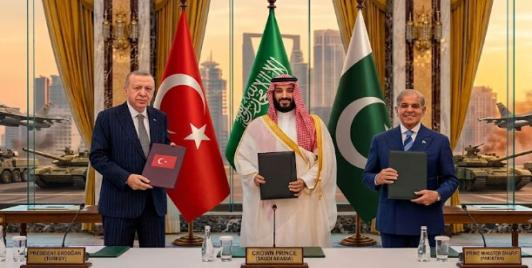
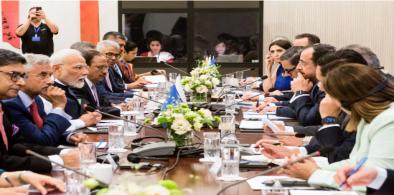
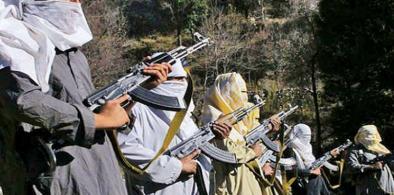
In Pakistan's and Turkiye's Military Commitment, the Mecca Pact Faces its First Litmus Test

It would also explain why Pakistan is trying to preserve a distinction between supporting Saudi Arabia and fighting the Houthis. Pakistan has every reason to avoid another open-ended conflict in the Middle East. Its military is heavily committed to its own security challenges. Its economy cannot easily absorb the political and financial consequences 

EU and India Should Cooperate Strategically on Middle East Stability

EU and India could establish a regular EU–India-Middle East Consultative Mechanism involving foreign-policy officials and experts. Its purpose would be to coordinate positions before major international gatherings and meetings. 

Sri Lanka’s Ruling Marxists-Leninists on Delhi, Beijing Visits: Embracing Diplomatic Pragmatism?

For Sri Lankan politics, this is more than diplomatic sightseeing. It raises a fundamental question whether the JVP is developing a sophisticated strategy of balancing relations with India and China or is it gradually adapting itself to the organisational models of powerful one-party or dominant-party systems in China and India respectively?

Continuing Kuki-Naga Conflict is a Threat to Northeast India's Security

The ongoing civil war in Myanmar has caused an influx of armed cadres (Meitei, Naga and Kuki) into Manipur's border tracts like Kamjong district, further squeezing finite land resources and aggravating historical territorial disputes. What began as a localized dispute under the state's newly elected government in February 2026 has escalated into intense, multi-district armed warfare. 

More on Geopolitics, Security and Strategic Affairs

Afghanistan should not be turned into a nest of terrorism again

Biden needs to go through all the wrong decisions made by Trump and come out with valuable and healthy steps to maintain democracy in Afghanistan and to respect the blood its soldiers had shed, and end the war, writes Majidullah Rasooli for South Asia Monitor

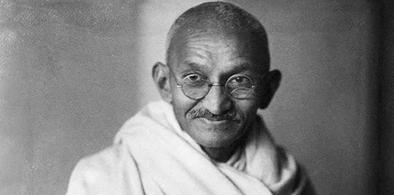
Gandhi’s 73rd death anniversary: Remembering the apostle of peace in today's context

Gandhiji had a presence. That is a mark of a great soul and a very much evolved spiritual being. To Gandhiji spirituality came first; other things like politics, public life, etc. were by-products of his spirituality, writes Anil K Rajvanshi for South Asia Monitor

Growing Indo-Saudi Arabia ties will amaze the world

The contributions made by the Indian community in the development of Saudi Arabia have always been appreciated by the Saudi government. Keeping in view the contribution of expat Indians, the Saudi government, irrespective of their religion, treats every expat Indian equally like its own citizen, writes Asif Rameez Daudi for South Asia Monitor

Billionaire raj: Can India address its growing wealth disparity?

The massive and growing concentration of incomes is not good news for India's fragile social fabric as it can trigger a political backlash, writes N. Chandra Mohan for South Asia Monitor

Digitalisation as a policy priority: How South Asia compares with Southeast Asia

In South Asia, while digitalisation is of a high priority intervention, the other more basic issues such as enabling access to livelihood, health and education would need to be addressed and given a much higher priority so that inequalities in per capita consumption expenditure that prevail among households are addressed immediately, writes Partha Pratim Mitra for South Asia Monitor

Health Diplomacy: India-made vaccine at centre stage of pandemic management

India has a longer track record of supplying medicines and vaccines to the rest of the world, than any other country, including China, writes Rajendra Shende for South Asia Monitor

US reviving military ties with Pakistan for Afghan peace amounts to chasing a chimera

The US under Biden is all set to revive military ties with Islamabad hoping that Pakistan will help bring peace in Afghanistan. America has obviously not learned any lessons over the decades, writes Lt Gen Prakash Katoch (retd) for South Asia Monitor

Pakistan's slow assimilation of Gilgit-Baltistan: A strategic challenge for India

Pakistan so far has given limited autonomy to the local population after having wrested G-B after the accession. But it now wants to declare it as a provisional province of the country, writes Pushp Saraf for South Asia Monitor

Bangladesh economy showed resilience during COVID; but prosperity should reach all

By 2025, Bangladesh is forecast to be the 34th largest economy in the world and will continue at second place in South Asia after India, writes Mohammad Rubel for South Asia Monitor

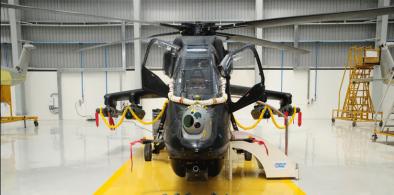
Producing a world-class helicopter: India needs to develop a strong indigenous industry

If India were to write out a defence industrial policy it may read as follows: 'to establish and foster a strong indigenous helicopter industry with the design and production capacity to cater to all in-country military requirements and bid for export military and civil markets'. writes Rear Admiral Sudhir Pillai (retd) for South Asia Monitor

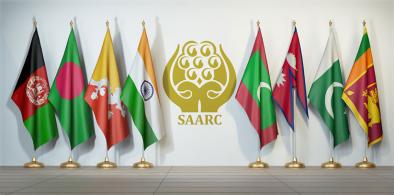
With SAARC stalled, India must invest in alternative regional mechanisms

With SAARC stalled, India must prioritize regional and sub-regional alternatives to recalibrate its neighborhood strategy and its overall foreign policy, writes Don McLain Gill for South Asia Monitor 

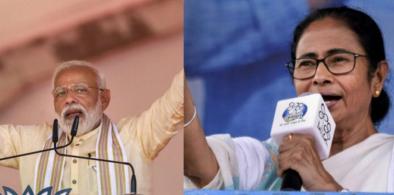
Battle for Bengal: Can Mamata Banerjee survive the BJP onslaught?

The rapid growth of the BJP in West Bengal since the 2014 parliamentary elections can unquestionably be seen as a turning point in the state's turbulent politics, writes Asif Rameez Daudi for South Asia Monitor

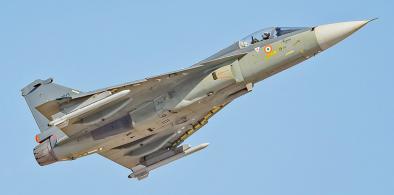
India beefs up air force with indigenous fighter jets: Dawn of a new era in military self-reliance

The most crucial justification for acquiring home-grown and home-built hardware is the military’s expectation that overhaul and replacement of parts, as well as repair of battle damage will be undertaken by the domestic industry in a most expeditious manner, writes Admiral Arun Prakash (retd) for South Asia Monitor

Is India headed for economic autarky?

The upshot of an inward-looking regime is a diminishing extent of trade openness - a sharp contrast with the East Asian miracle economies that prospered with export-orientation, writes N Chandra Mohan for South Asia Monitor

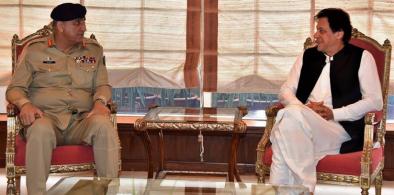
Is Imran Khan proxy for Pakistan Army's 'minus two' gambit?

The most significant thing at the several ‘jalsas’ (protest rallies) that opposition have been organising across the country in Pakistan is to challenge the army’s role and, for the first time, the top brass is being named, writes Mahendra Ved for South Asia Monitor