
Apart from being the largest country in the region in terms of geography and economy, New Delhi’s responsibilities as an important player in South Asia also rest on its efforts to improve the region's social and economic parameters.
Yet, strategic behavior of both India and China is fundamentally opposed to each other as witnessed in the agreements signed between India and Japan during Takaichi’s visit to India. China views India’s foreign policy as an effort to embed itself in an alliance aimed at containing it.
The NATO summit can indirectly transform India from a regional power into a West Asia stakeholder by integrating India into maritime security frameworks, supporting connectivity projects, strengthening intelligence ties, reinforcing India’s role as an alternative to China. The long-term outcome is that India could emerge as a pillar of stability linking Europe, the Gulf, and the Indo-Pacific
Japan has also proposed developing a Bay of Bengal–Northeast India Industrial Value Chain aimed at transforming the region into an integrated industrial zone. As part of the Free and Open Indo-Pacific vision, this includes strengthening cross-border connectivity with Bangladesh, Myanmar, Nepal and Bhutan.
China's expressed interest in modernising and upgrading both Chattogram and Mongla ports suggests the emergence of an interconnected infrastructure network linking the Bay of Bengal with southwestern China through Myanmar. If realised, such connectivity would enhance trade flows, improve regional logistics and deepen China's economic footprint across the Bay of Bengal littoral, while simultaneously increasing Bangladesh's importance as a regional transit and connectivity hub.
Apart from being the largest country in the region in terms of geography and economy, New Delhi’s responsibilities as an important player in South Asia also rest on its efforts to improve the region's social and economic parameters.
India offered unqualified support to Hasina over the last decade or so. For India, it will be a major challenge to see how it builds a relationship when a new democratic government emerges in Bangladesh. China had invested more in infrastructure in Bangladesh in the last decade or so; and the relationship was improving. But it did not interfere in domestic political issues.
M R Rangaswami, Silicon Vally entrepreneur, angel investor and philanthropist, and a community leader who founded Indiaspora, said: "I never thought in my wildest dreams that we would have an Indian American running for President of the United States but this is now a reality".
The considerable economic progress under Hasina's governance starkly contrasts with the stagnation in political reforms. Persistent issues such as limited press freedom, corruption, and inadequate improvements in democracy, rule of law, and human rights have marred her administration’s record
The interim government is led by civilian leadership. However, the extent of military control in this government remains unclear. According to some political observers, even if not officially present, the military will have a significant influence on this government.
At a time when unvarnished animus for one another is often the norm in India and Pakistan, not to mention Bangladesh now, the two simple women have offered a lesson in decency, dignity and civility.
Rural women have said that the physical and sexual security of women was strongly protected under the Taliban regime. The women in Afghanistan are caught in a conundrum. While they resent systemic social repression and denial of gender rights under the Taliban regime, the return of political instability in the country they fear can increase their physical and sexual insecurity.
Smuggling activities along the Afghan border are often linked with militant groups and organized crime. The illegal trade of arms has contributed to the proliferation of the "Kalashnikov culture" across the length and breadth of Pakistan.
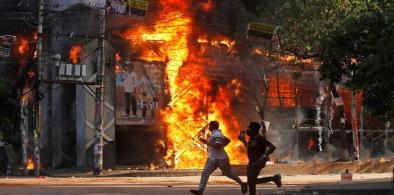
Given the nature of these 'student' demonstrations, it is apparent that Bangladesh faces serious danger from a network of underground political activists and extremists aiming to destabilise the country. These issues are putting Prime Minister Sheikh Hasina's leadership to the test
Google and Facebook, which collect vast amounts of user data, will be required to overhaul their data-handling practices to meet the stringent requirements of the bill. Critics argue that certain provisions grant excessive power to the government, potentially undermining the very privacy protections the bill seeks to establish.
A growing area of cooperation between India and the UAE is agriculture. UAE has committed to setting up three food parks in India - in the states of Haryana, Gujarat and Madhya Pradesh - at an estimated cost of $2 billion to address the issue of food security as both countries had also agreed to set up a food corridor.
It is undeniable that although the movement was initially for quota reform, it later took the shape of a movement to overthrow the government. It was an attempt to taste power through undemocratic, back-alley, violent means. An attempt was made to create a "Bengali Spring: in Bangladesh in the style of the Arab Spring.
The inclusion of the military dimension in India-Saudi Arabia relations is of great strategic significance which is expected to gain more momentum in the future.
Bangladesh's triumph in off-grid renewable energy, epitomized by the SHS program, serves as a global benchmark. The collaborative efforts of government, private sector, and public entities have ushered in a new era of sustainable energy.
Pakistan's climatic catastrophe requires a global response. Developed countries must fulfill their pledges to provide financial and technological assistance to developing countries like Pakistan so that they can effectively mitigate and adapt to climate change.