

China at the Core of the India-Japan Strategic Partnership
Yet, strategic behavior of both India and China is fundamentally opposed to each other as witnessed in the agreements signed between India and Japan during Takaichi’s visit to India. China views India’s foreign policy as an effort to embed itself in an alliance aimed at containing it.
 Jul 06, 2026
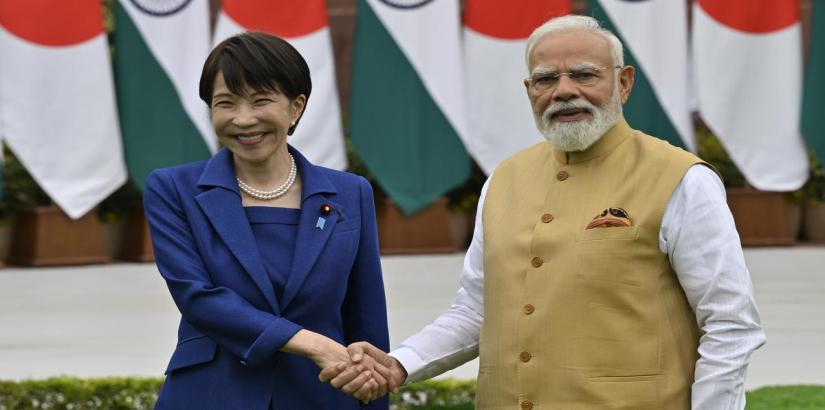
Japanese Prime Minister Sanae Takaichi’s first official visit to India at the invitation of Prime Minister Modi from 1-3 July 2026 for the 16th Japan-India Annual Summit and to discuss a wide range of areas of cooperation to further enhance the Japan-India Special Strategic and Global Partnership is aimed at China’s grand strategy. The 16th Japan-India Annual Summit Joint Statement, titled “Advancing a Partnership of Strategic Convergence and Trust for Shared Growth, Prosperity and Resilience” is laden with meaning that should be a cause of concern for China.
Structural Rivalry between Japan and China
Reacting to the Japanese PM’s visit to India, Guo Jiakun, spokesperson of the Foreign Ministry of China, stated, “Cooperation between nations should not target or harm the interests of third parties, let alone serve as a pretext for forming exclusive cliques or stroking confrontation”. A special reference was made to India and Japan strengthening cooperation on critical minerals to enhance the resilience of related supply chains. China called for maintaining the stability and security of global industrial and supply chains as the common responsibility of all countries, and all parties should uphold an open and cooperative attitude and play a constructive role in this regard. Recently, Chinese authorities detained two Japanese nationals on allegations involving prohibited goods and rare earth minerals.
Politico-military tensions between China and Japan have sharpened with Japan abandoning its post-world war position on re-militarization. Deepening structural rivalry over Taiwan, military buildups, economic security and competing visions of regional order, now define China-Japan relations. A possible Taiwan Strait conflict, a core concern for China, is now tied directly to Japan’s national survival by the Takaichi administration.
To a question from an opposition lawmaker, during the Lower House Budget Committee session on 7 November 2025, who asked whether a blockade of the Bashi Channel between Taiwan and the Philippines would constitute a “survival-threatening situation” she stated, “If an armed attack (by China) were to occur against Taiwan, ‘if a naval blockade were to be imposed by warships’, and if other measures were also taken to counter it, the use of force could occur.
China further sees Japan’s leadership challenge the post-World War II international order, and according to Mao Ning, Chinese Foreign Ministry spokeswoman, after the end of World War II, Japan's obligations as a defeated country required it to be "completely disarmed and not to maintain such industries as it would enable the country to rearm for war". From a Japanese perspective, it is obliged to adapt to the US stance on security alliance architecture where allies are required to play a more assertive role through higher defense spending and preparedness.
This structural rivalry is now in full play at the tactical-operational level. In June, the Japanese Defense Ministry began shipping a Ground Self-Defense Force (GSDF) Type 12 surface-to-ship missile launcher, along with medium-sized unmanned reconnaissance aircraft for target surveillance and positioning in Minamitorishima, Japan’s easternmost island in the Pacific.
As Japan and Philippines Japan map out their claims in the region, China’s Coast Guard vessels have intermittently navigated within Japan’s exclusive economic zone (EEZ) south of Yonaguni Island and have made unilateral claims regarding those waters. In sum, the military situation in East Asia remains unfavorable to China and its grand strategy.
Strategic Trust Deficit in Sino-Indian Relations
India and China have never really managed to build strategic trust since the early 1960s and instead have lost trust over each other’s strategic ambitions. While both countries were the first to institutionalize Panchsheel, the five-principles of peaceful coexistence, it is simply not being followed in letter and spirit between the two.
India has been critical of China’s increasing footprint in South Asia through unilateral strategic projects such as China’s Belt and Road Initiative. China’s military assistance to Pakistan is a prime concern for India, and recent events in 'Pakistan-occupied-Kashmir (PoK)' and other provinces of Pakistan reinforces India’s assessment of the flawed policy adopted by China with regard to Pakistan.
With China admitting that Chinese engineers from the Aviation Industry Corporation of China (AVIC) were directly involvement in supporting Pakistani operations during Operation Sindoor, it is unlikely that Sino-Indian relations will ever normalize. This is despite China’s necessity to play a major role in India’s economic growth given its economic situation and general consensus within India for greater investment from China into India that is good both for the economics of the relationship and for broader bilateral ties.
Xu Feihong, in his editorial titled “The Five Guidelines to a Dragon-Elephant Tango” published by The Hindu on 03 August, 2024 identified “strategic trust” as the key factor in India-China relations. Chinese Foreign Minister Wang Yi, while attending the BRICS NSA conference in Delhi days before Takaichi’s visit, said that it is "imperative" for India and China to respect each other's "core interests" and take concrete actions to implement the "important consensus" reached by the leaders of both countries. He further stressed that India and China are partners, not rivals.
Yet, strategic behavior of both India and China is fundamentally opposed to each other as witnessed in the agreements signed between India and Japan during Takaichi’s visit to India. China views India’s foreign policy as an effort to embed itself in an alliance aimed at containing it.
Strategic Convergence between India and Japan
According to the 16th Japan-India Annual Summit Joint Statement published by MOFA (Japan), India and Japan reiterated their grave concerns over the use of economic coercion and non-market policies and practices, including arbitrary export restrictions that may lead to supply chain disruptions, particularly on critical minerals and critical industrial sectors, and price manipulation. They underscored the "importance of diversified, resilient and reliable global supply chains, a fair competitive global environment, and the need to avoid reliance on any one country".
This “one country” is obviously China which by its own choice is aiming to achieve national rejuvenation through the path of “socialism”. By doing so China is distorting the principles of capitalist market. In theory, while capitalism operates on the market as a medium of exchange having its own law, socialism has no market.
China, in its own reading, is now at the primary stage of socialism and operates socialist market and state-led capitalism. It is this approach of China that places it as an odd man out in a world where capitalism is the governing principle. In this regard, China has no one to blame but itself in perceiving that many nations are attempting to align themselves against it.
(The author is a Lecturer at Sichuan International Studies University, Chongqing, China and a Non-Resident Fellow at the Society for Policy Studies, New Delhi. Views expressed are personal. He can be reached at themayandischool@gmail.com )







Post a Comment