

Between the Melody Moment and the Hard Work Ahead: Modi's Europe Tour Outcome Will Depend on Delivery in Coming Years
India's MSME sector, the backbone of its export economy, remains largely unequipped to navigate European standards and certification requirements. As ABC Live noted, the next stage will be tougher than negotiation: India must now prove that its exporters, MSMEs, regulators, ports, testing labs, and state governments can actually use the agreement. A framework signed in Gothenburg means nothing to a textile exporter in Tiruppur who cannot get a product certified to EU standards.
 Jun 06, 2026
Indian Prime Minister Narendra Modi's five-nation tour of Europe last month, covering the UAE, the Netherlands, Sweden, Norway, and Italy between May 15 and May 20, generated the kind of optics Indian foreign policy loves: a "special strategic partnership" with Italy alongside Giorgia Meloni, a viral photograph of Modi gifting Melody toffees to the Italian PM, 17 strategic outcomes signed with the Netherlands covering migration, green hydrogen, defence, and economic engagement, and bilateral ties with Sweden elevated to a strategic partnership. India's Ministry of External Affairs announced fresh investment commitments of nearly $40 billion from over 50 CEOs Modi met along the way. The numbers are large. The symbolism is rich. The sceptic, however, is entitled to ask: then what?
The backdrop to this visit matters. On January 27, 2026, India and the European Union concluded negotiations for the India-EU Free Trade Agreement at the 16th India-EU Summit, a deal that had been stuck in diplomatic mud for nearly two decades. Modi himself called it, with characteristic understatement, the "mother of all deals." The EU has long eyed India as a key market, and the FTA's conclusion removed the single biggest obstacle to a genuinely transformative economic partnership. So the timing of this European tour was not incidental. It was a political signal: India is ready to move from rhetoric to implementation.
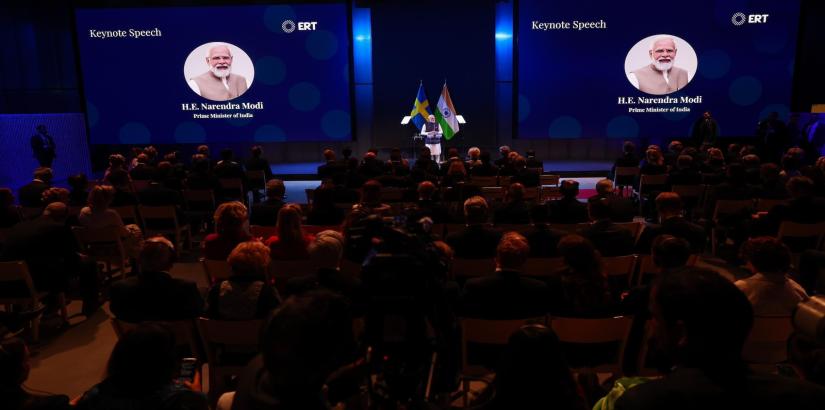
That signal was delivered most crisply in Gothenburg, where Modi addressed the European Round Table for Industry on May 17 alongside Swedish Prime Minister Ulf Kristersson and European Commission President Ursula von der Leyen, describing the FTA as a transformative partnership for trade, technology, manufacturing, services, and resilient supply chains. Von der Leyen used the occasion to hail a "dynamic new era" in EU-India relations. This is the appropriate register for a concluded agreement: shift the conversation toward delivery, bring business leaders into the room, and make implementation a shared priority rather than a bureaucratic formality. That much was done well.
Meeting European Standards
The geopolitical context gave the tour additional urgency. The Russia-Ukraine war has entered its fifth year, and a new conflict has erupted in West Asia. The Strait of Hormuz, which carries around 20 percent of global petroleum and 20 percent of liquified natural gas, remains effectively closed following the US-Iran standoff, with vessel traffic down to roughly 5 percent of pre-conflict levels. For India, heavily dependent on energy imports and deeply exposed to Gulf supply chains, this visit was an important diplomatic push focused on energy security, technology partnerships, and supply chain resilience. Diversifying energy partnerships is not optional in this environment. It is existential. The European leg, combined with the Abu Dhabi stop, reflected a government that understands this arithmetic.
But atmospherics are not architecture. The FTA creates value only when exporters, investors, ports, customs authorities, regulators, certification bodies, and businesses actually use it. Right now, none of those pieces are fully in place. India's MSME sector, the backbone of its export economy, remains largely unequipped to navigate European standards and certification requirements. As ABC Live noted, the next stage will be tougher than negotiation: India must now prove that its exporters, MSMEs, regulators, ports, testing labs, and state governments can actually use the agreement. A framework signed in Gothenburg means nothing to a textile exporter in Tiruppur who cannot get a product certified to EU standards.
A 43-Year Absence
Then there is the question of strategic depth. Modi's visit to Norway was the first by any Indian Prime Minister in 43 years, according to the German Marshall Fund. Norway's significance lies partly in its working model of trade integration with the EU through EFTA and TEPA, a template India can study. But a 43-year absence is also a reminder of how thin India's diplomatic footprint in Northern Europe has been, and a single summit, however productive, does not substitute for sustained engagement.
The same logic applies to the semiconductors conversation with the Netherlands. ASML and Tata Electronics announced a deal to supply advanced lithography technology for India's first front-end semiconductor fabrication plant in Dholera, Gujarat, at a planned investment of $11 billion. That is a credible and genuinely significant commitment. It is also a single plant, in a sector where India is starting decades behind.
Headlines are not Outcomes
What Modi's Europe tour does confirm is a genuine structural shift in India's foreign policy orientation. The country that once prided itself on non-alignment as an end in itself is now actively and unapologetically pursuing deep economic interdependence with liberal democracies, on technology, defence, trade, and supply chains. Following the May elections, the BJP and its allies now govern 21 of India's 28 states, covering nearly 80 percent of the country's 1.4 billion people, a phenomenon not seen since the Congress under Indira Gandhi. This domestic consolidation provided the political confidence to make large commitments abroad. Europe, for its part, is increasingly willing to treat India as an indispensable partner rather than a hedging power.
That is progress. But a "special strategic partnership" with Italy and a $40 billion investment pledge are headlines, not outcomes. The hard work, covering regulatory harmonisation, port-level logistics reform, standards recognition, MSME capacity building, and parliamentary ratification of the FTA, happens quietly, away from cameras and Melody toffees. India has historically been better at the summit than the follow-through. The real test of Modi's Europe tour is not what was announced in The Hague or Rome. It is what is actually delivered in the next three years.
(The author is a PhD Research Scholar in the Centre for European Studies, School of International Studies at Jawaharlal Nehru University, Delhi, India. The author writes on Indian foreign policy and EU-India relations. Views expressed are personal. He can be reached at sanketkumar1247@gmail.com LinkedIn: https://www.linkedin.com/in/sanketkumarprajapati/ )


Post a Comment