US Defence Secretary Lloyd Austin arrived here on Friday for discussions on cooperating to face “most pressing challenges” in the Indo-Pacific, an euphemism for China’a maritime muscle-flexing in the region
Neutrality and balance — Colombo’s habitual vocabulary — have yielded little economic benefit. Ultimately, Sri Lanka slid into bankruptcy. Given this background, the land link is not merely a strategic starting point but a necessity. India’s strategic position on Sri Lanka is perennial; whether the bridge is built or not, India’s concerns remain fundamental. As an immediate neighbour and rising global power, India will not allow rivals to use Sri Lanka as a base.
If India and China choose collaboration by setting aside strategic suspicion in the climate domain, they could fundamentally reshape the trajectory of the 21st century, as they have already demonstrated individually through their pursuit of clean energy over the past decade. More importantly, such a coalition could revive the COP28 fossil-fuel phase-down pledge, which stalled at COP29 in Baku and appears to be drifting further at COP30 in Belém.
Increased industrial activity in India could generate demand for raw materials, intermediate goods, and services from countries such as Nepal, Bhutan, Bangladesh, and Sri Lanka. Bangladesh’s textile industry could strengthen its links with Indian manufacturing networks, while Sri Lanka may gain from expanded opportunities in tourism, logistics, and services.
ADB’s role has evolved beyond financing into shaping India’s structural transformation into a high-growth, technology-driven, and climate-conscious economy. Compared to other multilateral institutions, it offers a more agile, implementation-focused, and regionally attuned approach. As India moves toward becoming one of the world’s largest economies, this partnership will play a defining role in shaping not only India’s growth trajectory but also the broader economic future of Asia.
US Defence Secretary Lloyd Austin arrived here on Friday for discussions on cooperating to face “most pressing challenges” in the Indo-Pacific, an euphemism for China’a maritime muscle-flexing in the region
Calling the Indo-Pacific "increasingly the geopolitical centre of the world", United Kingdom Prime Minister Boris Johnson will visit India in April to ostensibly create a democratic counterweight to China
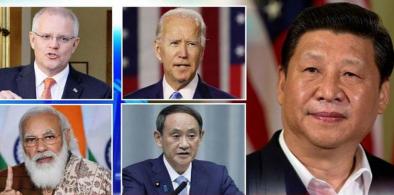
China has accused the Quadrilateral Security Dialogue (QUAD), a four-nation grouping comprising Australia, India, United States and Japan, of "ideological bias and cold war mentality" and described it as a clique based on an ideology that is "detrimental to the border"
Indian government organisations such as Computer Emergency Response Team (CERT-IN) and National Critical Information Infrastructure Protection Centre (NCIIPC) have reported that Chinese hackers have attempted to infiltrate the country's cyberspace after troops from the two neighbours disengaged from Pangong Lake in eastern Ladak
A controversy erupted in Sri Lanka on Friday when people in Sri Lanka noticed that Amazon, an online platform, was selling doormats with imprinted Sri Lankan flag on them, reported Colombopage
The International Monetary Fund (IMF) has said that they are “closely monitoring” the Sri Lanka’s recent currency swap deal of $1.5 billion with China, reported Colombopage
Islamic political parties have called upon the Bangladesh government to sever all diplomatic ties with China, owing to alleged persecution of Uighur Muslims in the country
On the heels of the Quad summit, US Defence Secretary Lloyd Austin will visit India next week to confer with Defence Minister Rajnath Singh as the US focuses on China as an emerging threat, according to a Pentagon official
As the virtual private network (VPN) usage grows in countries like India and South Asia to have a more secure and private Internet browsing experience, a new report has warned that Chinese government have access to massive sets of data like private emails, messenger conversations and personal records, as most of the VPNs being used are Chinese-owned, a new report has warned
Leaders at the first Quad summit committed Friday to harness India's vaccine manufacturing prowess in what Prime Minister Narendra Modi called a “landmark” partnership to deliver a billion doses to the Indo-Pacific region and beyond as the four-nation group eyes a broader cooperation agenda centred around their common democratic ethos
“The Quad has come of age,” Indian Prime Minister Narendra Modi declared on Friday at the summit of their leaders to take the group to a next level of enhanced cooperation between the four countries - the US, Australia, Japan and India
The United States has said China should have no role to play in deciding the successor of spiritual leader Dalai Lama
The Indian Air Force plans to raise its second squadron of Rafale fighter jets at Hasimara Air Force base in West Bengal by next month to counter threats from China
Spelling the end of Chinese equipment in Indian telecom networks, the Department of Telecommunications (DoT) has mandated that from June 15 this year telecom operators will only use "trusted products" in their networks
Japan has sounded an alarm about Chinas regional intent ahead of the May 12 summit of the Quad grouping, which also includes India, Australia and the US, that is likely to take place later this week