

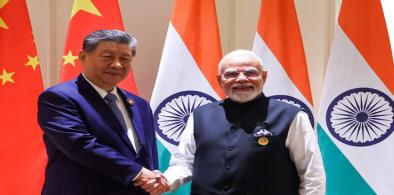
India’s narrative against China must be reviewed and reframed and the appropriate use of India’s military capability must get accepted by the political leadership.
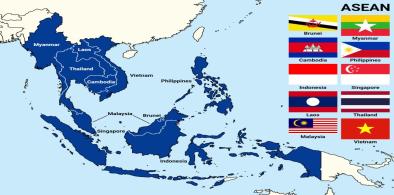
The external support by China and Russia lent support to the Tatmadaw, especially during the elections, and while ASEAN and western powers have refused to accept the legitimacy of the election, many of the immediate neighbours like India, Bangladesh, and Thailand prefer what they see as stability under the military, given their cross-border concerns.
At a time when global consumers are increasingly drawn to wellness-oriented and sustainable diets, South Asian culinary traditions, particularly those rooted in India’s Ayurveda, offer significant potential. However, without institutional backing, this remains diffused cultural capital rather than strategic influence.
The China tale offers important lessons. China’s rise in the renewable sector is not just fuelled by demand for clean energy, but by a broader strategy, linking energy policy with manufacturing, technology development and global trade. India now seems to have begun taking steps in this direction. Policy measures such as the production-linked incentives scheme for solar manufacturing and efforts to expand domestic battery production are intended to strengthen the country’s clean energy ecosystem.
China’s expanding influence in Myanmar and Bangladesh does not operate in isolation. It is reinforced by Beijing’s long-standing strategic partnership with Pakistan, frequently described by both sides as an “all-weather” alliance. In recent years, Islamabad has sought to revive and expand diplomatic engagement with both Dhaka and Naypyidaw, reflecting a broader effort to re-establish its presence along the eastern arc of the Bay of Bengal. While Pakistan lacks China’s financial scale or infrastructure capacity, its diplomatic signalling complements Beijing’s presence
India’s narrative against China must be reviewed and reframed and the appropriate use of India’s military capability must get accepted by the political leadership.
With the declining impact of deterrence measures, including dwindling effectiveness of confidence-building measures and a wide array of dialogue-building processes in trying to mitigate risks of conflicts, the question of a full-blown conflict stemming from the inevitability of Thucydides’ trapping would be a matter of when and where.
When the Security Council’s Counter-Terrorism Committee (CTC) met in Mumbai last month, an audio clip of Sajid Mir directing the 26/11 terrorists at the Chabad House Jewish cultural centre was played to focus on the role of the terrorist under Beijing protection at the UN.
The rise of nationalist sentiments globally and in Europe, as seen in the premiership of Giorgia Meloni in Italy and Rishi Sunak in Britain, are conflating political circumstances for a global pushback against China’s actions where these countries are ready to call out China in a more forthright manner.
A forceful "unification" of Taiwan has been projected by most analysts as happening within the next five years of Xi’s new third term, as he will need this to cement a history-making legacy that will help him extend his rule for life
Bangladesh negotiated with India for 35 years, but the negotiations did not make any headway due to the river's importance to West Bengal. So Bangladesh has to look for other solutions where advanced Chinese technologies and experiences may have something to offer.
This partnership is also mutually driven by concerns over China’s territorial and naval expansion in its neighbourhood. As India prepares for the Malabar exercise being hosted by Japan this year, the focus should be on providing a stable, secure and prosperous Indo-Pacific.
Taipei needs full regional support for its survival and in its efforts to repel a Chinese invasion; it cannot afford to be distracted by other lingering issues with other neighbours, including Japan, which Beijing is happy to exploit to its advantage.
"The National Defense Strategy is really premised on this urgent need to sustain and strengthen deterrence with the focus on the People's Republic of China," the US official said.
Myanmar's military junta is facing fierce resistance from various ethnic minorities. A shadow government, called National Unity Government (NUG), was formed to counter the military government. The shadow government has already appealed to the international community for support, to which the United States, the European Union and ASEAN member states have responded.
Experts have even called for Japan to deepen bilateral security cooperation with India, Britain and France, countries that have shown a new resoluteness towards Chinese actions in the Indo-Pacific.
No country comes close to China’s sophisticated influence-seeking tools and the way it leverages its soft power. The relentless pursuit by Chinese propagandists, out to stake their claim on the global information order, are challenges that the independent global information order needs to meet.
The launching of supply chain resilience in the Indo-Pacific region is another attribute of the rising interest in India. India’s strong leadership in the region evokes new opportunities to reap benefits from its low-cost hub, laden with high IT technology.
Colonna tweeted in French that it was the “launch of a new trilateral format in the #Indo-Pacific zone with India and the Emirates“ with “a common ambition to move forward in 4 areas: #security and #defence, #Climate, #Technologies and people(-to-people) exchanges”.
Professor Thussu says, ”Although New Delhi remains a traditional friend of Dhaka, the growing presence of China in Bangladesh and elsewhere in South Asia, makes it difficult for Hasina to prioritize India over China: the scale and depth of Chinese investment, aid etc. can’t be matched by India.”