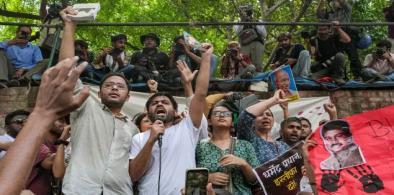

Cockroach Janata Party protest in Pune

A Mature Democracy Must be Confident Enough to Hear Youth Anger: Domestic Unrest can Become Global Politics in Hours

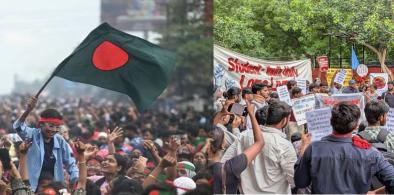
Democracies need dissent. Young Indians have every right to demand credible examinations, transparent recruitment, accountable institutions and a responsive government. To delegitimise all youth anger as foreign manipulation would be intellectually lazy and politically dangerous. But it is equally naive to pretend that geopolitics ends at the border of domestic protest.

Making Workplaces Safer in South Asia: Prevention Less Costly than Catastrophe

Workplace accidents impose costs far beyond the immediate loss of life and injury. Families lose breadwinners, enterprises suffer productivity losses, projects face delays and governments incur healthcare and compensation costs. The social consequences can be particularly severe for migrant and informal workers

Is Delimitation Becoming a Penalty for Good Governance for India's Southern States?

For decades, these states invested heavily in women’s education, public health, industrialisation, literacy and population control. Fertility rates in many southern states have already fallen below replacement levels. In contrast, several northern states lagged behind for years on precisely these indicators. If parliamentary representation now shifts overwhelmingly toward states with higher population growth, the message becomes deeply perverse: governance discipline weakens political power.

Denial of Voting Rights to Undertrials: Blinds Spots in India's Democracy

At its heart, the challenge to Section 62(5) is a test of constitutional sincerity, of whether the Indian Republic truly believes that citizenship endures even behind bars. Enacted in the infancy of the republic, the provision has long outlived its moral logic. It collapses the distinction between confinement and culpability

More on Public Policy and Governance

A crying need for empathy and equity in India's education system

There is a culture that refuses to understand the pain of an entire class of population subjugated over the centuries, a harshness that translates in general to every other aspect of Indian life, superimposed on which is the ever-present threat of violence (State and non-State) that makes the claim of a nation that stands for non-violence hollow.

Giving poor easier access to welfare benefits: Need to develop citizen experience-focused policies

Across India, accessing the correct eligibility documents is many times harder for the poor than an average privileged caste and a class person. If we add complex digital interfaces for application to paperwork ordeal, then the experiences of the poor worsened. This burdensome citizen experience either dampens the confidence of citizens in welfare policy or reduces the net benefit access due to the cost borne by the citizen.

Elections in Meghalaya: A paragon of civility in India's coarse democratic politics

It was interesting to observe how focused party representatives and voters in this small northeastern state bordering Bangladesh were on basic development issues; and how vocal voters are in seeking their basic rights at the local level, perhaps showing what genuine grassroots democracy should reflect. 

Clean up the mess: A case for action in the Adani saga

The government has a choice it can sit back and do nothing, or it can choose swift regulatory action and full-fledged investigations into what has been alleged to be, in the words of Hindenburg Research, “the world’s 3rd richest man pulling the largest con in corporate history.”

Oil magnet to lead the global conference to phase out oil? UAE has a unique opportunity to show the way: An Indian perspective

Dr Al Jaber has been awarded the Champion of the Earth award from UNEP.  Indian Prime Minister Narendra Modi conferred on him a lifetime achievement award for his contributions to energy security, building bridges to emerging Asian economies, and reshaping traditional energy business models.

Lessons from the Adani stock crash: Indian regulator must restore faith in the market

No doubt that the Adani Group will do its utmost to bounce back, but regulators and policymakers must ensure that investors’ trust in the markets is not dented. India’s stock markets are world leaders in terms of technology and surveillance systems. The regulators and exchanges must match that in terms of excellent governance and strengthening the foundation of trust.

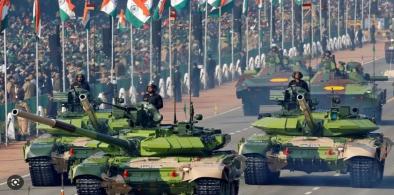
India adds its first tactical ballistic missile to its military arsenal

The newly developed missile, fired from a canister, can make precise manoeuvres before impacting a target.

Healing hands in a disaster: Poignant notes from flood-ravaged Sindh

Flash floods destroyed 70 per cent of the region’s standing summer crop. The stagnant flood water has derailed the planting of the next crop. For a population already tethering on the brink, this spells doom. I’m petrified of the famine looming on the horizon – something my friends at the #FixSindhDrainage Twitter Space have been communicating for the past three months.

Who gained from India's ill-conceived demonetisation policy?

The net impact of the overall  Rs.32.12 lakh crore currency in circulation at present is that the benefit of demonetisation stands undone, resulting in a disturbing level of growth of a parallel economy and corruption in the country.

Has the RSS reshaped its agenda for the upcoming elections?

Why has the language of the RSS chief seemingly changed from his 2018 speeches at Vigyan Bhavan? There may be many reasons for Bhagwat to be more forthright than sugarcoating his agenda earlier. Many state elections are due in 2023 and general elections are due in 2024. The polarization around identity issues seems to be the main instrument in its hands.

Why has India's national census been delayed

The present delay in conducting the national census, when even some of our South Asian neighbours have conducted theirs, despite covid difficulties, is cause for concern.

Wildlife at risk in Bangladesh as infrastructure development disrupts protected forests

Bangladesh has two laws on forest protection, only one of which, the 2019 revision of the 1927 Forest Act, makes even a glancing mention of infrastructure projects inside forests. It prohibits making any changes to a restricted forest, and threatens violators with up to five years in prison and up to 50,000 taka ($490) in fines. That hasn’t stopped the state from building multiple-lane roads through protected forests.

‘Third World’ or ‘Global South’? Its time to redefine

‘Third World’ and ‘Developed Nation’  are terms that are derogatory and ethnocentric in concept. The terns 'Global North' and the 'Global South' can offer researchers, columnists, as well as development partners a politically balanced perspective. 

In Covid wake, India caught off-guard over measles outbreak; exposes fragility of health system

Interestingly, strategies employed during the Covid pandemic are being replicated. Much like the Cowin app was used to track and monitor Covid vaccinations, the Indian government plans an app to monitor every eligible child to ensure that they are up to date with their vaccination schedules

Bangladesh's Matarbari Deep Sea Port offers new prospects for maritime connectivity in South Asia

The port can grow to be one of the key hubs of trade and business in South Asia as a result of its geographic advantages and deep-sea port capabilities.