

Denial of Voting Rights to Undertrials: Blinds Spots in India's Democracy
At its heart, the challenge to Section 62(5) is a test of constitutional sincerity, of whether the Indian Republic truly believes that citizenship endures even behind bars. Enacted in the infancy of the republic, the provision has long outlived its moral logic. It collapses the distinction between confinement and culpability
 Jun 08, 2026

India’s blanket ban on prisoner voting under Section 62(5) of the Representation of the People Act, 1951 (“RPA”), is facing renewed constitutional scrutiny in Sunita Sharma v. Union of India & Anr., W.P. (C) No. 909 of 2025. According to the Prison Statistics India by the National Crime Records Bureau (NCRB), India houses over 450,000 undertrial prisoners, accounting for nearly 77 percent of its total prison population. These individuals, legally presumed innocent, remain excluded from the very process that defines their citizenship.
Section 62(5) of the Representation of the People Act, 1951-
“No person shall vote at any election if he is confined in a prison, whether under a sentence of imprisonment or transportation or otherwise, or is in the lawful custody of the police:
Provided that nothing in this sub-section shall apply to a person subjected to preventive detention under any law for the time being in force.”
This single clause conflates two distinct stages of criminal justice: custody and conviction. It treats confinement as culpability, converting a procedural condition into a moral verdict, while permitting preventive detainees to vote. The challenge seeks not privilege but parity: polling access within prisons, postal ballots where necessary, and disenfranchisement limited to those convicted of serious offences. The constitutional question is stark: can democracy continue to speak in the name of those it refuses to hear?
Section 62(5): The Statutory Paradox
Section 62(5) appears neutral, yet its sweep is absolute. It excludes every person “confined in a prison” regardless of whether their detention arises from a judicial sentence, pending trial, or even police remand.
This inconsistency offends the Article 14 test of reasonable classification. The intelligible differentia, confinement, bears no rational nexus to the object of the law, electoral purity. If security risks justify exclusion, preventive detainees would logically fall within its scope. Their exemption reveals that the classification is not principled but arbitrary.
Legislative history confirms this, through the parliamentary debates in 1951 on the RPA, wherein Section 62(5) was justified purely on grounds of administrative convenience. No record suggests deliberation on its constitutional coherence. Seventy-four years later, that administrative logic has ossified into an unquestioned norm, one increasingly out of step with democratic constitutionalism.
From Pradhan to Baranwal: The Judicial Trajectory:
The Supreme Court of India first addressed this question in Anukul Chandra Pradhan v. Union of India. Chief Justice Sujata Manohar upheld the validity of Section 62 (5), reasoning that it furthered “the conduct of free and fair elections” by “preventing criminalisation of politics”-
“It is well known that for the conduct of free and fair elections, it is necessary to prevent criminalisation of politics and maintain probity in public life. Any provision enacted with a view to promote this object must be welcome and upheld as subserving the constitutional purpose.”
This reasoning, while contextually shaped by concerns over criminal infiltration into legislatures, made two analytical missteps-
Firstly, it conflated the right to contest elections (which may legitimately be restricted for convicts) with the right to vote (which is foundational to citizenship). Secondly, it treated voting as a statutory privilege, not a constitutional right.
That premise has since been dismantled. In People’s Union for Civil Liberties v. Union of India, the Court held that an informed vote forms part of the freedom of expression under Article 19(1)(a)-
“The foundation of a healthy democracy is to have well-informed citizens. The right to know about the candidate standing for election is the very essence of the right to free speech.”
This judgment elevated voting from a statutory entitlement to a participatory constitutional right.
Furthermore, In Anoop Baranwal v. Union of India, the Court further affirmed that “free and fair elections” constitute part of the basic structure of the Constitution. If elections themselves are constitutionally guaranteed, then meaningful participation in them cannot be statutorily denied.
Together, these decisions form an arc, from Pradhan’s proceduralism to Baranwal’s constitutionalism, under which Section 62(5) has shown an absolute exclusion which appears to be increasingly indefensible.
Core of Constitutional Promise
The challenge to Section 62(5) is not merely statutory but structural, it strikes at the core of India’s constitutional promise. Its legitimacy must be tested not by administrative convenience but by constitutional coherence. By extinguishing the political agency of those yet to be found guilty, the provision invites scrutiny under Articles 14 and 21, which demand fairness and non-arbitrariness in state action. The Constitution does not permit punishment by presumption. The question, therefore, is whether Section 62(5) is not efficient, but just, whether it accords the unconvicted the equality, dignity, and proportionality that constitutional limits require.
Equality and Rational Classification
Article 14 prohibits arbitrary discrimination. Classification of Section 62(5), between citizens in custody and those outside, is unintelligible in relation to its purpose. The object, as per Pradhan, is electoral purity; yet the provision indiscriminately captures undertrials, remand detainees, and even those wrongfully arrested. The equality principle demands a closer connection between guilt and exclusion.
In E.P. Royappa v. State of Tamil Nadu, the Court held that “arbitrariness is the antithesis of equality.” Section 62(5) epitomises arbitrariness, punishing the unconvicted for administrative simplicity.
Dignity and Substantive Due Process
Article 21, as expanded in Maneka Gandhi v. Union of India, requires that all laws restricting liberty be “just, fair, and reasonable.” The act of voting, though not enumerated as a fundamental right, is inseparable from the dignity and autonomy that Article 21 protects.
In Francis Coralie Mullin v. Union Territory of Delhi, the Court observed that the right to life includes “the right to live with human dignity.” Denying the franchise to the unconvicted, solely on the basis of confinement, deprives them of that dignity.
The Proportionality Test
The modern test of proportionality, as articulated in Justice K.S. Puttaswamy (Retd.) v. Union of India, represents the judiciary’s shift from administrative convenience to constitutional justification. It requires that any restriction on rights pursue a legitimate purpose, maintain a rational connection to that purpose, employ the least restrictive means, and preserve a fair balance between competing interests. Justice D.Y. Chandrachud, speaking for the majority, brought forth this principle with clarity-
“The legitimate aim of the State must be established; there must be a rational connection between the means adopted and the objective pursued; the measure must be the least intrusive available; and the extent of restriction must not have a disproportionate impact on the right itself.”
(Puttaswamy, para 310)
This framework, now embedded in India’s constitutional jurisprudence, provides a structured lens to examine whether Section 62(5) withstands scrutiny. When tested on these parameters, the provision fails on each count.
Table- Application of the Proportionality Test to Section 62(5)
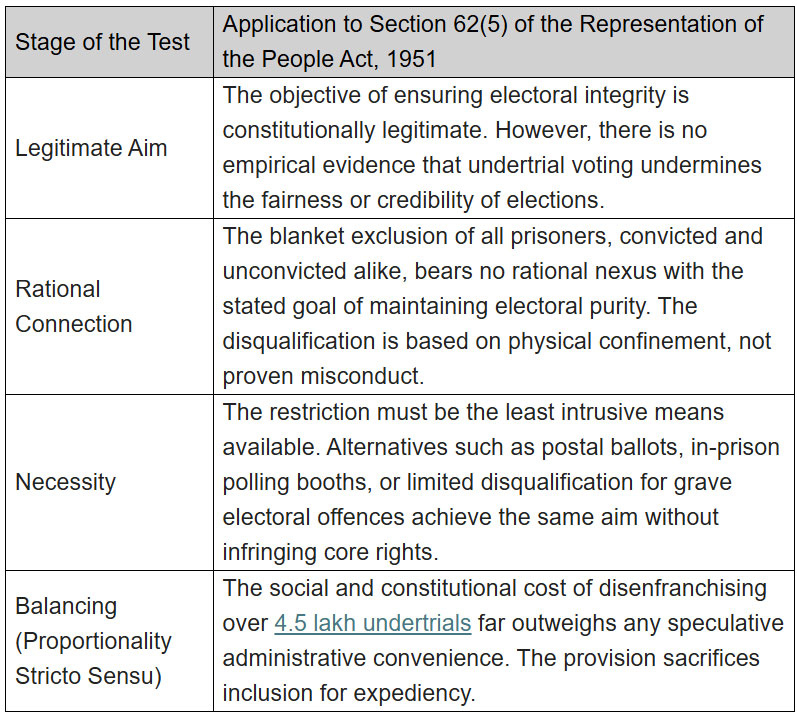
Thus, Section 62(5) fails every constitutional test, it erases innocence, conflates custody with guilt, and subordinates rights to convenience. Against this backdrop, it becomes instructive to look beyond India’s borders, to examine how other constitutional democracies have reconciled incarceration with inclusion.
Conclusion
At its heart, the challenge to Section 62(5) is a test of constitutional sincerity, of whether the Indian Republic truly believes that citizenship endures even behind bars. Enacted in the infancy of the republic, the provision has long outlived its moral logic. It collapses the distinction between confinement and culpability, reducing the presumption of innocence to a procedural formality. What began as a measure of administrative convenience has hardened into a quiet exclusion, one that silences nearly three-fourths of India’s incarcerated population before guilt has ever been proven.
While Anukul Chandra Pradhan once justified this exclusion in the name of electoral purity, purity achieved through exclusion is neither constitutional nor democratic. Subsequent decisions, from People’s Union for Civil Liberties to Anoop Baranwal, have reimagined democracy as a continuous process of participation, where legitimacy flows from inclusion, not isolation.
The question now before the Court carries significance beyond its immediate context; it is an opportunity to reaffirm that liberty and voice are not divisible, and that the unconvicted remain full members of the constitutional community. The comparative experience, from South Africa’s “badge of dignity,” to Canada’s “mark of membership,” to Pakistan’s “democratic duty”, shows that mature democracies treat the right to vote not as a privilege of virtue but as an affirmation of belonging. When India extends that recognition to its undertrials, the circle of democracy will at last be complete: liberty may be restrained, but citizenship will remain whole.
(The writers are Anubhuti Raje, a final year law student at Gujarat National Law University, Gandhinagar, and Devendra Verma, an independent legal researcher based in Ahmedabad, Gujarat. Views expressed are personal. They can be contacted at axraje@gmail.com)





Post a Comment