

Will Balen Shah's Visit Usher a New Chapter in India-Nepal Relations?
Balen Shah's choice of India over China for his first foreign trip is seen as a pragmatic focus on economic ties and administrative delivery following Nepal's recent political transition, even though visiting India first has been the tradition for Nepal's prime ministers, KP Sharma Oli being an exception.
 Nov 24, 2026
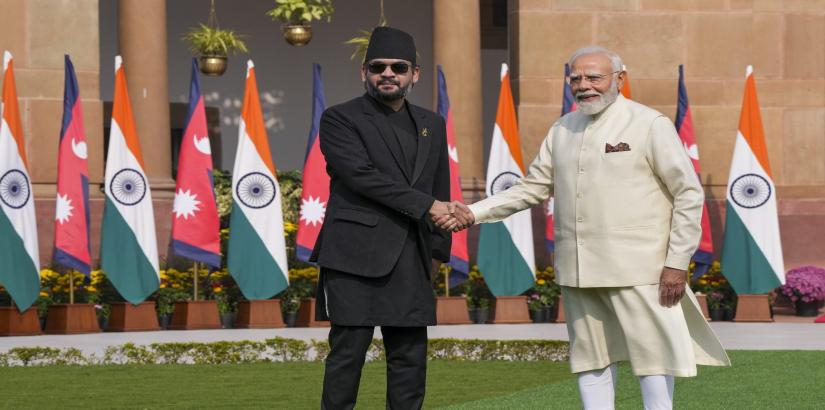
Nepal's Prime Minister Balendra "Balen" Shah's visit to India November 22–23 marked his first bilateral foreign trip since taking office in March 2026. He was accompanied by a high-level official delegation, including Foreign Minister Shishir Khanal and Finance Minister Swarnim Wagle, as well as a 52-member private-sector delegation participating in the Nepal-India Business Forum.
A Slew of Agreements
Following talks in New Delhi with Indian Prime Minister Narendra Modi, the two nations announced major financial assistance, infrastructure launches, and bilateral agreements:
· Flood Reconstruction Package. Modi announced a Development Cooperation Package of NPR 24,000 crore (₹15,000 crore or US$1.6 billion) to support Nepal's post-flood recovery and long-term development.
· Education Initiatives. India announced plans to establish an offshore campus of the Indian Institute of Technology (IIT) in Nepal and expanded scholarships for Nepali students studying in India.
· Cross-Border Connectivity & Infrastructure. Both leaders jointly flagged off the Saryu-Kamala Rail Service connecting Ayodhya in India to Janakpur Dham in Nepal, linking two major cultural and religious centres.
· Dharchula Road Bridge. Both leaders virtually inaugurated the Dharchula road bridge connecting Uttarakhand and Nepal. [1, 2]
· Integrated Check Posts. Both laid the foundation stone for the Integrated Check Post (ICP) at Banbasa and agreed to expedite construction on the Dodhara Chandani ICP on the Nepalese side.
After delegation-level talks at Hyderabad House, India and Nepal exchanged following eight Memorandums of Understanding: one, Space and Satellite Communications - South Asia Satellite network collaboration via ISRO and Nepal's Ministry of Information and Communication; two, Forensic Science – between India's National Forensic Sciences University and Nepal Police's Crime Investigation Department; three, Police & Security Training – between India'sRashtriya Raksha University and Nepal's National Police Academy; four, Civil Service Capacity Building – between India’s National Centre for Good Governance and Nepal’s Administrative Staff College; five, Traditional Medicine - cooperation focused on ayurveda and traditional systems; six, Health & Medicine - joint healthcare initiatives; seven, Urban Development - technical assistance for sustainable urban planning; eight, Agriculture - Cooperation cantered on livestock and fisheries.
India and Nepal finalized an NPR 184 billion ($1.1–$1.2 billion) energy-sector credit line, laid the foundation stone for the 669 MW Lower Arun Hydroelectric Project, dedicated Phase II of the Motihari–Amlekhgunj petroleum pipeline, and agreed to fast-track major multipurpose river projects and cross-border transmission grids.
India's development package advanced the 400 kV cross-border transmission corridors like Inaruwa–New Purnia and Dodhara–Bareilly. Both nations reaffirmed long-term electricity trade agreements. Phase II of the Motihari–Amlekhgunj pipeline was formally dedicated and a foundation stone was laid for the Jhapa oil terminal alongside plans for the Siliguri–Jhapa pipeline.
The China Factor in Ties
Following the devastating August 26, 2026, ice-rock avalanche and flash floods near the Nepal–China border, which killed over 1,400 people, leaving thousands missing, both India and China responded with immediate emergency aid. Nepal's Foreign Minister Khanal initially demanded legal and moral climate compensation from top greenhouse gas emitters, specifically China, the US, and India, but later retracted his demand and thanked India and China for their relief efforts.
Addressing the UNGA on September 24, 2026, Balen Shah formally proposed a trilateral Himalayan Climate Resilience Mechanism co-led by Nepal, India, and China to protect the fragile mountain ecosystem and manage cross-border disasters.
India's 2015–2016 border blockade was the single biggest catalyst that pushed Nepal to actively seek strategic and economic alternatives in China, though geography and economics eventually prevented Kathmandu from fully shifting into Beijing's orbit. Beijing stepped in by signing a landmark 2016 Transit and Transport Agreement, granting Nepal access to four Chinese seaports and three land ports to theoretically break India's transit monopoly. While the blockade permanently broke India's psychological and diplomatic monopoly, giving Nepal a "China card" to balance New Delhi, practical realities, like the Himalayan geography and stalled BRI projects, pragmatic balancing acknowledges that while China offers useful leverage and investment, Nepal's economic survival and energy trade remain inseparably tied to India.
Balen Shah's choice of India over China for his first foreign trip is seen as a pragmatic focus on economic ties and administrative delivery following Nepal's recent political transition, even though visiting India first has been the tradition for Nepal's prime ministers, KP Sharma Oli being an exception.
At the same time, it must be remembered that China has drawn Nepal into its strategic sphere primarily by capitalizing on Nepal's desire to end its historic geographic dependence on India, using transit agreements, BRI infrastructure pledges, and deep political outreach.
According to Nepal’s Economic Survey 2025/26, China accounts for 48% of Nepal’s total approved FDI investment and 45.5% of all approved foreign projects, making it the single largest source of new investment pledges. However, while China dominates new annual pledges, its actual realized FDI stock is roughly NPR 35-40 billion, as many pledged Chinese projects face delays over tax disputes, regulatory hurdles, and geopolitical friction.
Finally, only time will show how Balen Shah's visit will usher a new chapter in India-Nepal relations, especially since he did not raise the boundary issue that has raised a political storm in Nepal in the past. Meanwhile, Nepal must continue with its balancing act between India and China.
(The author is an Indian Army veteran and a strategic affairs commentator. The views expressed are personal. He can be reached at prakashkatoch7@gmail.com)







Post a Comment