

Pakistan’s Hangor-Class Fires Its First Missile. Can It Shift the Maritime Balance in South Asia?
The September 27 firing is therefore best seen as the beginning of a new phase in Pakistan’s naval modernization. The larger strategic question is still open. Whether Hangor changes the regional maritime balance will depend on what comes next
 Oct 14, 2026
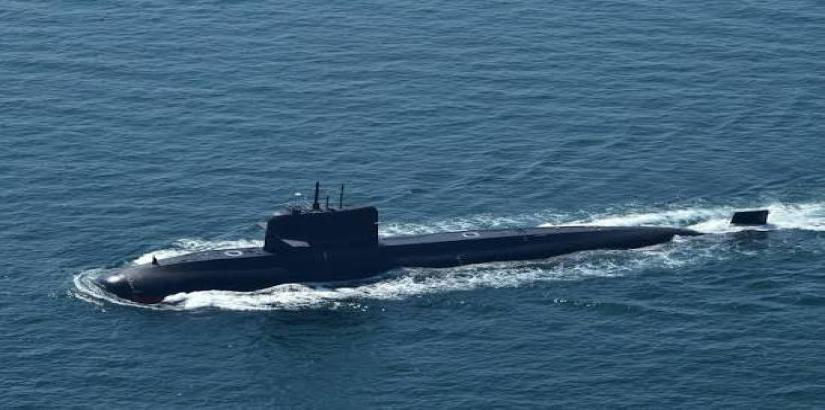
Pakistan’s first Hangor-class submarine has crossed an important threshold by moving from acquisition and induction toward operational use. On September 27, PNS/M Hangor conducted its maiden live-weapon firing in the North Arabian Sea, successfully engaging a designated long-range target with an anti-ship cruise missile. Chief of the Naval Staff Admiral Naveed Ashraf witnessed the firing and highlighted the submarine’s combat capability and its importance for Pakistan’s maritime deterrence.
The test does not mean Pakistan has suddenly closed the naval gap with India. India retains a larger and more diversified fleet, a broader naval-industrial base, and an expanding anti-submarine warfare capability. But the firing is important because it provides the first visible indication that Pakistan’s Hangor program is moving from procurement toward operational use. That shift could challenge India’s maritime superiority to exercise in the Arabian Sea.
From Acquisition to Operational Use
Pakistan is acquiring eight Hangor-class submarines in cooperation with China. Four are being built in China and four in Pakistan under a technology-transfer arrangement. The first submarine, PNS/M Hangor, was commissioned in China in April 2026 and arrived in Karachi in June.
The September firing matters because it shows the platform being tested with one of its principal weapons rather than simply being delivered to the fleet. Pakistan has also continued to invest in the wider program. In June, the government approved Rs10.15 billion in additional funding for the Hangor Project under the Revised Armed Forces Development Plan 2030.
But a successful missile firing should not be confused with full combat readiness. Submarines depend on trained crews, maintenance, logistics, communications, intelligence and surveillance, and the ability to operate as part of a wider force. The larger question is whether Pakistan can sustain an operational submarine force once more Hangor boats enter service.
India Holds the Larger Naval Advantage
The Hangor program should not be viewed against India’s continuing naval expansion, as India still holds the larger Navy advantage. India completed its six-submarine Project 75 program with the commissioning of INS Vagsheer in 2025. New Delhi is also pursuing Project 75(I), which envisages six additional conventional submarines equipped with air-independent propulsion, modern weapons and advanced sensors. India is also strengthening the capabilities needed to detect submarines. Its Mahe-class Anti-Submarine Warfare Shallow Water Craft program is adding new vessels equipped for underwater surveillance and anti-submarine warfare. INS Malvan was commissioned in July 2026, while Mangrol was delivered to the Indian Navy in August. Both are part of an eight-vessel program.
India’s broader naval buildup also extends beyond submarines. New Delhi continues to expand indigenous shipbuilding, maritime surveillance and surface combatants. Therefore, Pakistan’s new submarines are entering a competition in which India is strengthening both its ability to operate at sea and its ability to locate underwater threats.
Pakistan’s Bet Is Sea Denial
Pakistan does not need to match India ship for ship to affect how India operates. The more relevant concept is sea denial. Instead of trying to control large areas of the sea, a sea-denial force seeks to make an adversary’s operations more difficult and riskier. Submarines are particularly suited to this role because their value comes partly from uncertainty: an adversary must account for a platform it cannot easily see.
Pakistan has been moving in this direction for some time. Earlier in 2026, it tested the Taimoor air-launched anti-ship cruise missile as well as other naval strike systems. The combination of submarine, surface, and air-launched weapons points toward a layered approach in which Pakistan seeks to threaten an adversary’s maritime forces without trying to establish command of the sea. Hangor fits naturally into that approach.
An operational Pakistani submarine fleet could force India to devote more resources to anti-submarine warfare, surveillance and force protection. Indian commanders would have to account for the possibility of submarines operating in areas where surface forces might otherwise have greater freedom of manoeuvre.
Hangor cannot give Pakistan control of the Arabian Sea, but it can give India a more difficult sea-control problem. That distinction is central to understanding what it could change.
The September 27 firing demonstrates that PNS/M Hangor can conduct an anti-ship missile engagement during a live exercise. It does not establish how the submarine would perform during sustained wartime operations, how long it could remain deployed, or how effectively it could operate within a broader targeting and command network.
Submarine warfare depends heavily on information. A submarine needs to locate or receive information about a target, approach or engage it without compromising its own position, and maintain communications with the wider force as required. Those demands make intelligence, surveillance, reconnaissance and command-and-control just as important as the submarine or missile itself.
Pakistan’s wider naval modernization therefore matters. The Hangor program is taking place alongside exercises and investments aimed at improving multi domain operations, including the integration of naval, air, unmanned and other capabilities. Thus, the real question is whether Pakistan can connect these pieces into a coherent sea-denial system.
Eight-Boat Fleet is the Real Test
The strategic impact of Hangor will become clearer as the eight-submarine program develops. A single submarine can create uncertainty. A larger fleet can create persistence.
If enough boats are available for sustained deployments, Pakistan could maintain a more regular undersea presence while rotating vessels through training, maintenance, and operations. That would make it harder for India to assume that locating one submarine removes the larger threat. But building eight submarines is only part of the challenge. Pakistan will need trained crews, maintenance facilities, spare parts, shore support, secure communications, and a reliable system for providing submarines with the information they need to operate effectively.
The four submarines being built in Pakistan also offer an opportunity to deepen local industrial experience and reduce some of the long-term burden of relying exclusively on overseas construction. This is where operational readiness will matter more than procurement figures. A larger fleet that spends much of its time unavailable for deployment would not produce the same strategic effect as a smaller force that can maintain a credible and unpredictable presence.
India’s Response Will Shape Outcome
India’s response will also shape the strategic effect of the Hangor program. Its expanding submarine and anti-submarine capabilities mean that the Hangor program will become part of a wider competition between underwater concealment and underwater detection.
That could produce a familiar cycle. Pakistan improves submarine survivability and striking capability. India strengthens its ability to locate and track those submarines. Pakistan then has greater incentives to improve its own surveillance, communications, and survivability.
This competition does not automatically produce instability. A more survivable Pakistani submarine force could strengthen deterrence by making it harder to assess how quickly Pakistan’s maritime forces could be neutralized.
But the same competition can increase uncertainty in a crisis. The more both sides depend on finding and tracking underwater forces, the more difficult it becomes to know what the other side can see, where its submarines are operating, and how it might interpret an ambiguous contact.
That makes maritime risk reduction increasingly important alongside naval modernization.
Shift in the Balance of Risk
Pakistan is unlikely to use the Hangor program to achieve conventional naval parity with India. India’s overall fleet, submarine program, shipbuilding capacity, and anti-submarine capabilities give it a much broader maritime base. But parity is not the only way military power can affect a strategic balance.
For Pakistan, the value of Hangor lies in forcing India to treat a larger part of its maritime environment as contested. If the eight submarines become a reliable and integrated force, India may have to devote more resources to surveillance and anti-submarine warfare, plan surface operations with greater caution, and accept greater uncertainty in the Arabian Sea.
That would amount to a shift in the balance of risk, even without a change in the overall balance of naval power. It can be narrower: denying India the ability to use its larger naval force without high operational costs.
The Strategic Test Is Integration
The September 27 firing is therefore best seen as the beginning of a new phase in Pakistan’s naval modernization. The larger strategic question is still open.
Whether Hangor changes the regional maritime balance will depend on what comes next: how quickly the remaining submarines enter service, how often they can be deployed, how effectively they are supported, and how well they are integrated with Pakistan’s wider maritime surveillance and strike architecture.
If those pieces come together, Hangor will matter not because it makes Pakistan equal to India, but because it could make Indian maritime superiority harder to convert into uncontested freedom of action.
(The writer is a researcher affiliated with the Institute of Strategic Studies Islamabad (ISSI). She holds a BS in International Relations from the International Islamic University Islamabad. The views expressed are of the author alone. She can be reached at akbarsherzimah@gmail.com or via LinkedIn at www.linkedin.com/in/sherzimah-akbar-28aa23382. )







Post a Comment