

India Through a Different Lens: Post BRICS Summit, a Nuanced Change in Outlook Towards India in Chinese Media and Policy Circles
The real change, then, is not merely that Chinese media sounded friendlier towards India. It is that they assigned India a different place in the story. New Delhi appeared as a complex but consequential partner, whose strategic autonomy and cooperation matter to China's imagining of a changing world order.
 Sep 16, 2026
News is never only what is said. It is also what appears first, what is repeated, what recedes, and what future a report invites readers to imagine. Read that way, Chinese coverage of the BRICS summit in New Delhi did more than sound warmer towards India. It quietly repositioned India within Beijing's public narrative.
India appeared less through the familiar lenses of its strategic ties with the United States or the unresolved Himalayan boundary, and more as an autonomous major power whose cooperation matters to Beijing's broader narrative of the Global South, multipolarity and global governance. The differences remained, but Chinese coverage reordered their importance.
A Different Phraseology
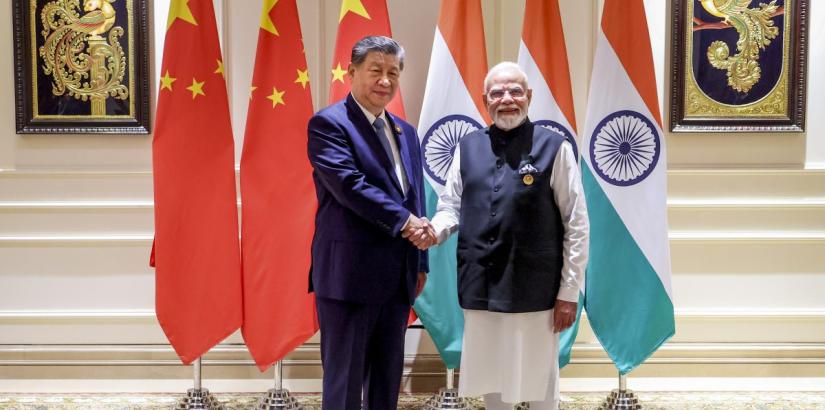
Xinhua provided the clearest official framing after Xi Jinping met Narendra Modi on September 12. It reported a candid, in-depth exchange and an important consensus that China and India should be partners. In the English account carried by China Daily, Xi described the two countries as “partners for cooperation, not rivals” and said each should view the other's development as an opportunity rather than a threat. The phrasing matters because it seeks to shift the vocabulary through which the relationship is usually read. The border was present but placed within a wider architecture.
China’s Foreign Ministry said the two sides should seek “parallel, mutually reinforcing progress” in advancing bilateral relations and resolving the boundary question, while maintaining peace and tranquillity in the border areas. India’s public account differed in emphasis. New Delhi said border peace remained an “essential basis” for the continued development of relations and highlighted the structural trade imbalance, supply chains and “meaningful and predictable market access”.
The contrast becomes sharper in the Chinese account of Modi's remarks. Beijing attributed to him the view that India follows an independent foreign policy and that ties with China are not affected by any third party. The same Chinese account said that India's policy and position on issues relating to Taiwan and Tibet remained unchanged, and that India would not allow forces to engage in activities against China from its territory.
None of these formulations appears in the Indian Prime Minister’s Office account. They should therefore be read as China’s published account of the conversation, not as jointly authenticated quotations. Diplomatic readouts are not transcripts. They are acts of selection.
China Daily carried that selection to an international readership. Its September 14 headline stated that China and India should be partners. The report emphasised shared development, direct flights, people-to-people exchanges, and multilateral coordination. An editorial a day earlier described the meeting as setting a pragmatic trajectory for relations and argued that recent leader-level engagement had helped prevent differences from overwhelming the relationship. The tone was affirmative without pretending the hard questions had disappeared.
Global Times added interpretation. Wang Xu of Peking University's Centre for South Asian Studies said that if Kazan in 2024 marked a turning point and Tianjin in 2025 helped put relations back on a stable track, the New Delhi meeting could be seen as a new phase of confidence-building. His focus was practical. Border management, exchanges, trade, investment and multilateral coordination could give political understandings a more durable institutional form. That sequence is telling. Separate encounters become a story of gradual recovery. Kazan is the return, Tianjin the stabilisation, and New Delhi the point at which stabilisation may acquire institutional weight. It is a narrative of movement, not reconciliation.
Other voices in Global Times placed the bilateral relationship within the broader BRICS framework. Lan Jianxue of the China Institute of International Studies highlighted the opportunity created by India and China hosting consecutive BRICS summits. Xu Feibiao of the China Institute of Contemporary International Relations later focused on the practical agenda, covering artificial intelligence, trade and investment, digital industry, smart manufacturing and talent development. Xi's summit speeches reinforced this direction. BRICS was described as an influential platform for emerging markets and developing countries, while the rise of the Global South was linked to a more multipolar world.
Emphasis on Cooperation Potential
However, Chinese scholarly commentary also offered notes of caution. Writing in The Paper before the summit, Fudan University scholar Lin Minwang described the broad direction of India-China relations as stable and improving, while warning that a closer reading of the details still required caution. He highlighted visas, Chinese investment, and the durability of India’s approach towards China. This was not an official government statement and should not be read as one. Its importance lies in showing that the Chinese conversation contains scepticism as well as optimism.
The think tank record requires the same care. A discussion published on September 10 with Mike Liu, vice president and senior fellow at the Beijing-based Centre for China and Globalisation, examined BRICS, trade, artificial intelligence, visas, exchanges between people and China's engagement with South Asia. The conversation had been recorded on September 3, before the summit.
It is therefore useful as evidence of the policy atmosphere around the visit, but not as a verdict on the meeting between Xi and Modi.
A Different Framing
Taken together, the public Chinese record suggests something more nuanced than a simple reset. India is being placed more firmly within Beijing's language of the Global South and multipolarity. The border remains important, but Chinese coverage resists allowing it to become the sole lens through which the relationship is viewed. Economic cooperation, people-to-people exchanges, and multilateral coordination are given space to breathe alongside unresolved strategic questions.
The real change, then, is not merely that Chinese media sounded friendlier towards India. It is that they assigned India a different place in the story. New Delhi appeared as a complex but consequential partner, whose strategic autonomy and cooperation matter to China's imagining of a changing world order.
Whether that framing endures through the next serious disagreement will tell us far more about the depth of the present accommodation than any photograph of two leaders smiling in New Delhi.
(The author is a journalist-turned-interdisciplinary academic with over 20 years of experience in broadcast and digital media, as well as research across Asia and Europe. He holds a PhD from Hong Kong Baptist University and is currently based in China. Views expressed are personal. He can be reached at arjunchatt@gmail.com/ WeChat: ARJUN13717687208/ https://www.linkedin.com/in/arjun-c-276a8065/).





Post a Comment