

EU Fast-Tracks FTA with India as BRICS Summit Signals Shifting Geopolitical Dynamics
The timing of the EU announcement coincided with the BRICS+ Summit in New Delhi, creating speculation about whether the EU was seeking to reinforce its strategic engagement with India amid the growing influence of the BRICS grouping.
 Sep 13, 2026
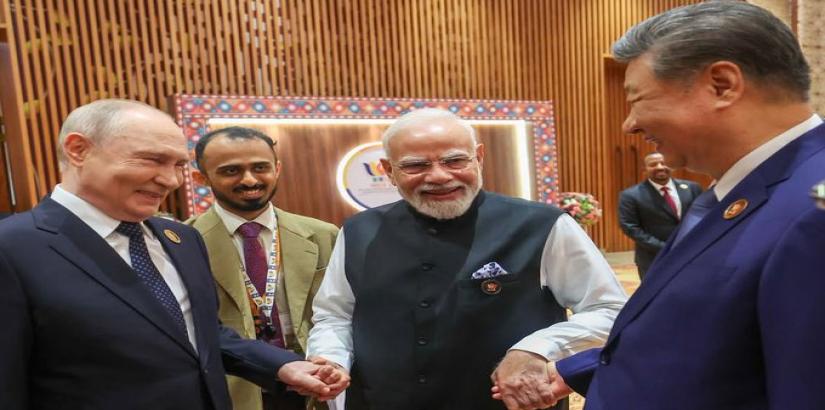
The European Union has accelerated the process for concluding its long-negotiated Free Trade Agreement (FTA) with India, signalling the growing importance of the EU-India partnership in an increasingly fragmented global environment.
The timing of the announcement, made during the BRICS+ Summit in New Delhi, has prompted questions as to whether the move reflects a strategic response to the expanding influence of BRICS+ and the growing prominence of India as a key actor in global affairs.
While the EU presents the agreement as part of its broader Indo-Pacific strategy and commitment to economic cooperation, the geopolitical context suggests that the announcement may also be intended to reinforce Europe's presence in a region where competing political and economic blocs are gaining influence.
The Commission's Urgency
On 11 September, as the BRICS+ Summit commenced in New Delhi, the European Commission announced that it had submitted proposals to the Council of the European Union which represents the 27 EU governments seeking authorisation for the signature and conclusion of the EU-India Free Trade Agreement.
If approved, the agreement would become the largest trade deal ever concluded by either side.
The European Commission argues that the agreement would: Improve market access for businesses, reduce tariffs and non-tariff barriers, create more predictable rules for trade and investment and strengthen economic ties between the EU and India.
Current annual trade between the two partners exceeds 180 billion euro in goods and services and supports approximately 800,000 jobs within the EU.
The European Commission estimates that 96% of EU goods exports to India would benefit from tariff reductions or elimination.
European businesses could save approximately 4 billion euro annually in customs duties. Consumers would benefit from greater choice and increased competition.
The European Commission's move is consistent with the fast-track procedure introduced earlier this year by EU Trade Commissioner Maroš Šefčovič. This approach seeks to speed up implementation of trade agreements at a time when geopolitical uncertainty is increasing, global supply chains remain vulnerable and International trade institutions face growing pressure.
A notable indication of urgency is the Commission's decision to circulate the agreement initially only in English, with translations into the EU's other 23 official languages to follow later.
This departs from the EU's normal practice of providing legal texts simultaneously in all 24 EU’s official languages.
EU Trade Spokesperson Olof Gill explained to journalists in Brussels that President Ursula von der Leyen had committed during her January visit to India to secure progress on the agreement before the end of the calendar year.
Challenging Western Assumptions
The timing of the EU announcement coincided with the BRICS+ Summit in New Delhi, creating speculation about whether the EU was seeking to reinforce its strategic engagement with India amid the growing influence of the BRICS grouping.
The summit highlighted several developments that challenge Western assumptions regarding global alignment, expanded participation from Global South countries, continued cooperation between India, Russia and China despite geopolitical tensions.
Particularly noteworthy was the presence of a large Russian business delegation accompanying President Vladimir Putin, reportedly focused on discussions concerning supply chains and food security cooperation.
For many European policymakers, such developments underline the difficulty of isolating Russia economically and diplomatically.
The BRICS+ Summit declaration drew attention to rising global military expenditures and argued that these increases occur at the expense of development financing for poorer countries.
Although the declaration did not explicitly target the EU, the language could be interpreted as an indirect criticism of European efforts to strengthen defence spending and military production in response to perceived threats from Russia.
The summit occurred against a backdrop of multiple global crises, the Russia-Ukraine war, ongoing conflict in Gaza and the wider Middle East, and continued concerns over disruptions to key maritime trade routes, including the Strait of Hormuz.
These issues have intensified debates over the future structure of global governance and economic cooperation.
India's Nuanced Multialignment
A central theme emerging from both the EU-India relationship and the BRICS+ Summit is India's increasingly sophisticated policy of strategic autonomy.
Earlier in the year in January, New Delhi hosted European Council President António Costa and European Commission President Ursula von der Leyen. Several months later, the same city hosted leaders of BRICS+ countries.
According to the European Union Institute for Security Studies, India's ability to engage simultaneously with diverse geopolitical groupings demonstrates its growing effectiveness as a practitioner of "multi-alignment".
From this perspective, India's value to the EU does not lie in full strategic convergence but in maintaining dialogue and cooperation despite differing policy positions.
As the Institute argues, the objective should be to prevent differences from hardening into lasting geopolitical divisions.
Despite growing economic cooperation, significant differences remain. The wars in Ukraine and Gaza have highlighted contrasting approaches to international security among EU and BRICS+ members.
Concern Among European Policymakers
The European Parliament has repeatedly emphasised the need for greater engagement with individual BRICS+ countries while simultaneously seeking to counter what it describes as Russia's destabilising activities, China's expanding global influence.
The expansion of BRICS+ has increased discussion regarding the potential emergence of alternative financial arrangements.
Members of the European Parliament's Committee on International Trade have urged policymakers to monitor these developments closely.
The EU currently has no formal institutional relationship with BRICS+ as a collective organisation.
However, European policymakers increasingly recognise that the enlarged grouping represents a platform through which the Global South can articulate common interests and pose a challenge to traditional Western dominance in global governance.
Against this backdrop, the EU's push to conclude the India FTA can be viewed as serving multiple objectives, strengthening economic ties with one of the world's fastest-growing major economies, deepening the EU's presence in the Indo-Pacific region, reinforcing resilient supply chains, ensuring continued European relevance in a global environment characterised by growing multipolarity and building a closer relationship with India without requiring full political alignment.
Geopolitical Calculation Behind Decision
The EU's decision to accelerate ratification of the India Free Trade Agreement reflects both economic opportunity and geopolitical calculation. Officially, the move is presented as part of a broader effort to strengthen trade and investment ties with India. However, the timing of the announcement during the BRICS+ Summit inevitably invites a wider strategic interpretation.
As BRICS+ expands its influence and India continues to pursue its policy of strategic autonomy, the EU increasingly faces the challenge of engaging major emerging powers without expecting exclusive partnerships. The proposed FTA therefore represents not only a trade agreement but also a strategic investment in Europe's long-term relationship with one of the most influential actors in an evolving multipolar world.
(The author is Brussels-based Non Resident Fellow of the New Delhi-based Society for Policy Studies who has been tracking and reporting on EU and European affairs and NATO for the past four decades. The views expressed are personal. He can be reached at nawab_khan@hotmail.com. X: @NawabKhan10)





Post a Comment