

Belgium and India: Building a Strategic Partnership Beyond Economics and Trade
Belgium views India as an opportunity to reduce its economic dependence on China and limit vulnerability to developments in the United States. India offers scale, growth, industrial capacity and ambition, while Belgium offers technology, specialised expertise, logistics and access to the European market.
 Sep 07, 2026
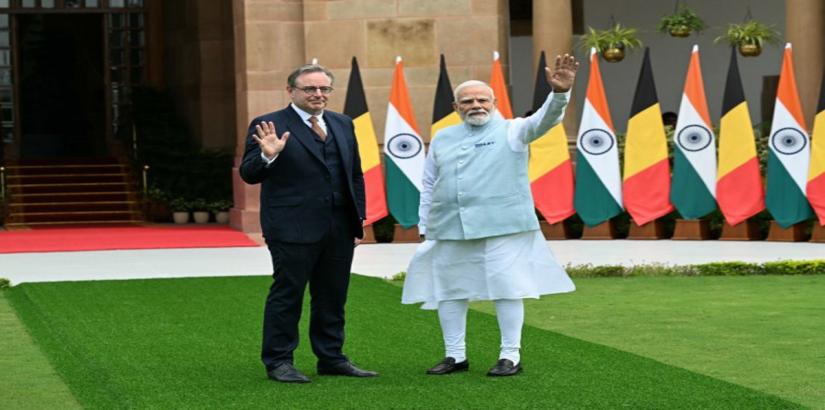
Belgian Prime Minister Bart De Wever’s official visit to India on 3–4 September marked an important step in strengthening bilateral relations between the two countries. The visit was particularly significant for defence cooperation, trade and investment, logistics, emerging technologies and economic diversification.
It was also diplomatically important: it was the first visit of a Belgian prime minister to India in two decades. The previous such visit was that of former Belgian Prime Minister Guy Verhofstadt in November 2006.
The visit can therefore be understood as part of a broader Belgian strategy to deepen engagement with India at a time of changing geopolitical and economic circumstances.
Belgium is seeking to build on the momentum created by a major economic mission to India led by Princess Astrid of Belgium in March 2025, the conclusion of the EU–India Free Trade Agreement earlier in 2026, India’s rapid economic growth and large domestic market.
Belgium views India as an opportunity to reduce its economic dependence on China and limit vulnerability to developments in the United States. India offers scale, growth, industrial capacity and ambition, while Belgium offers technology, specialised expertise, logistics and access to the European market.
De Wever met with Prime Minister Narendra Modi in New Delhi. He described their discussion as “very candid” and focused on ways in which Belgium and India could expand cooperation.
The Belgian delegation also held discussions with Piyush Goyal, India’s Minister of Commerce and Industry, Devendra Fadnavis, Chief Minister of Maharashtra, and Indian business representatives.
The two sides signed several agreements covering areas including green energy, international crime-fighting, defence, diplomacy, emerging technologies, education and military exchanges.
A particularly important development was the memorandum of understanding between India’s Central Bureau of Investigation and the Belgian Federal Police, aimed at cooperation against transnational organised crime and cybercrime.
The diplomatic component indicates that the relationship is expanding beyond traditional economic ties. Cooperation in policing, cybercrime, education and defence suggests an attempt to develop a broader strategic partnership rather than a relationship based solely on trade.
Defence Cooperation a Central Outcome
Defence cooperation emerged as one of the central outcomes of the Belgian visit. Belgium and India agreed to strengthen military cooperation, while defence-industry organisations from both countries committed to greater collaboration. A Letter of Intent establishes a framework for structural cooperation between the two armed forces.
The proposed areas of cooperation include military training, officer exchanges, research and development, seminars, joint military exercises, maritime security and the development of an industrial roadmap.
The Belgian Defence College also plans to organise its World Study Trip in India in 2027.
In addition, Belgian Defence Minister Theo Francken announced the signing of seven major defence contracts with India. Fifteen Belgian defence companies participated in the mission, while seven specific industrial collaborations were identified as particularly important.
An important institutional development was the cooperation agreement between the Belgian Security & Defence Industry and the Society of Indian Defence Manufacturers.
This is significant because India is undertaking extensive military modernisation. Belgium therefore sees India’s defence procurement programmes as a potentially major market for Belgian technology and industrial expertise.
Defence cooperation has both a strategic and commercial dimension. Strategically, it strengthens bilateral security ties and creates opportunities for cooperation in areas such as maritime security and military training.
Economically, India’s large-scale military modernisation provides Belgian defence companies with access to a potentially substantial market. The Belgian government’s objective is therefore not simply to increase military-to-military contact, but to convert political trust into concrete industrial partnerships, technology cooperation and contracts.
Trade, Investment and the EU–India FTA
According to Prime Minister De Wever, 235 Belgian companies invest in India, while 95 Indian companies operate in Belgium. Bilateral trade in goods amounts to approximately €9.4 billion annually. The two countries intend to double bilateral trade over the next five years, with opportunities identified not only in defence but also in semiconductors, green energy, chemicals, pharmaceuticals, logistics and other advanced industrial sectors.
Belgium’s proposition to India is based partly on its role as a gateway to the European market. Its ports, industrial clusters and logistical connections provide Indian companies with access to European markets.
The conclusion of negotiations on the EU–India Free Trade Agreement last January provides an important structural context for Belgium’s increased engagement with India. The EU headquarters are based in the Belgian capital, Brussels. Once implemented, the agreement is expected to reduce or eliminate import duties on a wide range of products, simplify customs procedures, facilitate trade between India and the EU, and create new opportunities for investment and industrial cooperation.
The European Commission estimates that EU exports of goods to India, worth nearly €49 billion in 2024, could potentially double by 2032. The sectors expected to benefit include chemicals, pharmaceuticals, machinery, textiles and food.
The free trade agreement changes the strategic calculation for Belgium. Rather than treating India simply as a bilateral export market, Belgium can position itself as an intermediary between India and the wider European market.
Indian companies can use Belgian logistics and infrastructure to enter Europe, while Belgian and European companies can use India as a major growth market.
Antwerp-Bruges and Long-Term Engagement
The Port of Antwerp-Bruges, which has maintained a permanent presence in Mumbai since 2006, plays a central role in Belgium’s economic strategy towards India. On 4 September, the port organised a high-level dialogue in Mumbai involving Belgian and Indian policymakers and business leaders. The discussions focused on opportunities arising from the India–EU Free Trade Agreement.
In 2025, the port handled 6.3 million tonnes of goods originating from or destined for India. Belgium’s third-largest breakbulk trade partner, India was also its seventh-largest container trade partner.
The port is seeking to position itself not merely as a transport hub but as a long-term strategic platform connecting Indian companies with Europe.
A further multi-sector Belgian trade mission to India is planned for 1–5 February 2027, demonstrating that the September visit is intended to generate sustained commercial engagement rather than remain a one-off diplomatic event.
Belgium is presenting itself to India as a specialised rather than large-scale economic partner. The sectors identified as having particular potential include defence, military modernisation, pharmaceuticals, chemicals, industrial capabilities, trade and manufacturing, semiconductors and specialised technology.
This reflects De Wever’s broader argument that Belgium’s relatively small size is not necessarily a disadvantage. Belgium can offer specialisation, technology, experience and European market access rather than competing with India on scale.
From Historical Links to Strategic Partnership
The visit also contained a symbolic historical element. De Wever brought Prime Minister Modi a chocolate replica of India Gate, the New Delhi landmark commemorating soldiers from British India who died on European soil during the First World War.
Although the sculpture did not survive the journey intact, De Wever used India Gate as a symbol of the historical links between Belgium and India. He connected this shared history with the possibility of cooperation in the current geopolitical environment, particularly around prosperity and security.
Bart De Wever’s visit indicates that Belgium is attempting to move its relationship with India from traditional economic engagement towards a broader strategic partnership.
Belgium wants to expand bilateral trade and increase the number and depth of business relationships between the two countries. Belgium’s ports and industrial infrastructure provide India with a gateway to Europe, particularly as the EU–India Free Trade Agreement creates new trade opportunities.
The most immediate opportunity lies in defence and industrial cooperation, where India’s military modernisation creates a potentially large market for Belgian companies. At the same time, the EU–India Free Trade Agreement provides Belgium with an opportunity to strengthen its role as a European gateway for Indian trade and investment.
The broader strategic rationale is diversification: India is viewed as a rapidly growing and increasingly important partner that can help Belgium reduce economic vulnerabilities while opening new markets for Belgian companies.
In strategic terms, the visit can be characterised as an attempt to convert Belgium’s traditional strengths—technology, specialisation, logistics and access to Europe—into a long-term partnership with India’s scale, growth and industrial ambitions.
(The author is a Brussels-based Non-Resident Fellow of the New Delhi-based Society for Policy Studies, who has been tracking and reporting on EU and European affairs and NATO for the past four decades. The views expressed are personal. He can be reached at nawab_khan@hotmail.com. X: @NawabKhan10}.







Post a Comment