

The Geopolitics of the Dalai Lama Institution and Tibetan Reincarnation: China’s Quest for Control
In Tibetan society, the process of identifying reincarnations is understood as one of the most sacred expressions of rebirth. Although this tradition may be unfamiliar outside the Tibetan Buddhist world, it is deeply rooted in Tibetan religious culture. Communist China remains fundamentally alien to this traditional reincarnation system.
 Jul 22, 2026
The Tibet-China conflict is one of the longest unresolved civilizational-state conflicts in Asia. Since China’s occupation of Tibet in 1950, the People’s Republic of China (PRC) has systematically destroyed Tibet’s culture and history and brutally suppressed the Tibetan identity and basic human rights.
On 1 July 2026, China implemented its new ethnic unity law. It intensifies tensions among global ethnic Chinese communities and international organizations concerned with China affairs. According to World Population Review, there are approximately 1.4 billion Chinese-speaking people worldwide. Through this law, China seeks to expand its legitimacy and influence among ethnic Chinese communities globally while further erasing the distinct identities and histories of China’s occupied peoples such as Tibetans, Uyghurs, and Mongolians. In this sense, the law represents new form of China’s transnational repression. It also challenges the fundamental rights and principles enshrined in the Universal Declaration of Human Rights, which provides basic human rights to all people around the world.
Attempt to Rewrite Tibetan History
As soon after executed the law, Yu Jing, the spokesperson of the Chinese Embassy in India, reaffirmed the Chinese government's authority over the succession of “each Dalai Lama” and misrepresented the title of the Dalai Lama. This public diplomacy strategy implies an attempt to rewrite Tibetan history in a manner that could undermine Tibetan civilization and culture while seeking to bring Tibetan Buddhism under a Chinese Communist Party–defined socialist framework with Chinese characteristics.
To exert greater control over Tibetan Buddhism and its cultural sphere, China has sought to influence the institution of the Dalai Lama. As a result, Chinese officials and state media have increasingly asserted Beijing’s authority over the process of selecting the Dalai Lama’s reincarnation. This position reflects the Chinese Communist Party’s long-standing skepticism toward religion. Mao Zedong, the founding leader of the People’s Republic of China, viewed religion as an opium. During a meeting with the 14th Dalai Lama in Beijing in 1954, Mao expressed this view directly to him.
Reincarnation and Tibetan Society
The Tulku, reincarnation system of Tibetan Buddhism is traditionally guided by Tibetan Buddhist culture and religious beliefs. This system was formally established within the Tibetan monastic community and has become deeply embedded in the Tibetan society and its culture sphere of influence. It represents one of the most sacred institutions of Tibetan Buddhism and has evolved into an integral part of the Tibetan way of life. The reincarnation tradition is fundamentally rooted in Tibetan religious practices, cultural heritage, and collective identity of Tibet. As such, it embodies not only a spiritual tradition but also a living expression of Tibetan Buddhist culture and its identity.
Dalai Lama and Tibetan Buddhist Reincarnation
The 14th Dalai Lama is the symbol of Tibet and aspiration of Tibetans, and a beacon of peace and compassion. His noble teaching and global contribution are reflected in major international honors, including the Nobel Peace Prize, the Templeton Award, and the U.S. Congressional Gold Medal. But Chinese government denounce him and always disseminate negative campaign and distort the centuries old Dalai Lama institution for its own political need.
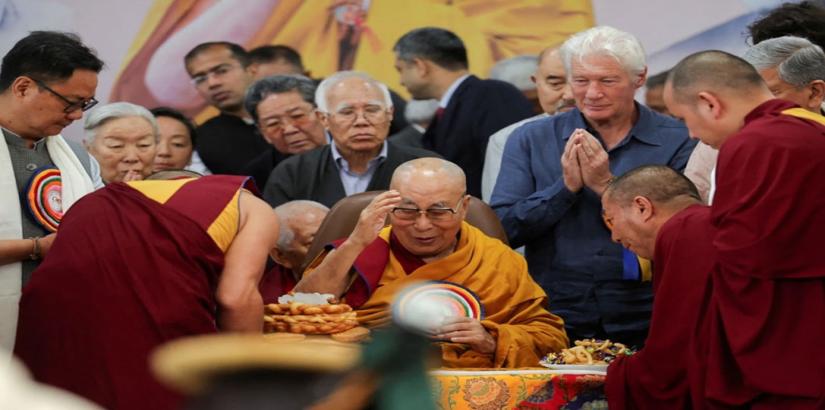
On 6 July 2026, people around the world celebrated the 91st birthday of His Holiness the 14th Dalai Lama. Aware of his advancing age, China has steadily sought to weaponize the Tibetan Buddhist reincarnation system. This sacred practice began in Tibet in the 13th century with the Karmapa lineage.
According to the renowned 16th-century Sakya scholar Mangto Ludrup Gyatso (1523–1596), Karmapa Rangjung Dorje (1284–1339) was considered as Tibet’s first reincarnated tulku. In 1288, in present-day Kyirong district in Tibet, Karmapa Rangjung Dorje was recognized by the great 13th-century Tibetan yogi Orgyenpa (1230–1309) as the reincarnation of Karma Pakshi (1204–1283). The lineage traces back to Dusum Khyenpa (1110–1193), the first Karmapa and founder of the Karma Kagyu school, also known as Karma Kamtsang, which was established in the 12th century. The year 1288 is therefore formally regarded as the beginning of the Tibetan tulku reincarnation system in the history of Tibetan Buddhism. This traditional continuity remains central to Tibetan Buddhism in Tibet, India, Mongolia, Nepal and Bhutan. Under it, a young reincarnate lama is identified and enthroned after the death of the previous incarnation. The process is mostly guided by the predecessor lama’s instructions and conducted by highly trained Buddhist masters. In the case of the 14th Dalai Lamas, this process has traditionally involved the regent appointed by the Tibetan government in Tibet.
Attempt to Sinicize Reincarnation
The Chinese government has asserted its authority over Tibetan Buddhist reincarnation, claiming that the recognition of reincarnate lamas must receive state approval and comply with both religious precedent and Chinese law. The new ethnic unity law appears to serve as part of a broader legal framework intended to override the Tibetan Buddhist reincarnation system.
In 2007, China’s State Administration for Religious Affairs issued Order No. 5, a national regulation governing reincarnation. By requiring all reincarnate lamas to register with the state, the government turned a sacred religious tradition into a bureaucratic process susceptible to political control and corruption. Between 2007 and 2017, Chinese authorities officially recognized more than 1,300 Tibetan Buddhist reincarnate lamas, or tulkus. Through the creation of a tulku database, China appears to be preparing to influence the recognition of the 15th Dalai Lama by sinicizing Tibetan Buddhism under a legal framework of Chinese characteristics.
China’s Distortion of Tibetan History
By enforcing the new ethnic unity law, China uses historical distortion approach to claim legitimacy over Tibetan Buddhism. Just days ago, Yu Jing, spokesperson for the Chinese Embassy in India, reaffirmed Beijing’s claim that the title Dalai Lama was “formally recognized by the central government in 1578”. She further asserted that “in 1653, Qing Emperor Shunzhi granted the Fifth Dalai Lama a golden certificate and seal, creating a long-standing practice under which each Dalai Lama must receive approval and investiture from the central government”. Beijing repeatedly advances this argument whenever the Sino-Tibetan conflict gains international attention. In fact, the title Dalai Lama is a Mongolian word meaning “ocean,” conferred by the Mongol chieftain Altan Khan in 1578. Therefore, “Dalai Lama” means “Ocean of Wisdom” and has no origin in the Chinese language or imperial title system. It is nothing related to Chinese political affairs and state relations with Tibet.
Chinese authorities have also claimed, without credible basis, that “all Dalai Lamas were born in China” and that the Chinese central government therefore has the right to approve “each succession” under its laws and regulations. Yu Jing repeated this narrative after the worldwide celebration of His Holiness the 14th Dalai Lama’s 91st birthday. This claim is historically false and has no foundation in the Sino-Tibetan history. Rather, it appears to be a politically manufactured narrative promoted by China after the Dalai Lama received the Nobel Peace Prize in 1989.
The Dalai Lama lineage itself contradicts to Beijing’s claim: the Fourth Dalai Lama, Yonten Gyatso (1589-1617), was an ethnic Mongolian born in Mongolia, while the Sixth Dalai Lama, Tsangyang Gyatso (1683-1706), was born in Urgyenling, an area in Mon-Region, in what is now Tawang district of Arunachal Pradesh, India.
The title Dalai Lama was officially conferred upon Gyalwa Sonam Gyatso, the third in the lineage of the Dalai Lama institution. The first and second lineage holders, Gyalwa Gedun Drupa (1391–1474) and Gyalwang Gedun Gyatso (1475–1542), did not officially hold the title of Dalai Lama.
More importantly, Tibet’s relationship with the Manchu Dynasty was established during the reign of the Great Fifth Dalai Lama, Ngawang Lobsang Gyatso (1617–1682). The Manchu Emperor Shunzhi (1643–1661) invited the Great Fifth Dalai Lama to his capital in 1651. According to the Dalai Lama’s account, he left Tibet for Peking in 1652 and subsequently met Emperor Shunzhi outside Peking in 1653. This state correspondence and diplomatic protocol demonstrated that the Manchu Emperor received the Dalai Lama as the sovereign head of Tibet.
Strategic Instrument of Chinese Ambition
In Tibetan society, the process of identifying reincarnations is understood as one of the most sacred expressions of rebirth. Although this tradition may be unfamiliar outside the Tibetan Buddhist world, it is deeply rooted in Tibetan religious culture. Communist China remains fundamentally alien to this traditional reincarnation system. Yet, for political and strategic control over Tibetan Buddhism and its wider influence in Asia, China has sought to bring the Dalai Lama institution under a framework of Chinese characteristics.
In statements issued in 2011 and 2025, His Holiness the 14th Dalai Lama firmly rejected Chinese interference in matters of his reincarnation. He emphasized that the process must remain within the Tibetan Buddhist tradition and be guided by legitimate religious authorities and followers. In 2025, he reaffirmed that he would be reincarnated and stated that the Gaden Phodrang Trust alone has the authority to identify and recognize the next Dalai Lama.
Chinese strategists and policymakers view Tibetan Buddhism with “Chinese characteristics” as a strategic instrument for advancing an Asian century shaped by Chinese socialist influence. This perspective appears to draw on Dai Jitao, a Chinese Nationalist Party leader who regarded Tibetan Buddhism as important to the unification of the modern Chinese nation. He also argued Buddhism as a foundation not only for Sino-Tibetan relations, but also for China’s broader relations across Asia.
However, the distortion of the historical legacy of the Dalai Lama institution, the denigration of the 14th Dalai Lama, and efforts to assimilate Tibetan Buddhism are characteristic of a colonial-style approach to control over Tibet by the Chinese Communist government.
(The author is a research fellow at the Tibet Policy Institute, Dharamsala, India. He holds a PhD in International Relations from the University of Madras. The views expressed are personal. He can be contacted at tsewangdorjimu@gmail.com )





Post a Comment