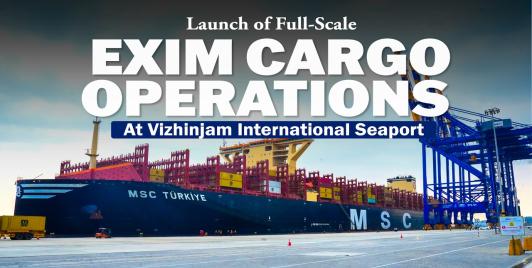
From God's Own Country to the World's Investment Destination: Kerala Wins Tourists But Why Not Investors?
Another asset remains underutilised: the global Malayali diaspora. Few Indian states possess such an extensive international network. For decades, remittances have sustained Kerala's economy. The challenge now is to transform that relationship from remittance to investment.
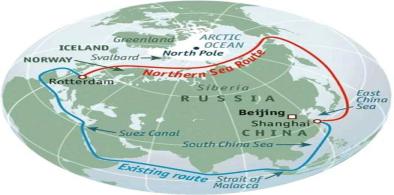
The Arctic Shortcut: China’s Northern Sea Route and the Rewiring of Global Maritime Trade
As Arctic ice retreats, geography itself is being rewritten. The Northern Sea Route illustrates how environmental change, technological innovation, commercial strategy, and geopolitics are converging to reshape international trade.

South Asia's Balance of Payments Challenge: The Changing Dynamics of External Balances in South Asia
South Asia remains one of the least integrated regions in the world despite geographical proximity and complementary economic structures. Greater regional trade, improved transport connectivity, cross-border electricity markets, digital payment systems and investment partnerships could substantially reduce external vulnerabilities.

India's Employment Debate: A Future With Plenty of Work, But Fewer Jobs
Between 2004 and 2023, India produced roughly five million graduates every year, but graduate employment increased by only around 2.8 million annually. Even fewer obtained salaried employment. Millions are either unemployed or working below their qualifications or in the waiting room for the elusive government job.
More on Economy, Trade and Development


Driving the future: India-China collaboration on EVs can be model for green mobility
One such opportunity lies in the realm of electric vehicles (EVs). Both India and China are on the cusp of transformative shifts in transportation, and the adoption of EVs could play a pivotal role in sustainable development and poverty alleviation in India. As India considers domestic EV manufacturing in collaboration with Chinese companies such as BYD, Leapmotor, and NIO, the potential for job creation, trade, and technology transfer is enormous. Chinese expertise in EV technology could help India meet its ambitious environmental goals while bolstering economic growth.

A positive shift in India-China relations can be a global changer
In such a scenario, closer engagement with Beijing, does not mean that New Delhi needs to abandon its call for open sea lanes and unhindered movement through the South China Seas, or its support to QUAD, or participate in the naval exercises in the Pacific, or disown His Holiness the Dalai Lama, or break trade and other contacts with Taiwan, to name a few. Each is critical to crafting India's foreign and security policy towards China, the ASEAN, and the Indo-Pacific.
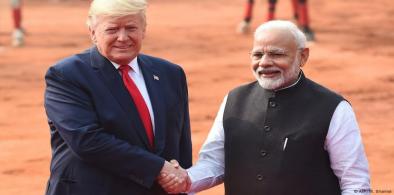
India poised for a larger role in Trump's foreign policy, Indo Pacific Strategy
Trump's strategic motivations would likely involve promoting a pro-American government in Dhaka, with Modi playing a role in shaping Bangladesh’s political future. This could open up avenues for joint Indo-US ventures in Bangladesh, possibly even enabling American companies to facilitate energy projects connecting Nepal’s hydropower resources through India to Bangladesh.

Why China has high stakes in a Buddhist archaeological site in Afghanistan
China has sought to grab this crucial mining opportunity due to the absence of major power competition in Afghanistan. Beijing's previous efforts were foiled but currently it is the only major power willing to make a bet on the Taliban government. In 2023, the official mining deal was signed between Afghan Deputy PM for Economic Affairs Abdul Ghani Baradar and Chinese Ambassador Zhao Xing. Both view this project as the start of a new era of economic and trade cooperation between the two countries.

After India-China thaw, Beijing draws Nepal in strategic embrace
Oli is scheduled to China after November 15. The primary discussion will likely be on speeding up the BRI as well as economic cooperation between the two nations. Beijing will do its best to draw Nepal deeper into its strategic sphere and further a joint approach in dealing with India to further China’s national interests.

Indian and China: Two different paths to economic progress
It is not possible for India to follow the China model of governance of less political freedom and more economic freedom. Yet, the present government may be well advised to implement pending reforms like land, labor, and judicial at the earliest.

Tonga's 'debt trap' illustrative of China's strategic stakes in South Pacific
The debt problem facing Tonga sheds light on the intricate nature of economic reliance and the broader geopolitical landscape in the South Pacific. Concerns regarding geopolitical control in a strategically significant region and the sustainability of debt have been highlighted by China's growing influence, not just in the region but beyond stretching to South Asia

US could play a larger role in shaping Bangladesh's future trajectory
This visit was strategically important for both the US and Bangladesh. For the US, it was an opportunity to solidify its presence in South Asia at a time when the region is becoming increasingly important in the broader context of US-China competition. Bangladesh, situated at the crossroads of South and Southeast Asia, plays a crucial role in the Indo-Pacific region.

Indian states have growing stake in a Free and Open Indo Pacific
India’s ties with South Korea, Japan and Taiwan which have grown in recent years have become even more important in the context of the current geopolitical and economic situation in the Indo-Pacific. India would also want to be one of the beneficiaries of the China+1 strategy being followed by many companies in East Asia.

Pakistan needs to play a larger role in the geopolitics of the Indian Ocean
The evolving Indo-Pacific strategy, led by the United States, has added a new layer of complexity to the geopolitics of the Indian Ocean. As the U.S. and its allies seek to counter China's influence in the region, India has emerged as a key partner in this strategic framework. However, this realignment has implications for regional stability, particularly for Pakistan

The Quad remains relevant in upholding Indo Pacific security
Quad does create an overarching arc of stability in the region, checking the expansion capacity of Beijing, which will in turn boost India’s regional ambitions that are mutually aligned with the Quad’s objectives.

Modi visits to Brunei, Singapore show India's commitment to Indo Pacific engagement
Modi marked a new chapter in his strategic geopolitical moves over the past few months since the start of his third term with visits to the region and to Ukraine. All these marked a new frontier for India’s power projection while sending a clear message to allies and adversaries that New Delhi has its own bargaining chips in pursuance of its strategic neutrality while ensuring the best returns for its national security and international interests.

With increased militarisation, is a PLA demobilisation possible in Ladakh?
Vacating the Kailash Range without linking it to PLA withdrawal from Depsang-Demchok was a strategic blunder, proving how easily China cons our negotiators. Our political hierarchy wouldn't know how poorly this decision was viewed by our units/soldiers

How China-inspired democratic model empowering Sri Lanka's local communities
Sri Lanka’s TEPES and PEC share many similarities with China’s whole-process democracy. Both nations are working closely to exchange experiences and collaborate on the implementation of these systems in Sri Lanka.