

India’s Housing Challenge: Bridging the Gap Between Macro Development and Basic Needs
Aggressive migration of youth and workers to metro cities in search of better opportunities is common across the region. And so is the response deficit by local and central governments in providing them with basic, dignified lifestyles. The time has come for the elected representatives to think differently and narrow the gap between government schemes and results on the ground.
 Sep 18, 2026

The Satya Niketan tragedy in Delhi is an extraordinary calamity, which calls for an extraordinary response. In September 2026, five college students lost their lives in a building collapse in Delhi’s Satya Niketan neighbourhood, not far from the capital's elite diplomatic enclave.
These were students from other states who had joined Delhi University for further studies and were staying in old, unmaintained buildings at steep rents due to the shortage of university-provided student accommodation.
This disaster is not an incident to bemoan and then consign to the vault of public memory. It is a crisis to act upon.
A functional democracy is one where all citizens have the right to reach for their dreams, and the government must provide them with the means to do so. Basic living infrastructure and access to education are two lifelines which must always be kept pulsing. Their unhindered availability is vital to create the launchpad of opportunity for India’s billion-plus population.
The first set of actions needs to be initiated by the Government. These include an immediate relook at resource allocation and prioritization. It would also require reworking the fundamental principles of project allotment and housing stock creation in the medium term.
The other set of actions needs to be ingrained into the citizens and civic society. On how we aid the Government in the formulation of a refreshed policy, how we track the progress of policy goals and demand accountability.
The Housing Gap
Let us look at the allocation for urban housing via the Pradhan Mantri Awas Yojana (PMAY) – Urban and PMAY Urban 2.0, as per the latest Budget document of the Government of India (GoI). This is on a declining trend in both absolute and % terms. The category accounted for a mere 0.46% of the Total Budget as per BE (Budget Estimate) FY27, down from 0.50% as per BE FY26.
The actual FY25 utilization and the RE (Revised Estimate) FY26 numbers are even lower, at 0.13% and 0.17% of the total budget, respectively, which means that the allocation is only on paper.
Moreover, if we probe beyond the headline numbers, some stark facts emerge: Affordable Rental Housing (ARH) is an important component of PMAY that can directly address the residential needs of migrant workers and students. However, the actual impact of this scheme on the ground is clouded in fuzzy details and incomplete information. The ARH portal under the Ministry of Housing and Urban Affairs (MoHUA) has outdated documents.
The progress report only says, “MoA signed”, and the latest presentation available is dated August 2020. There is no integrated dashboard displaying the city-wise ARH units actually in use and ready for use by the people.
As per the Government’s own limited data on this website, under a sub-component of the scheme, the conversion of available government-funded houses into ARHCs (Affordable Rental Housing Complexes) has been abysmally low.
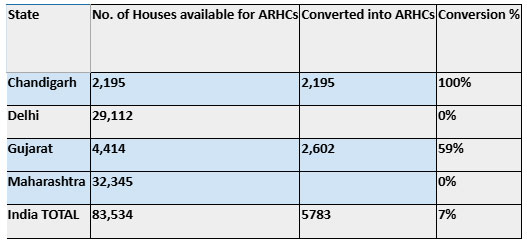
Nationally, only about 7% of identified units have successfully gone live, with the majority in states like Gujarat and Chandigarh. Delhi and Maharashtra, which hold some of India’s largest urban conglomerations, have nil conversion. It is worthwhile mentioning that Delhi has a large available stock, accounting for 35% of the country’s total, but the actual progress to usable units has been zero.
The only updated page on the ARH portal appears to be the advertising page, which proclaims that the scheme is meant to address the needs of (among others) laborers, industrial workers, students, and the urban poor, including the street vendors, rickshaw pullers, and other service providers.
With such well-intentioned objectives, it is all the more dismal that the program has delivered less than 10% of the actual units. Are ARHCs fated to be just mythical creatures and marketing ploys, or will they create actual pockets of affordable, liveable urban places for India’s wider population?
The Cost of Urban Growth
A budget allocation of under 2% for housing, urban and rural combined appears to fall short of global benchmarks. According to various statistics, in certain developed countries, the comparable figure is higher than 3% (Source: OECD Affordable Housing Database).
More importantly, in India, the actual rollout and spending usually trail the annual budgetary outlay. Apart from budget allocations, the general affordability of non-subsidized market-based housing in urban centers also needs to improve substantially.
Various metrics show that apartment costs in Delhi and Mumbai are in the same bracket as those in New York and London, while in terms of per capita income, India is among the bottom 25% of countries. This dichotomy cannot persist.
One of the root causes is the land allocation policy of ULBs (Urban Local Bodies). Recently, headlines were made when a public land authority in the National Capital Region (NCR) successfully auctioned a mixed-use 12.5-acre land parcel for a staggering INR 1800 crore.
If the raw material for residential projects, i.e., the land itself, is priced at such levels, where would the final unit cost end up, after factoring in development costs and profit margins? And if ULBs still believe in pursuing revenue maximization through land allotment, why does that cash flow not plough back into better amenities for the less advantaged? Why, for example, are the civic bodies not building adequate student housing for learners who come to the city in search of better avenues?
ULBs across India, especially those in megacities like Delhi and Mumbai, seem to have morphed into land brokers. They need to recall their original obligation to provide functional civic facilities for their voters.
Similar to Maslow’s hierarchy of human needs, every government should consider a layered priority of goals. The distribution of budgetary resources should broadly align with a “development pyramid framework”.
First, the foundational requirements, such as housing, sanitation, and education, must be met. Only then does the next level of development projects become relevant.
The governance approach that over-focuses on hyper-visible development that flaunts global economic power needs to change. While India’s expressways and jazzy airports have blossomed over the last 10 years, has there been enough attention to the fundamental stratum? This question can no longer be pushed aside.
Our authorities cannot ignore structural essentials that are directly related to the quality of life experienced by citizens daily.
Rethinking Public-Private Accountability
Pivoting from budget pyramids, it is interesting to consider a recent transaction in the aviation sector and how we might look at public-private accountability differently.
In September 2026, Adani Airport Holdings Limited (AAHL)—the airport subsidiary of Adani Enterprises Limited (AEL)—raised USD 1 billion in equity capital from marquee global investors, including Temasek and BlackRock. The transaction established a pre-money equity valuation of USD 18 billion for the airport platform.
One of the platform’s assets, the Navi Mumbai International Airport (NMIA), accounts for about 10-15% of the total valuation, according to rough market estimates. This asset is housed in an SPV, which is a JV with the local body. The concerned urban local body (ULB) allocated the land for the project under a revenue share arrangement and has 26% to 30% equity in the SPV.
Through the recent stake sale, the private partner has unlocked value at the Holdco level on the strength of the underlying assets. Perhaps rightly so, as they invested the risk capital required for greenfield project development and brought in the execution wherewithal. But under the given structure, the ULB’s stake remains a stagnant, non-monetizable paper asset. It does not really release any resources for community infrastructure.
Could there be a solution through a somewhat different model?
As the airport project is likely to be the flagship development of the surrounding region, could some of the onus for ecosystem upliftment be placed on the conglomerate owner? For example, in lieu of other arrangements, could they be given targets to develop social infrastructure like student housing and community washrooms, within a 10 or 12 km radius of the airport facility?
They might be able to deliver such projects more efficiently than ULBs. Additionally, if their branding is attached to such infrastructure, they may also be incentivized to ensure its long-term maintenance better.
While this article is triggered by an Indian catastrophe, the core issue resonates across South Asia. Aggressive migration of youth and workers to metro cities in search of better opportunities is common across the region. And so is the response deficit by local and central governments in providing them with basic, dignified lifestyles.
The time has come for the elected representatives to think differently and narrow the gap between government schemes and results on the ground.
In parallel, citizens need to ask questions and measure outcomes. We, the people, must be watchful and vigilant. We need to determine what we are ready to accept. The unsettling trends of premiumization of housing and education becoming hard to get – are we going to let these become part and parcel of our lives? Or do we want to demand better and more even access to these life essentials which can eventually lead to fairer chances for all and real, widespread prosperity.?
The buck stops with us.
(The author is a debt markets expert with around 25 years of experience. The views expressed are personal. She can be reached at shalini.shrivastav@gmail.com )





Post a Comment