

Indian Artillery: Speed of Acquisition Is as Important for Readiness as Technology
India has demonstrated that it can develop and manufacture modern artillery systems. What needs reassessment is how quickly we acquire, integrate and field them, and how effectively we ensure that new technologies communicate and operate together.
 Sep 30, 2026
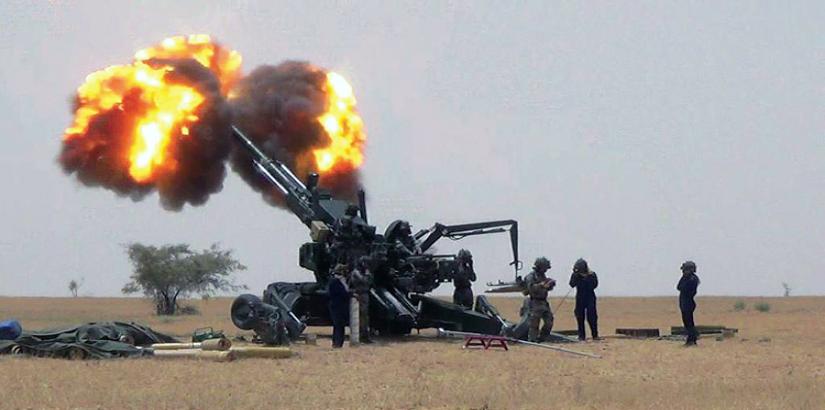
At the DEFCON 2026 in New Delhi, Defence Minister Rajnath Singh said that India has moved from “deterrence by denial” to “deterrence by punishment” - in other words, from primarily preventing an adversary from achieving its objectives to imposing costs following aggression. He linked this shift to the changing security environment and to the need to combine diplomacy with military preparedness and technological capability.
A perspective on Indian Artillery
The importance of artillery, even in an era when the modern battlefield is increasingly dominated by drones, cannot be overstated, particularly in the kind of conflict environment that exists along India's land borders.
Of the nine terror targets neutralised across the borders during Operation Sindoor by the Indian Army, seven were engaged by artillery. The figure itself is a reminder that, despite the rapid emergence of drones and other technologies, conventional artillery remains a potent and relevant instrument of warfare.
The Indian media has suddenly begun discussing Indian artillery with a sense of urgency. The immediate reason is an important development in India's neighbourhood. Pakistan is expanding its inventory of Chinese SH-15 self-propelled howitzers, a 155 mm/52-calibre truck-mounted artillery system. There is also a possibility of technology transfer from China to Pakistan.
The significance of this development, however, is not merely the increase in the number of artillery systems available to the Pakistan Army. It is the enhanced mobility and responsiveness that such systems provide on the modern battlefield, particularly when integrated with weapon-locating radars, drones and other systems for target acquisition and engagement.
The Changing Battlefield
Modern artillery is no longer simply about guns, ammunition and range. The battlefield has become an integrated network of guns, missiles, drones, sensors, communications and precision weapons, with each contributing to the delivery of firepower.
A target may be detected by a drone, satellite or other surveillance system; its location established through sensors and weapon-locating radars; the information transmitted through digital communications; and the appropriate weapon — whether a gun, missile or precision munition — selected to deliver the required effect.
The gun therefore remains central to artillery, but it is now one component of a much larger networked firepower capability. Mobility and the ability to shoot and move quickly are equally important for survivability. Weapon-locating radars can rapidly identify the source of incoming fire, while drones and other surveillance systems make concealment and prolonged deployment increasingly difficult.
This has been one of the important lessons of the Russia-Ukraine war. Artillery remains indispensable, but mobility, connectivity, precision and rapid response have become increasingly important.
For the Indian Army, this means that artillery modernisation can no longer be viewed simply as replacing old guns with newer ones. It must encompass the complete capability - guns, missiles, drones, target acquisition, communications, precision, mobility and survivability - and bring it to the soldier while it remains relevant.
India needs substantially more mobile artillery, particularly wheeled artillery. This does not mean that towed artillery has become irrelevant. The M777, for example, has demonstrated the continuing value of a lightweight towed gun in mountainous terrain. But where counter-battery threats are intense, self-propelled and mounted systems offer important advantages in mobility, rapid displacement and survivability.
India's Artillery Modernisation
The Indian Army began its Field Artillery Rationalisation Plan more than two decades ago. Initiated in 1999, its actual momentum came only after 2010, when five major artillery programmes were rolled out.

I remember visiting Deolali in 2017 for a reunion with some of my old course batchmates. It was also around the time when the first M777 Ultra-Light Howitzers had arrived in India. I had the opportunity to meet the first crew operating these guns.
It was a memorable reminder that, after decades of stagnation, Indian artillery was finally beginning to see a new generation of guns.
But the question now is no longer simply whether India can produce a modern gun. It is whether we can modernise the artillery system as a whole, and do so fast enough.
Where the Programmes Stand
The five programmes illustrate different approaches to modernisation.
ATAGS represents indigenous development. Developed by DRDO with Indian industry, 307 guns were contracted in March 2025, along with 6x6 gun-towing vehicles, at a total cost of about ₹6,900 crore. At around 18.5–19 tonnes, however, it is heavier than the Army's subsequent preference for a sub-15-tonne 155 mm/52-calibre Towed Gun System.
K9 Vajra demonstrates the value of technology absorption and rapid production. The first 100 guns were contracted from L&T in 2017 and delivered ahead of schedule. Originally intended primarily for desert operations, the system was subsequently adapted for deployment in Ladakh after the 2020 China standoff. The Army has since continued to expand its planned K9 inventory.
Dhanush, the “Desi Bofors,” represents indigenous development based on the technology and experience of the Bofors FH-77B. The programme faced production and quality-related difficulties and significant delays. The 2018 controversy over Chinese-made bearings supplied as German-made components further highlighted problems in the supply chain, although the Ministry of Defence stated that there was no adverse observation regarding the quality of the bearings.
Sharang was a pragmatic bridge to modernisation. The existing 130 mm M-46 guns were upgraded to 155 mm/45 calibre, providing a relatively quick means of expanding the 155 mm inventory while newer systems were being developed and inducted.
M777 addresses a different operational requirement: a lightweight 155 mm gun suitable for mountainous and high-altitude terrain. Its continued relevance demonstrates that there is no single artillery solution for India's varied terrain.
Together, these programmes demonstrate that India can develop, manufacture, upgrade and absorb technology in modern artillery. The problem is not simply technological capability.
The Real Challenge
The greater challenge is the speed, continuity and integration of acquisition.
Trials are necessary, and procedures exist for good reasons, particularly when equipment is intended for combat. But when trials, evaluations and procurement processes continue for excessively long periods, the system can end up decelerating rather than accelerating modernisation.
There is always a danger that, by the time a system completes its trials and induction — sometimes years after the original requirement was formulated — the technology or operational requirement may have moved on.
More importantly, modernisation cannot be pursued in isolated compartments. Guns, drones, sensors, weapon-locating radars, communications and precision weapons must be able to work together as an integrated system. A drone detecting a target is of limited value if the information cannot be rapidly communicated to the appropriate firing unit. Similarly, a modern gun cannot deliver its full potential if it is not connected to the sensors and command-and-control systems that enable rapid target engagement.
The challenge before Indian artillery is therefore not merely to acquire more guns. It is to build, integrate and field an interconnected firepower capability and to do so quickly enough that it reaches the soldier while it is still relevant.
India has demonstrated that it can develop and manufacture modern artillery systems. What needs reassessment is how quickly we acquire, integrate and field them, and how effectively we ensure that new technologies communicate and operate together.
Speed of acquisition and integration is as important for readiness as technology itself.
(The author is an Indian Army veteran and a contemporary affairs commentator. The views expressed are personal. He can be reached at kl.viswanathan@gmail.com )





Post a Comment