

Guardians of Harmony: Acknowledging Role of Mothers as Peacebuilders
India has its own legacy of maternal peacebuilding, from Jijabai to the Meira Paibi. What we lack is the language to celebrate and institutionalize these contributions. Recognizing mothers as peacebuilders is not just a cultural insight; it is a practical necessity for societies striving for harmony.
 Sep 06, 2026
In today’s world, conversations about peace often feel strangely out of place. We live amid chaos: wars that seem endless, political disturbances that fracture societies, ecological destruction that triggers disasters, and conflicts that seep into the most intimate spaces of our lives—between parents and children, partners, siblings, and even strangers on the road. Road rage incidents rise, families fracture, and communities struggle to hold themselves together.
Against this backdrop, speaking of peace may sound naïve, even unrealistic. Yet it is precisely in such times of turbulence that dialogue on conflict resolution and peacebuilding becomes not only relevant but urgent.
Peace is not the absence of conflict; it is the presence of mechanisms, values, and practices that allow societies to navigate disagreements without violence. It is about building bridges where divisions exist, and nurturing empathy where hostility threatens to take root. And often, the most powerful agents of peace are not diplomats or politicians but ordinary individuals whose everyday acts of care and mediation sustain harmony. Among them, mothers occupy a unique place.
The Talaandig Experience
Earlier this year, I visited the Talaandig community, an Indigenous People (IP) group in Bukidnon province, Philippines, as part of a peacebuilding training programme organized by the Mindanao Peacebuilding Institute. My week-long stay in Songco village revealed a profound truth: in this community, mothers are not only nurturers of families but also the architects of peace.
On the very first day, during the permission-taking ritual, the wife of the village head (Dattu’s wife) explained how women have assumed responsibility for ensuring peace—within families, between tribes, and even in their interactions with the state.
She told me: “We are the mothers. We give birth and raise our children. We know their strengths and weaknesses. So we can ensure that when our children get into a conflict situation, it neither harms them nor the other person, who is also someone’s child. As mothers we have more responsibility, and we are best equipped to resolve issues.”
Her words captured the essence of maternal peacebuilding: the ability to see conflict not as a battle to be won but as a relationship to be preserved.
Later, the eldest woman of the foster family I lived with narrated how she had gone to a nearby village that very day to resolve a family dispute. She added simply: “You know, we are all mothers, and hence we are the peacebuilders.” This matter-of-fact assertion reflected how deeply ingrained the role of mothers is in sustaining harmony.
The cultural event on the final evening of our training offered another striking illustration. Among the dances performed was a traditional courtship dance. Two young men competed for the attention of one woman, leading to a staged conflict. At that moment, six women entered the stage, forming a human chain between the men to prevent escalation. The symbolism was unmistakable: women, as mothers, are the mediators who prevent disputes from tearing the social fabric.
As an Indian observer, I was struck by how explicitly the Talaandig community names and celebrates mothers as peacebuilders. In India, community-level groups—such as women’s collectives, self-help groups, and Gandhian-inspired Shanti Sena networks—often play similar roles in resolving disputes and fostering dialogue. Yet, we rarely frame these efforts in the language of “peacebuilding.” The Philippine example challenges us to recognize and valorize the everyday peace work of mothers in our own context.
Indian Parallels: Mothers as Peacebuilders
India’s history and present offer a rich tapestry of maternal peacebuilding that spans from legendary figures to grassroots movements. Rajmata Jijabai, the mother of Shivaji Maharaj, instilled in him the values of justice, discipline, and Swarajya, shaping a vision of self-rule rooted in fairness and responsibility.
Similarly, Vidyavati, mother of Bhagat Singh, embodied resilience and moral clarity, nurturing her son’s revolutionary spirit while sustaining her family through hardship. Beyond these iconic examples, everyday mothers in India’s villages play a crucial role in mediating disputes through panchayats, ensuring conflicts do not escalate into violence and preserving harmony at the community level.
Across states like Kerala, Maharashtra, and Bihar, women’s self-help groups have gone beyond microfinance to act as informal peace councils, resolving disputes and strengthening bonds of trust.
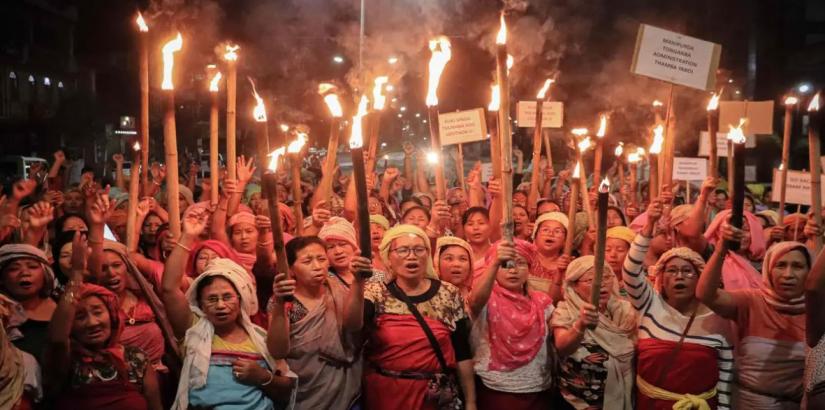
In conflict-prone regions, maternal peacebuilding has taken on even more visible forms. The Meira Paibi movement in Manipur, known as the “women torchbearers,” has shown how mothers can resist violence, protect communities, and demand accountability from both insurgents and the state.
Likewise, in Kashmir, mothers have emerged as powerful voices against cycles of conflict, often standing at the forefront of protests, vigils, and reconciliation efforts, embodying the pain of loss while advocating for peace and justice.
Taken together, these examples demonstrate that maternal peacebuilding is not alien to India; it is deeply embedded in our traditions and contemporary struggles, though often unnamed. By recognizing and valorizing these contributions, we can begin to see mothers not only as nurturers of families but as indispensable architects of social harmony.
Conflict Resolution as Moral Duty
The Talaandig women’s philosophy is rooted in empathy and relational responsibility. By seeing every child as “someone’s child,” they extend maternal care beyond the family to the entire community. This transforms conflict resolution from a technical exercise into a moral duty.
For India, where conflicts often arise from caste, communal, or ethnic divisions, the Talaandig model offers a fresh lens. Imagine if we consciously acknowledged mothers as peacebuilders in villages, urban neighborhoods, and even political spaces. Their lived experience of nurturing, mediating, and protecting could become a cornerstone of grassroots peace initiatives.
The Talaandig community taught me that peacebuilding is not only about treaties or negotiations—it is about everyday acts of care, empathy, and mediation. Mothers, by virtue of their roles, are uniquely positioned to prevent conflicts from escalating and to sustain harmony across generations.
India has its own legacy of maternal peacebuilding, from Jijabai to the Meira Paibi. What we lack is the language to celebrate and institutionalize these contributions. Recognizing mothers as peacebuilders is not just a cultural insight; it is a practical necessity for societies striving for harmony.
(The author is an Associate Professor, Department of Sociology, Christ (Deemed to be University), Bangalore. The views expressed are personal. She can be reached at sudhansubala.sahu@christuniversity.in )





Post a Comment