

Asymmetric Warfare via Migration: What India Can Learn from Spain’s Ceuta Crisis
Rightly, India is now treating mass irregular Rohingya migration as an engineered, hybrid national security threat that requires a coordinated border guarding, diplomatic, and legal response.
 Aug 01, 2026
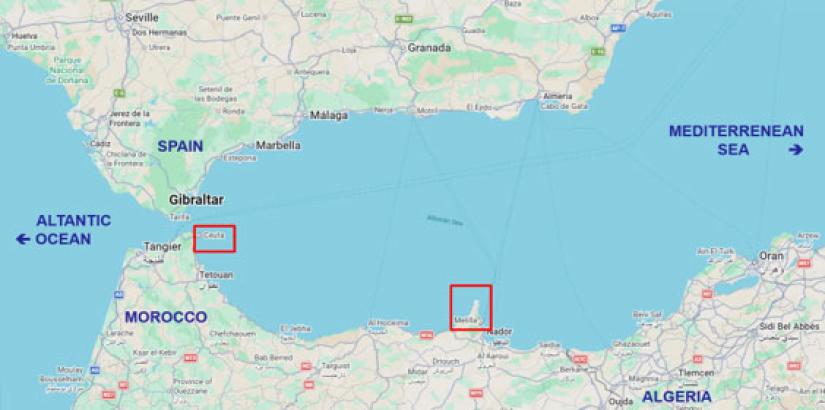
Between 30–31 July 2026, a sudden, unprecedented humanitarian and security crisis destabilised the borders of Ceuta, an 18.5 sq km Spanish autonomous city on the North African coast. Located on the Strait of Gibraltar, directly across from mainland Spain, Ceuta - alongside its sister city Melilla - serves as the European Union’s only land border with the African continent.
A sudden, massive influx occurred within this 48-hour window. Thousands of mostly young Moroccan and sub-Saharan men swam around maritime breakwaters or breached land border gates. This unexpected surge temporarily overwhelmed the border security infrastructure, which relied on just 55 Spanish border agents then on duty to secure the city frontier.
The chaos turned tragic when at least 18 to 34 migrants drowned attempting to swim around the Tarajal breakwater in rough waters. On the Moroccan side of the border there were violent clashes as Moroccan riot police deployed tear gas and water cannons to disperse the remaining crowds. Some vehicles and buses got burnt too.
Surge by Non-Citizen Irregular Migrants
Spain has possessed and continuously administered Ceuta since 1580 (nearly 450 years). It is legally recognised as an integral, sovereign territory of the Spanish State, not a colony.
The enclave maintains an intricate socio-religious balance. Out of a permanent population of roughly 83,000 citizens, the demographic makeup is split approximately 50/50 between Christian Spaniards and Spanish Muslims of Moroccan descent. They have peacefully coexisted as Spanish citizens for generations.
By comparison, mainland Spain features a population that is roughly 55% Roman Catholic, 3–4% practising other minority faiths (including Islam), and approximately 40–42% identifying as atheist, agnostic, or no religion / indifferent.
The sudden July 2026 surge was by non-citizen irregular migrants (overwhelmingly Muslim), looking to enter the European Union. Morocco has maintained a long-standing diplomatic claim over Ceuta, and routinely uses the permeability of the border as political leverage during diplomatic disputes with Madrid.
What Triggered the Surge
Domestic legal change è Deliberately distorted social media dissemination è Sudden shift to maritime route è Tactical overwhelm at Tarajal breakwater.
The crisis was not a military invasion, but a coordinated and engineered rush. It was driven by three distinct operational triggers -
The Supreme Court Legal Loophole: On 8 July 2026, Spain's Supreme Court ruled that maritime pushbacks (immediate turnbacks without legal processing) cannot legally apply to migrants intercepted at sea.
Information Space Weaponisation: Human trafficking mafia and social media syndicates rapidly distorted this judicial ruling. Viral videos on platforms like TikTok and Instagram falsely advertised that Spain had implemented an "open-border policy" for anyone arriving by water.
The Maritime Pivot: Driven by the mistaken belief that reaching Spanish waters guaranteed standard legal processing and immunity from immediate expulsion, tens of thousands rushed to the Moroccan town of Fnideq to swim across the short maritime gap to Ceuta's beaches. The surge was exacerbated since Moroccan border vigilance was relaxed during the country's national Throne Day festivities.
Madrid Maintained its Sovereignty
The Spanish government has strictly maintained its sovereignty. The Spanish military has been deployed alongside police divers and maritime vessels to re-secure the Tarajal breakwater.
As of midday 31 July 2026, over 25,000 of the estimated 40,000 to 60,000 migrants have already been repatriated back to Morocco under an emergency bilateral agreement. Hundreds of others are voluntarily walking back across the border due to a complete lack of shelter or state support.
Dissecting the Invisible Catalysts
The Ceuta incident exposes an evolving facet of international security:
Asymmetric "Leverage Diplomacy". Migration is no longer just a humanitarian issue; it is a tool of statecraft. By regulating the flow of human movement, transit nations can exert pressure on neighbouring states to extract financial aid, security concessions, or diplomatic recognition.
The Vulnerability of Liberal Judiciaries. A well-intentioned judicial ruling meant to protect human rights was immediately decoded with a slant, weaponised, and utilised by criminal networks, resulting in a mass border breach.
The Digital Acceleration. Propagation on social media acts as an accelerator for the border crises. Rumours move faster than states can deploy forces, expanding border defence from a physical confrontation to now include information warfare.
Intra-Continental Political Fracture. The event has triggered immediate diplomatic fallout across Europe. Hardline political factions in Italy and France have used the breach to demand the suspension of Spain from the Schengen free-travel zone, illustrating how localised border pressures can rapidly undermine broader regional alliances.
Lessons for Indian Policy Makers
As India manages its porous eastern frontiers and the Rohingya influx, the Ceuta crisis offers lessons:
Insulate Legal Frameworks from Exploitation: India must ensure its domestic immigration laws, refugee guidelines, and judicial rulings are airtight. Operational loopholes must be avoided, ensuring that legal grey areas cannot be weaponised by cross-border trafficking syndicates. Special Intensive Revision (SIR) of electoral rolls by the Election Commission of India (ECI) is indeed a timely step.
Proactive Information Management: The Ceuta breach proves that border security begins in the digital space. Indian intelligence and border forces (such as the BSF) must have dedicated digital monitoring cells to better pre-empt border breaches.
Countering Migration-as-a-Weapon (MaaW): This crisis echoes historical precedents like the 2015 European Migration Crisis (where over one million migrants moved simultaneously along Aegean and Balkan routes, completely paralysing central European asylum infrastructure) and the 2021 Belarus-EU Border Crisis (where the Belarusian state directly engineered an asymmetric crisis by flying in thousands of non-citizens and forcing them toward Polish and Lithuanian land boundaries to force concessions).
Rightly, India is now treating mass irregular Rohingya migration as an engineered, hybrid national security threat that requires a coordinated border guarding, diplomatic, and legal response. Of late, better cooperation between the Central and State government is visible and heartening.
(The author, an Indian Army veteran, is a strategic affairs commentator and former Security Advisor, Ministry of Home Affairs, Government of India and former Advisor, Government of Seychelles. The views expressed are personal. He can be reached at sanjayaggy1@gmail.com/ https://www.linkedin.com/in/brigsanjayagarwal/recent-activity/all/





Post a Comment