

Sentenced to Silence? Mahrang Baloch’s Life Imprisonment Raises Uncomfortable Questions for Pakistan
Despite the narrative of the Pakistani state, Mahrang Baloch’s international recognition grew through 2024. Time magazine included her in its TIME100 Next list of emerging influential figures, citing her advocacy against enforced disappearances while the BBC named her to its 100 Women list.
 Jun 28, 2026
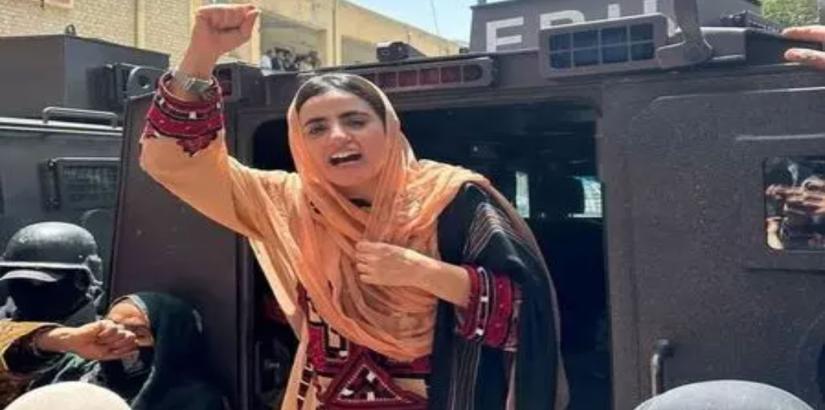
On 22 June 2026, Judge Muhammad Ali Mubeen of Anti-Terrorism Court (ATC) sitting in Quetta, capital of the restive Balochistan province in Pakistan, convicted Dr. Mahrang Baloch and three co-defendants of murder and unlawful assembly in connection with regards to the death of Frontier Corps (FC) Sepoy Shabbir Ahmed during a protest in Gwadar in 2024.
In the verdict as reported by Arab News, Baloch and fellow Baloch Yakjehti Committee (BYC) member Sibghatullah Shahji “were active participants of the unlawful assembly” and shared a “common objective” in the soldier’s killing, sentencing each “to imprisonment for life.”
Similarly, Baloch Students Organisation (BSO) chairman Balach Qadir and BYC central leader Abu Bakr Kalanchi received the same sentencing in the same proceeding.
According to a copy of the verdict acquired by Balochistan Pulse, Judge Muhammad Ali Mubeen ruled that the gathering organised by the BYC in Gwadar was not entitled to constitutional protection meant for peaceful gatherings under Article 16 of the Constitution.
It further stated, while Article 16 insures the right to peaceful assembly, that right remains subjective to legal restrictions and cannot be applied if violence is directed against state officials performing official duties. Additionally the court concluded that Frontier Corps personnel present at the site were in official capacity and classifying them as "occupiers" or "enemies" stripped the gathering of its constitutional protections. The court ruled that these actions constituted terrorism under the Anti-Terrorism Act, 1997.
It is imperative to mention, the “Baloch Raji Muchi” (Baloch National Gathering), organized by the BYC held in Gwadar in July 2024, focused on the enforced disappearances, extrajudicial killings, and resource exploitation in Balochistan.
According to reports, the official authorities opposed the gathering in Gwadar indicating security risks and CPEC-related foreign investments. The Provincial government officials claimed to have suggested Turbat or Khuzdar instead. However, according to reports, the organizers failed to heed the government’s warnings and proceeded with the Gwadar event. The prosecution’s case held that the crowd provoked by Baloch’s speeches attacked FC personnel Sepoy Ahmed while leaving sixteen injured. In response to the court ruling, Balochistan Chief Minister Sarfraz Bugti taking to social media stated that the justice had been delivered after two years of proceedings and that the slain soldier’s sacrifice would not be forgotten, while warning that violence and lawlessness in the province “would not be tolerated under any circumstances.”
The BYC characterized the verdict as “judicial tyranny” and an “open state” in a statement reported by the IANS news agency. The organization pointed out that two separate police reports (FIRs) were provided with several contradictions, such as the dates for Sepoy Ahmed’s death—July 27 and July 29. They cited this factor to expose the unreliability of the entire case.
Nadia Baloch, sister of Mahrang Baloch in her interview with Arab News, said the family’s lawyers had “refused to accept this decision,” emphasizing that the defence was not aware of the physical whereabouts of the judge, prosecutor, or witnesses during the proceedings, and censured the contradictory verdicts where the individual responsible for the death of the soldier was acquitted but the defendants charged with delivering speeches were handed life sentences. The defence has emphasized that it will appeal to Pakistan’s superior courts.
Raised in Violence
Born on 1 January 1993 in Manguchar, in Balochistan’s Kalat district, into the Langove tribe, Mahrang is the eldest of six children, five girls and one boy. Abdul Ghaffar Langove, her father, was a political activist employed by the Water and Power Development Authority (WAPDA). He raised issues pertaining to human rights violations in the province. According to reports, he was first detained by security forces in December 2009 and eventually released. However in mid-2011, he was again seized by the security forces and was found dead with visible signs of torture on his body. Upon the first disappearance of her father in 2009, the sixteen-year-old Mahrang began protesting immediately, burning her own school textbooks outside the Quetta Press Club demanding the return of her father.
She acquired her MBBS from Bolan Medical College in Quetta, and in 2020 led a successful student campaign against the removal of a regional admissions quota that protected access to the college for students from remote parts of Balochistan. In 2017, her brother Nasir was also detained. Mahrang led a campaign that led to his release.
Formation of BYC
The Baloch Yakjehti Committee (BYC), run by Mahrang Baloch, was conceived in July 2018, post her brother’s abduction by state forces. Several incidents reportedly led to the push for the formation and BYC’s activism. On 26 May 2020, armed men, reportedly to be associated with state-backed “death squad” killed a woman named Malik Naz Danuk. The victim was killed in the presence of her four-year-old daughter Bramsh, who was also shot and injured. This led to widespread outrage, protests, and the global “#JusticeForBramsh” campaign. The resulting campaign, the BYC, evolved over the following years.
In 2020, the assassination of exiled activist Karima Baloch in Canada and the killing of a Karachi University student, Hayat Baloch, by Frontier Corps gunfire further reinforced the BYC, a human rights platform acknowledged within Baloch nationalist politics by its explicitly women-led leadership.
In November 2023, after Balaach Mola Bakhsh's death in the custody of Balochistan’s Counter Terrorism Department (CTD) following weeks of enforced disappearance and a contested remand, BYC carried out a large campaign. Mahrang, accompanied by the relatives of the missing Baloch, organised a roughly 1,600-km “Long March” from Turbat to Islamabad. This culminated in a month-long sit-in at the National Press Club which drew sustained, if largely hostile, official attention. Later, mass rallies continued in Quetta in January 2024, and again at the Gwadar “Raji Muchi” gathering in July same year.
International Recognition, State Pushback
In a May 2025 press briefing, the Director-General of Inter-Services Public Relations (ISPR), Lt Gen Ahmed Sharif Chaudhry, called Mahrang Baloch a terrorist proxy. The BYC and Baloch have rejected this labelling. Despite the narrative of the Pakistani state, Mahrang Baloch’s international recognition grew through 2024. Time magazine included her in its TIME100 Next list of emerging influential figures, citing her advocacy against enforced disappearances while the BBC named her to its 100 Women list. The recognition appears to have set off an immediate state pushback, when at Jinnah International Airport, officials reportedly confiscated Mahrang’s passport and phone when she tried to travel to a Time-related event in New York. It was later reported that she had been placed on the Pakistan National Identity List, a registry reserved for suspects in terrorism, money-laundering, and fraud cases.
The Human Rights Commission of Pakistan called for her freedom of movement to be restored, and UN Special Rapporteur on Human Rights Defenders Mary Lawlor expressed their concern over the reported harassment. In March 2025, shortly before her arrest, Baloch announced on social media that she had been nominated for that year’s Nobel Peace Prize.
Statements of solidarity flowed from figures including Nobel laureate Malala Yousafzai and climate activist Greta Thunberg.
Countdown to Arrest
The events leading to Mahrang Baloch's arrest began on 11 March 2025, when the Balochistan Liberation Army (BLA) hijacked the Jaffar Express train carrying more than 380 passengers from Quetta to Peshawar. 354 hostages were freed and 33 attackers were killed according to the Pakistani government. After the authorities buried thirteen unidentified bodies, protests reignited by the Baloch families seeking identification. On 21 March 2025, demonstrators entered the hospital and removed several bodies.
Mahrang Baloch stated that forensic identification was critical because of longstanding allegations that victims of enforced disappearance are sometimes later presented as militants or terrorists. On 22 March, police acted against a BYC sit-in on Quetta's Sariab Road. According to the BYC, the police opened fire on peaceful protesters, while authorities claimed demonstrators attacked officers with stones.
Mahrang Baloch was arrested under the Maintenance of Public Order Ordinance.
Since March 2025, Baloch has been held in Hudda District Prison in Quetta. She and fellow detainees have alleged physical abuse, including a reported assault by police and Counter Terrorism Department personnel in April 2025.
Human rights groups have raised concerns about her treatment. Amnesty International reported in March 2026 that she developed a serious spinal condition in custody and was repeatedly denied adequate medical care. Bail requests by Baloch and several co-defendants were also repeatedly rejected. In January 2026, her lawyers, Imaan Mazari-Hazir and Hadi Ali Chattha, were also arrested and later convicted under Pakistan's cybercrime laws for social-media posts supporting her release. The Pakistani authorities stated that the posts glorified a proscribed individual who had been placed on the Anti-Terrorism Act's Fourth Schedule. Journalist Sohrab Barkat was also arrested in connection with related reporting.
Competing Narratives
Pakistani authorities argue that the BYC is closely associated with or exploited by, militant organisations such as the BLA. Officials claim that the individuals highlighted by the BYC as missing persons were later claimed by the BLA as fighters. They also cite the Civil Hospital incident and earlier protest violence as evidence that BYC activities have facilitated militant objectives.
The BYC's Position
Mahrang Baloch and the BYC reject all allegations of militancy. They maintain that the movement is peaceful and operates within Pakistan's constitutional framework. The organisation argues that the cases against its leaders are politically motivated efforts to criminalise dissent and suppress protests.
Another conflicting narrative can be seen also in case of the numbers reported of the Missing Baloch.
Pakistan's Commission of Inquiry on Enforced Disappearances claims to have recorded approximately 10,000 cases nationwide since 2011, including roughly 2,700 in Balochistan. Officials say many cases have been resolved.
Baloch rights groups, however, estimate that more than 21,000 people have disappeared since 2005 and report hundreds of disappearances and extrajudicial killings each year. Human rights organisations argue that many cases go unreported due to fear and that official figures undercount the problem. The true scale of the number of disappearances remains a much contested topic.
Human rights monitors have also suggested that the practice of enforced disappearance is built around an absence of paperwork by design, that many families do not report disappearances at all for fear of reprisal, and that government bodies often count a case as “resolved” the moment a person briefly resurfaces, even into further detention.
The Islamabad High Court found in January 2021 that the prime minister and his cabinet were accountable for the state’s failure to prevent the forced or arbitrary detention. However, in June 2025, the Balochistan Assembly passed legislation permitting detention without charge for up to three months, and in October 2025 dozens of activists, including BYC figures, were placed under Section 11-EE of the Anti-Terrorism Act (a provision which has been described as functioning as an informal terror watch list).
A Major Turning Point?
The ruling of ATC on Mahrang Baloch may mark a major turning point in the conflict between the Pakistani state and the Baloch rights movement. The Pakistani state projects the prosecution as a response to security threats and alleged links to militancy, while the arrest of Baloch and her supporters is viewed as an attempt to silence a peaceful campaign against enforced disappearances by others.
Mahrang Baloch’s detention has drawn sharp criticism from international human rights organisations such as the UN and Amnesty International.
PEN Norway and the Narges Foundation, the rights organisation run by Iranian Nobel laureate Narges Mohammadi, issued a joint statement saying the use of closed proceedings and video-link hearings “raised serious questions over judicial transparency, due process and compliance with domestic and international fair-trial standards,” adding that such arrangements “undermine confidence in judicial independence, accountability, and the right to a fair and public hearing.”
The likely scenario in case of Mahrang’s detention may be more appeals to the Balochistan High Court and potentially Pakistan’s Supreme Court from the defence counsel, followed by continued proceedings in separate cases related to the Quetta Civil Hospital protests and alleged support for a proscribed organisation and the likelihood of continued protests and mobilisation by the BYC.
Whether Mahrang Baloch has been sentenced for criminal conduct or silenced for challenging the state’s narrative remains fiercely debated. It is apparent that her life sentence has transformed her case from that of a single activist into a wider struggle over dissent, accountability and enforced disappearances in Balochistan.
(The writer is the Co-Founder of The Strategic Perspective and an independent researcher and analyst specializing in Af-Pak affairs, counterterrorism, and regional security. The views expressed are personal)




Post a Comment