

Rubio's India Visit: Convergence of Strategic Interests and Shared Concerns over China
However, the visit clarified one important reality: despite periodic friction over trade, tariffs, Russia, immigration, or strategic autonomy, neither India nor the United States presently has the luxury of disengagement. The relationship may no longer carry the earlier romanticism of “natural allies,” but it continues to be driven by geopolitical realities - energy security, China’s rise, maritime stability, technology supply chains, and the changing balance of power in the Indo-Pacific.
 May 27, 2026
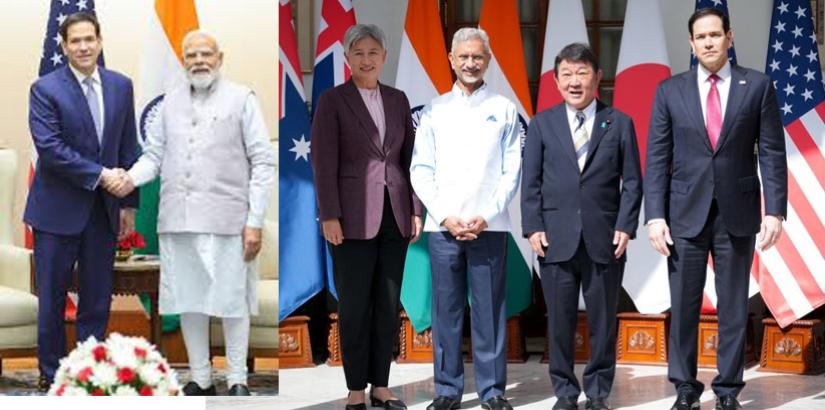
The four-day visit of U.S. Secretary of State (also officiating NSA) Marco Rubio was significant in many ways. Apart from participating in the QUAD Foreign Ministers’ meeting, Rubio held extensive discussions on several bilateral issues, many of them contentious. Visits of this nature usually indicate that the relationship is being viewed in a broader strategic context rather than through the prism of a single issue.
India-U.S. relations had remained broadly on an even keel for nearly twenty-five years, and it was generally assumed that this trajectory would continue during Trump’s second term. The Biden administration had earlier lavished considerable attention on India as a vital strategic partner and hosted PM Modi during a high-profile state visit in 2023. Trump too welcomed Modi to the White House early in his second term before imposing steep tariffs that disrupted the momentum in bilateral ties.
The bonhomie, however, proved short-lived for a variety of reasons - trade disputes, tariffs, and the fallout from Op Sindoor, the brief India-Pakistan conflict during which Trump claimed credit for mediation efforts that India rejected outright. For India, Trump’s recent visit to China further amplified concerns regarding the possible direction of U.S. strategic priorities.
Kolkata Visit and Symbolism
Rubio arrived in Kolkata on Saturday morning before travelling to New Delhi. His arrival ended a fourteen-year gap since a serving U.S. Secretary of State last visited Kolkata, making him the first top American diplomat to travel to the city since Hillary Clinton visited in 2012.
He later visited the headquarters of the Missionaries of Charity and Nirmala Shishu Bhavan, the children’s home for orphans run by the organisation. The Kolkata leg of the visit highlighted the softer humanitarian and cultural dimensions of diplomacy before the focus shifted to strategic and geopolitical discussions in New Delhi.
Modi-Rubio Discussions
Rubio later met PM Narendra Modi in New Delhi, where he reportedly “underscored the strategic importance of the U.S.-India partnership,” according to the U.S. State Department. The discussions covered regional and global peace and security, apart from broader strategic cooperation. Rubio also extended an invitation from the White House to PM Modi, according to U.S. officials.
The talks additionally focused on the ongoing U.S.-Israeli conflict with Iran. According to the American statement, Rubio emphasised that the United States would not allow Iran to “hold the global energy market hostage” and pointed to the potential of U.S. energy exports in diversifying India’s energy supplies.
India has been significantly affected by the ripple effects of the conflict. Tensions in the Strait of Hormuz have contributed to concerns over energy supplies and shipping disruptions, while also complicating U.S. efforts to reduce India’s dependence on Russian oil.
PM Modi’s office stated that India reiterated its support for peace efforts and stressed the need to resolve conflicts through dialogue and diplomacy. India has largely maintained a pragmatic position on the conflict - urging peace while refraining from joining those openly denouncing the U.S. and Israeli strikes that triggered the war.
Strategic Alliance Emphasised
Rubio also held bilateral discussions with External Affairs Minister Subrahmanyam Jaishankar, with both sides seeking to reinforce the strategic partnership even as underlying tensions remained visible.
During the joint briefing, Rubio repeatedly stressed that India remained a crucial “strategic partner” for the United States and clarified that policies relating to trade, immigration, sanctions, and visas under the Trump administration were global in scope rather than directed specifically at India.
Emphasising this point, Rubio stated: “I don’t view our relation with any country in the world as coming at the expense of our strategic alliance with India.” He further remarked: “There virtually is no country in the world that I could travel to that isn’t going to raise the issue of immigration to the USA.”
Jaishankar observed that the India-U.S. relationship rested on a convergence of national interests across multiple sectors. Referring to Washington’s foreign policy posture, he remarked: “The Trump administration has been very forthright in putting forward its foreign policy outlook as America First. ... We have a view of India First.”
On energy security, Jaishankar reiterated India’s requirement for reliable and affordable energy sources while making it clear that India would continue diversifying its energy basket.
Analysts suggest that recent statements from Washington on trade and security matters have contributed to a degree of trust deficit in the relationship. Rubio’s visit is therefore being viewed more as an effort to stabilise ties than as a breakthrough moment.
The relationship also continues to be shaped by India’s longstanding ties with Russia, an aspect that periodically complicates engagement with Washington. At the same time, the continued relevance of the QUAD reflects the shared concerns among the four nations regarding China’s growing strategic assertiveness in the Indo-Pacific region.
The Cultural Aspect
The cultural dimension of the visit was also prominently visible. The U.S. Embassy’s America250 gala at Bharat Mandapam brought together Rubio, Jaishankar, diplomats, business leaders, and senior officials, with President Trump joining virtually and internationally known music composer A. R. Rahman delivering the evening’s finale.
On May 25, Rubio, accompanied by his wife Jeanette Rubio, visited the iconic Taj Mahal and the historic Amber Fort.
These engagements highlighted the softer cultural dimension of Rubio’s India tour, which otherwise focused heavily on trade, defence, energy, and geopolitical affairs. Such visits are reminders that diplomacy is not confined merely to negotiations and strategic alignments. Civilisational heritage and people-to-people interactions remain important instruments of soft power.
The QUAD Meeting
The QUAD meeting once again underlined the strategic importance of the Indo-Pacific region and the emerging alignment among the United States, India, Australia, and Japan.
The partners announced fresh cooperation in maritime security and critical minerals. Rubio emphasised that the QUAD comprised democracies sharing common values, similar developmental approaches, and aligned strategic interests.
The meeting assumed added significance coming barely days after Trump’s visit to China, during which he spoke positively about closer cooperation between the world’s two largest powers, a “G2” concept viewed cautiously by many U.S. partners.
The QUAD members reiterated plans to work together on maritime initiatives, including combining surveillance capabilities and improving real-time information sharing for commercial maritime traffic. Australian Foreign Minister Penny Wong also announced QUAD cooperation on port development assistance in Fiji, where China has steadily expanded its influence.
Another major focus area was securing supply chains for critical minerals, increasingly seen as vital for advanced technologies, clean energy systems, electronics, and defence manufacturing.
Has Anything Changed?
Probably not dramatically - at least not immediately.
However, the visit clarified one important reality: despite periodic friction over trade, tariffs, Russia, immigration, or strategic autonomy, neither India nor the United States presently has the luxury of disengagement.
The relationship may no longer carry the earlier romanticism of “natural allies,” but it continues to be driven by geopolitical realities - energy security, China’s rise, maritime stability, technology supply chains, and the changing balance of power in the Indo-Pacific.
In diplomacy, sometimes the most important outcome of a long visit is not a dramatic announcement, but the reassurance that channels remain open and engagement continues.
(The author is an Indian Army veteran and a contemporary affairs commentator. The views are personal. He can be reached at kl.viswanathan@gmail.com )







Post a Comment