

From Protectorates to Partners: The US Resets Security Expectations in Asia
The central message at the Shangri-La Dialogue is that America is staying, but on new terms. It will remain the core military balancer in the Indo-Pacific, but it expects allies and partners to become serious contributors. The era of strategic free-riding is ending. The new Indo-Pacific order will increasingly be defined by those willing and able to share the burden of preserving it.
 Jun 22, 2026
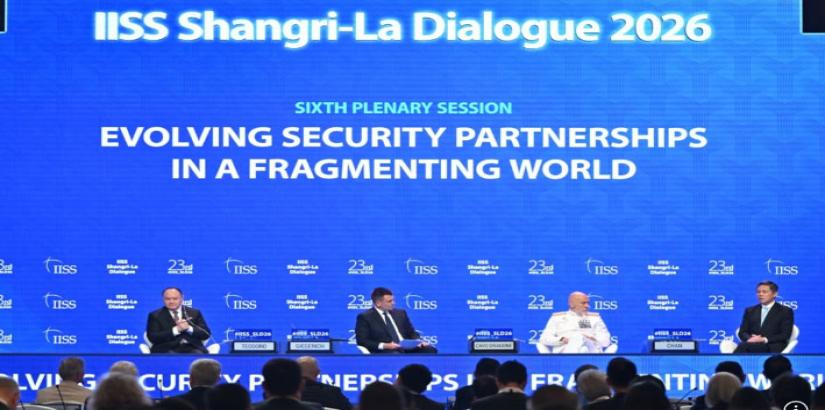
The recently concluded Shangri-La Dialogue in Singapore reaffirmed a new shift in power calculations and strategic intent in the region, with various messages and narratives reinforcing both commitments and the guardrails and red lines that are being upheld. This new era of power competition and strategic wariness has seen countries across the region scrambling to seek assurances and safeguards.
The message sent by the United States through Secretary of Defense Pete Hegseth’s address was direct, calculated and strategically consequential: America is not retreating from the Indo-Pacific, but it is no longer prepared to carry the region’s security burden almost alone.
This has forced the region to confront a new reality. The old model of American protection—where many regional states benefited from Washington’s deterrence and security umbrella while contributing only limited military weight of their own—is now coming to an end.
The message behind Hegseth’s formulation that Washington wants “partners, not protectorates” represents a strategic adjustment, not abandonment.
The US wants a more disciplined and militarily credible network that can help preserve the balance of power, while trying to reassure a region that has grown wary of the future commitment of the Trump administration as it recalibrates ties with Beijing.
Many in the region have been wondering whether the second Trump administration’s approach to China, trade and alliance politics would weaken US resolve in Asia. Its presence and messaging in Singapore were designed to answer those doubts, essentially signalling that the US remains committed, but expects relationships to become more balanced and mutually beneficial.
The broader message was that despite the strains and distractions in Europe, the Western Hemisphere and West Asia, Washington continues to see Asia as the arena where the future global balance of power will be determined.
This will become even more significant in the post-Trump era, when the elements of deterrence and power projection may not remain the same, particularly as other powers pursue different calibrations and ambitions for regional dominance.
Rebuilding Deterrence Through Denial
The second message from the US at the Dialogue was that deterrence must increasingly be rebuilt not through rhetoric but through deterrence by denial.
This is being advanced as a strategy to complicate any attempt by a major power to achieve quick military success, especially in disputed areas and strategic zones such as the First Island Chain and the South China Sea.
In practical terms, this translates into a more distributed deployment strategy, stronger access arrangements, more resilient bases, deeper logistics networks, enhanced maritime domain awareness and more integrated joint operations with allies and partners.
The strategic content was unmistakable: the US will not allow a single power to impose regional hegemony or dominate Asia’s maritime order.
Allies Will Be Judged by Capability, Not Sentiment
The third message is that allies in the region will increasingly be judged by capability and their readiness to share burdens and obligations, rather than sentiment.
A tiered partnership model is becoming more evident, prioritising countries that commit more resources and integrate more deeply into broader US strategic systems.
In other words, the traditional mechanism of one-sided security dependence will no longer suffice. Countries that rely on American deterrence while avoiding serious defence commitments are now expected to do more. Otherwise, they may find themselves becoming less central to Washington’s strategic planning.
This may not pose a major challenge for established allies such as Japan, South Korea and the Philippines, which are already increasing their defence commitments. However, it will have significant implications for countries in Southeast Asia that remain underinvested and continue to practise strategic hedging.
Regional players will increasingly be expected to strengthen maritime security, coast guard capabilities, cyber resilience, undersea domain awareness and defence industrial cooperation.
Even if they continue to embrace non-aligned rhetoric, they cannot escape the reality that regional security is becoming more operational, more technological and increasingly driven by hard power.
The US message is clear: countries that want a stable balance of power and credible deterrence must help build the material foundations that sustain them. These include ships, radars, drones, secure communications, joint training and defence readiness.
Convergence of Economics, Technology and Security
Another strategic message is that economics, technology and defence are now inseparable and more interdependent than ever before.
Regional security is no longer solely about military bases or naval deployments. It now encompasses supply chains, defence production, semiconductors, energy security, critical minerals, subsea cables, cyber systems and a range of emerging sectors that are deeply interconnected.
Undersea warfare is also gaining greater prominence, with nations scrambling to strengthen protection and deterrence measures. From undersea cables that carry the overwhelming majority of global data traffic to submarine warfare capabilities, the seabed itself is becoming a contested strategic domain.
The Malacca Strait, Singapore Strait, South China Sea and the surrounding seabed networks are no longer merely commercial routes. They have become strategic lifelines situated at the intersection of global security and trade.
ASEAN’s Strategic Dilemma
The overall tone presented by the US at the Dialogue was that America is willing to engage China, but from a position of strength.
The speech did not close the door to US-China engagement and, in fact, reflected a softer tone compared with previous years, signalling that Washington wants to reduce miscalculation and preserve military-to-military communication channels.
ASEAN states, however, will continue to face a difficult balancing act. They want and need US power to remain in the region, but they also want to avoid being perceived as instruments of US containment.
They want access to China’s markets, but they fear Chinese coercion. They seek strategic autonomy, but autonomy without capability ultimately becomes a vulnerability.
The US message therefore exposes ASEAN’s central dilemma. ASEAN centrality remains an important diplomatic platform, but it is insufficient as a security shield.
If ASEAN cannot build genuine capacity and deterrence in maritime security, cyber defence, undersea infrastructure protection and crisis coordination, external minilateral structures will continue to emerge as necessary mitigation platforms, forcing ASEAN to rely on external support.
America Is Staying, But on New Terms
The central message at the Shangri-La Dialogue is that America is staying, but on new terms.
It will remain the core military balancer in the Indo-Pacific, but it expects allies and partners to become serious contributors.
At the same time, the roles played by existing allies—particularly Japan, South Korea and the Philippines—will become even more important than those of the more hesitant countries in the region when it comes to deploying direct, rapid and dependable responses to regional conflicts and crises.
These allies constitute the first layer of deterrence, leveraging their geographical advantages, infrastructure and time-sensitive capabilities to complement US deterrence measures and rapid-response mechanisms.
The era of strategic free-riding is ending. The new Indo-Pacific order will increasingly be defined by those willing and able to share the burden of preserving it.
(The author is a Kuala Lumpur-based strategic and security analyst. Views expressed are personal. He can be contacted at collins@um.edu.my.)





Post a Comment