

Pakistan Takes Indus Water Issue to Brussels: Internationalising Dispute has Implications Beyond South Asia
The CEPS conference shows Pakistan is shifting the Indus issue from technical water management to geopolitical norm contest. That’s the key transition. Once a river dispute enters Brussels policy networks, international arbitration, climate diplomacy, and security discourse it becomes much harder to keep it bilateral. And that is likely Pakistan’s main strategic objective.
 Jun 21, 2026
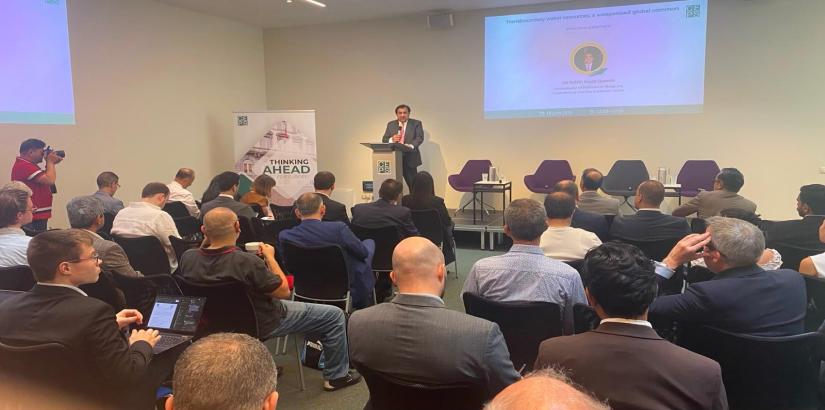
Pakistan is trying to get European policymakers, legal scholars, and climate institutions to see the Indus river water-sharing dispute as a humanitarian issue, a climate adaptation issue and a global commons issue. This is the most important takeaway from the recent Brussels seminar on Indus water.
The event—“Transboundary Water Resources: A Weaponised Global Common”—was held on Thursday 18 June in Brussels co-organised by the think-tank called Centre for European Policy Studies (CEPS ) and Pakistan’s Mission to the EU.
It explicitly framed shared rivers as a security, climate, and legal issue, with the Indus basin as the central case study. The conference sees the Indus dispute inside three international policy baskets: climate vulnerability, rule of law and conflict prevention.
Brussels matters because it is the de facto policy capital of the EU and holding it there serves in Europeanising the issue. This matters because the EU often shapes international legal narratives before formal UN action.
Pakistan's Europe Strategy
The event is worth reading not just as an academic seminar, but as part of Pakistan’s broader diplomatic strategy on the Indus dispute. The seminar’s title itself—weaponised global common—is strategically chosen. That language implies coercion, strategic withholding weaponization of environmental resources.
This seminar also points to a broader geopolitical development. Pakistan’s gradual re-entry into European policy conversations after a period of relative marginalisation following the UK’s departure from the European Union in January 2020. The United Kingdom historically served as Pakistan’s most natural political bridge into Europe.
For decades, the UK’s role inside the European Union gave Pakistan indirect access to EU institutions through: political networks , diaspora connections, parliamentary alliances, trade diplomacy.
Equally important was the presence of British politicians of Pakistani heritage in the European political scenery, who often helped amplify Pakistani concerns on issues such as Kashmir, trade preferences, and regional security.
While Members of the European Parliament (MEPs) are elected nationally, British political representation—before Brexit—gave Pakistan an informal but influential channel into Brussels.
Brexit disrupted that and the Pakistani diaspora’s institutional influence in Brussels became less direct. Islamabad’s ability to shape EU discourse through London diminished. This created a diplomatic gap.
For several years, Pakistan’s visibility in Brussels declined relative to its earlier influence, especially as the EU’s South Asia focus shifted more toward strategic engagement with India.
In that sense, the Indus conference is not just about water. It reflects Pakistan adapting to a new European landscape and building thematic coalitions inside Brussels itself.
That is an important shift. It suggests Pakistan recognises that to regain influence in Europe, it must align its diplomatic narratives with the EU’s own priorities—climate resilience, human security, and rule-based international order.
Internationalising Indus Issue
The CEPS conference suggests Pakistan is rebuilding presence through issue-based diplomacy rather than old political networks. Instead of relying on British intermediaries, Pakistan is now trying to enter EU debates through climate security and humanitarian law.
Deterrence is no longer just about water. It intersects with climate change, food security, energy security and strategic coercion. This is contemporary European language which the EU political landscape cherishes to listen to.
It is designed for Brussels’ post-Brexit institutional environment, where legitimacy increasingly comes from policy framing rather than diaspora-driven political access.
India’s position remains that the Indus Waters Treaty already has dispute-resolution mechanisms and should not be “externalised.” So to India, such conferences may be seen less as conflict resolution and more as reputation shaping.
The CEPS conference shows Pakistan is shifting the Indus issue from technical water management to geopolitical norm contest. That’s the key transition.
Once a river dispute enters Brussels policy networks, international arbitration, climate diplomacy, security discourse it becomes much harder to keep it bilateral. And that is likely Pakistan’s main strategic objective.
Water is increasingly being treated as a geopolitical instrument, much like trade or energy. For Pakistan, internationalising the dispute is about preventing water from becoming a unilateral strategic weapon.
For India, resisting internationalisation is about preserving sovereign flexibility.
Significance for South Asia
That’s why this case matters far beyond South Asia, it could shape how future transboundary river disputes are handled globally.
The first panel of the seminar focussed on the climate-society nexus, with special emphasis on Pakistan’s climate vulnerability and flooding and the responsible implementation of transboundary water agreements.
The second panel addressed transboundary cooperation by integrating rule-of-law perspectives, keeping in view the Indus Waters Treaty and bringing in examples from European water-sharing experiences
In a video recorded message to the seminar as the keynote address , Pakistani Foreign Minister Ishaq Dar noted that the Indus Treaty has survived three major conflicts and numerous challenges over more than six decades and called for enhanced international cooperation on water security, particularly in light of Pakistan’s acute climate vulnerability.
He also said the issue extended beyond South Asia, arguing that respect for treaty obligations was a global imperative and essential for regional stability and prosperity.
One of the main speakers was Feisal Hussain Naqvi, who has represented Pakistan in Indus-related arbitration. That signals this wasn’t only political messaging—it was linked to active legal strategy, water governance, transboundary justice.
Additionally, the seminar brought together Pakistan’s Federal Minister for Climate Change and Environmental Coordination, Dr. Musadik Masood Malik; Policy Officer, Water Europe, Ms. Madalena Cepeda; Senior Researcher at Utrecht University in the Netherlands, Ms. Cathy Suykens; international arbitration expert and former counsel for the Government of Pakistan in Indus Waters Treaty matters, Feisal Hussain Naqvi; Head of Climate Programme, Centre for European Policy Studies (CEPS), Isabel Scheckenbach; and Founder of Captiv8 Strategies and Editor of The Pakistan Playbook, Danish Qayyum.
Water Europe is a network of professionals and organizations that aim for building a water secure, sustainable, and resilient water-smart society across Europe and beyond.
(The author is an Indian journalist and long-time resident of Brussels who has been covering European and EU affairs for the past 40 years. Views expressed are personal. He can be reached at nawab_khan@hotmail.com. X: @NawabKhan10)





Post a Comment