

Colombo to Kathmandu, China Seeks to Counteract US Moves Across South Asia
While Washington and New Delhi seek to strengthen bilateral ties with Colombo, Beijing has strategically engaged with the political forces that control the government. By engaging directly with actors at the core of Sri Lanka’s governance, Beijing appears to be signalling its strategic intent—projecting influence and reinforcing ideological ties.
 Jun 28, 2026
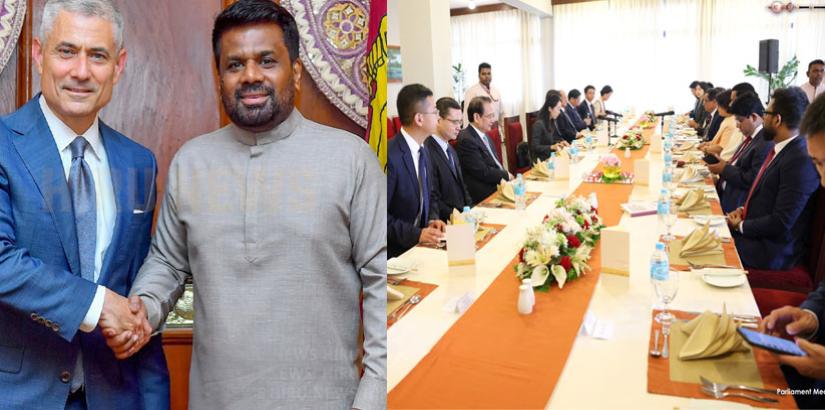
On 22 June, Washington underscored its commitment to deepening ties with Colombo by announcing the provision of a Fleet Broadband satellite communications system valued at approximately US$4 million (over Rs. 1.2 billion) for the Sri Lanka Navy. The announcement, delivered by U.S. Assistant Secretary of State for South and Central Asian Affairs Dr. S. Paul Kapur during his visit to SLNS Gajabahu at the Port of Colombo, highlighted the strategic importance the United States attaches to Sri Lanka’s role in safeguarding Indian Ocean security, particularly at a time of growing concern over China’s expanding footprint in the region.
Kapur described the system as “a transformational upgrade for the Sri Lanka Navy,” noting that the secure, real-time connection will be deployed across the fleet of offshore patrol vessels. “It will allow our Sri Lanka partners to respond quickly to emergencies, protect the cargo ships that fuel our economy, and disrupt illegal activity across the Indian Ocean before it reaches our shores,” he said.
Sri Lankan representatives, in turn, emphasised that the new capability significantly enhances maritime domain awareness, strengthens defence cooperation with the United States, and reaffirms the Navy’s vital role in monitoring activity along some of the world’s busiest shipping routes.
Washington Deepens Strategic Engagement
Kapur’s three-day visit to Colombo coincided with the arrival of other senior U.S. officials, including Pacific Air Forces Commander General Kevin Schneider, whose engagements centred on defence, security, and economic cooperation. These parallel visits highlight Washington’s growing emphasis on Sri Lanka amid mounting concerns over Chinese expansion in the Indian Ocean.
According to the U.S. Embassy in Colombo, the series of meetings reflects President Donald Trump’s commitment to strengthening partnerships that advance American prosperity and security, while deepening cooperation with Sri Lanka as a key Indian Ocean partner.
During his meeting with President Anura Kumara Dissanayake, Kapur expressed satisfaction with the current level of cooperation and reaffirmed Washington’s determination to further consolidate bilateral relations. Dissanayake, in turn, reiterated Sri Lanka’s commitment to supporting regional peace and stability, signalling Colombo’s willingness to engage constructively with international partners while navigating the complex strategic environment of the Indo-Pacific.
The U.S. strategic focus on Sri Lanka is not new. During his visit to Colombo, then Secretary of State Mike Pompeo bluntly described the Chinese Communist Party (CCP) as a “predator.” He added: “We see from bad deals, violations of sovereignty, and lawlessness on land and sea that the Chinese Communist Party is a predator, and the United States comes in a different way. We come as a friend and as a partner.”
This statement underscored Washington’s perception of Beijing’s influence in South Asia.
China's Expanding Strategic Footprint
China’s role remains central to this narrative. In testimony before the U.S. House Foreign Affairs Subcommittee on South and Central Asia, Dr. S. Paul Kapur observed that “defence cooperation with the United States helps [Sri Lanka] protect their borders and waterways against encroaching powers.”
During the hearing, Kapur emphasised that Sri Lanka’s geographical position gives it “outsized importance” in the Indo-Pacific and cautioned against Chinese coercion through predatory lending, citing the 99-year lease of Hambantota Port as a prime example. “We need to be able to offer high-quality, transparent, non-coercive alternatives,” he said, pointing to U.S. financing mechanisms, technology, and private enterprise as tools to counter Beijing’s strategy.
China’s engagement with Sri Lanka has been evident since the Rajapaksa era, when Beijing leveraged the final phase of the civil war to deepen ties with Colombo. While its moves have appeared more restrained in recent years, Beijing continues to signal its expansionist agenda and readiness to compete with the United States in the Indo-Pacific.
Symbolic Diplomacy and Political Messaging
Just days before Kapur’s visit, on 20 June, Chinese Ambassador Qi Zhenhong met Tilvin Silva, the influential Secretary of the JVP, which played a decisive role in shaping Colombo’s foreign policy direction. During the meeting, the Ambassador presented Silva with the fifth volume of The Governance of China by Xi Jinping and discussed educational programmes for JVP and NPP members.
The symbolism of this gesture is striking. While Washington and New Delhi seek to strengthen bilateral ties with Colombo, Beijing has strategically engaged with the political forces that control the government. By engaging directly with actors at the core of Sri Lanka’s governance, Beijing appears to be signalling its strategic intent—projecting influence and reinforcing ideological ties.
The question that arises is clear: What message is China sending to Washington through such aggressively choreographed diplomacy?
A Wider Regional Pattern
This assertive Chinese approach was already evident in Kathmandu, where a similar dynamic unfolded during the visit of Paul Kapur. On the same day Kapur arrived in Nepal, Cao Qing, Deputy Director of the Asian Affairs Department at China’s Ministry of Foreign Affairs, also visited and held high-level meetings.
According to sources, Kapur met separately with Rastriya Swatantra Party (RSP) chairman and senior leaders, raising concerns over the security and management of Tibetan refugees. Cao, meanwhile, voiced similar concerns but framed them from Beijing’s perspective, particularly in relation to recent visits by representatives of the 14th Dalai Lama.
The pattern is apparent: China continues to position itself to counter U.S. moves across South Asia, signalling a determined strategy of competitive power play. Against this backdrop, Sri Lanka’s ability to genuinely contribute to peace and stability in the region remains uncertain, particularly as Beijing attempts to entrench its influence in Colombo.
If such engagement persists unchecked, the aspiration of maintaining the Indian Ocean as a “zone of peace” will remain confined to paper declarations.
(The author is Founding Director, Centre for Strategic Studies–Trincomalee (CSST), Sri Lanka, and a geopolitical analyst. The views expressed are personal. He can be contacted at jjathi@gmail.com / director@trincocss.org / www.trincocss.org)





Post a Comment