

China's Nuclear Disarmament Diplomacy and its Expanding Strategic Arsenal
The unprecedented scale of China's nuclear infrastructure build-up increasingly raises questions about whether this represents strategic balance or strategic hypocrisy. As Beijing's capabilities grow, so too will international scrutiny of the widening gap between its disarmament discourse and its nuclear realities.
 Jun 26, 2026
Beijing has consistently framed its nuclear posture as uniquely self-defensive and oriented toward the eventual abolition of nuclear weapons. Its April 2026 Nuclear Non Proliferation Treaty National Report (NPTNR) exemplifies this: China "advocates the complete prohibition and thorough destruction of nuclear weapons," commits to a "nuclear strategy of self-defense," and insists it "will never engage in a nuclear arms race with any other country"
Yet the material evidence presents a more complicated picture. Satellite imagery reviewed by Reuters in May 2026 highlighted the expansion of Beijing’s strategic infrastructure in the remote Xinjiang desert, particularly around the Hami nuclear silo fields. Analysts at the Federation of American Scientists and the Carnegie Endowment for International Peace described the scale of these developments as an “extraordinary effort” in strategic hardening, raising questions about the consistency between China’s declaratory policies and its evolving nuclear posture.
China's Declaratory Framework: No-First-Use as a Legitimising Anchor
The centrepiece of China's nuclear diplomacy is its declared NFU policy. The 2026 NPTNR states China is "the only country among the five nuclear-weapon States" to have committed to NFU "at any time and under any circumstances" . The 2025 White Paper describes this as China's "greatest contribution to international nuclear arms control." The rhetorical function is considerable: NFU permits Beijing to present any defensive modernisation — expanded silos, warhead increases, hardened infrastructure — as inherently non-threatening. Yet the very infrastructure that strengthens second-strike survivability simultaneously enhances China's capacity to retaliate at scale, which is itself a form of escalation dominance. This circularity is rarely interrogated in multilateral settings.
Minimum Deterrence and the Sequencing Argument
China's second pillar is minimum deterrence- the assertion that its forces are maintained at the lowest level consistent with national security. The NPTNR cites the closure of nuclear facilities in Chongqing and Qinghai as evidence of restraint, yet these decisions date to the 1980s and 1990s, when China was a comparatively minor nuclear power. Invoking them as proof of present restraint is analytically questionable. The 2025 White Paper (WP) similarly asserts China has "always exercised the utmost restraint" — a claim the material record increasingly undermines.
China's third rhetorical pillar conditions disarmament on others acting first. The NPTNR insists that states "possessing the largest nuclear arsenals should continue to fulfil their special and primary responsibility for nuclear disarmament" before China is required to participate. Since the United States and Russia are unlikely to reduce Chinese force levels in any foreseeable diplomatic horizon, this sequencing condition functions as a structural exemption. Applied symmetrically, such logic would justify any state's expansion so long as a larger power exists above it — a logic that quietly undermines the NPT regime.
Transparency as Performance
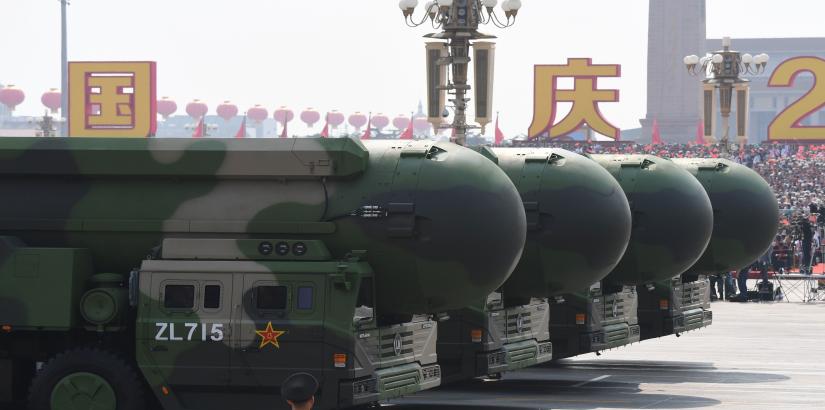
China's 2025 military parade, which publicly unveiled its nuclear triad for the first time — including the JingLei-1 air-launched missile, JuLang-3 submarine-launched ICBM (Intercontinental Ballistic Missile), and DongFeng-61 land-based ICBM — is cited in the National Report as a transparency measure. The March 2026 Seminar on Promoting Multilateralism and Advancing Arms Control Diplomacy, organized by China's Ministry of Foreign Affairs, brought diplomats from nearly twenty countries to the decommissioned 816 nuclear facility in Chongqing. Beijing presented the visit as evidence of its commitment to transparency and openness in nuclear affairs. Yet China continues to resist disclosure of warhead numbers, fissile material stocks, or force deployment configurations — the data that would constitute genuine verification. The National Report explicitly argues that NFU and peaceful development are "the most practical measure of transparency", redefining transparency as a declaration of intent rather than a disclosure of capability.
The Material Reality
The most significant development in China's nuclear programme is the expansion of its warhead stockpile and silo infrastructure. The US Department of Defense's latest annual report assesses China is on track to field approximately 1,000 warheads by 2030, with around 100 ICBMs already loaded across its three main silo fields — a substantial acceleration from the 200–300 warheads estimated in the early 2020s. US officials and arms-control analysts have concluded China is expanding its nuclear capabilities faster than any other nation.
The most striking recent evidence comes from the Hami network. Satellite imagery reviewed by Reuters in May 2026 documents a sprawling desert complex covering thousands of square kilometres: more than 80 concrete launch pads, two octagon-shaped installations ringed by personnel housing, hardened vehicle storage and weapons bunkers, airfields, and railheads. Hans Kristensen of the Federation of American Scientists assessed the infrastructure as designed for road-mobile ICBM launchers, electronic warfare, and C3 operations, calling it unlike anything he had previously observed. Tong Zhao of the Carnegie Endowment identified the octagon structures as likely linked to command, control, and communications for the Hami ICBM silo site.
China has also strengthened its Huoyan-1 early-warning satellite system, which Pentagon assessments say can detect an incoming ICBM within 90 seconds of launch. This combination of expanding warheads, hardened mobile infrastructure, new delivery systems, and advanced early warning constitutes a qualitatively different posture from the minimum deterrence China claims.
Widening Structural Gap
China's arms control documents consistently deflect scrutiny by directing attention toward the United States. The NPTNR opens by indicting "certain country" — clearly the US, though unnamed — as "the biggest source of destabilization". The same pattern appears in China's treatment of AUKUS, which Beijing characterises as "a serious risk of nuclear proliferation" that "violates the objectives and purposes of the NPT". Whatever the legal merits of this critique, its diplomatic function is to position China as a guardian of non-proliferation norms at precisely the moment satellite evidence reveals its largest strategic infrastructure expansion in decades. China's condemnation of alleged Japanese nuclear ambitions and US strikes on Iranian nuclear facilities serve identical functions.
The minimum deterrence, as Beijing employs it, provides no operational constraint on force levels. The NPTNR acknowledges China "continuously assessed challenges in the external security environment" and adjusted accordingly — meaning the minimum is whatever Beijing determines it to be. As the threat environment expands, so does the minimum. A deterrent designed solely for second-strike retaliation does not self-evidently require hardened launch pads, two large operational bases, and a satellite early-warning network. These capabilities are better characterised as the infrastructure of a mature, multi-mission nuclear power capable of operating across a spectrum of strategic scenarios — including nuclear coercion in regional contingencies.
China is not in legal violation of the NPT, which sets no numerical ceilings on nuclear-weapon states. The problem is one of diplomatic coherence. A state that presents itself as the principal advocate for multilateral disarmament while simultaneously constructing an extraordinary desert network of hardened infrastructure and expanding its warhead count toward 1,000 is engaged in incongruence that erodes confidence in the multilateral arms control system. China's opposition to a "universally applicable, unified verification template" compounds the concern: it shields Chinese force levels from external scrutiny at precisely the moment that scrutiny matters most.
China's nuclear disarmament diplomacy at the 2026 NPT Review Conference exhibits a widening structural gap between its declaratory commitments and its material strategic trajectory. The NFU policy, minimum deterrence doctrine, and step-by-step disarmament framework are coherent rhetorical instruments that legitimate China's self-presentation as a responsible nuclear power while insulating its expanding programme from accountability. The material evidence — a warhead stockpile approaching 1,000, new silo fields, a fully operational nuclear triad, and the extraordinary Hami infrastructure — tells a different story.
Walk and Chew Gum?
None of this is to suggest China's security concerns are illegitimate or that other nuclear-weapon states are beyond criticism. The United States and Russia maintain vastly larger arsenals, and great-power strategic competition imposes real pressures on all nuclear actors. But the specific character of China's multilateral engagement — sermonizing on disarmament obligations while resisting comparable scrutiny of its own posture — warrants sustained scholarly and diplomatic attention.
Chinese policymakers may believe they can walk and chew gum at the same time — promoting nuclear disarmament diplomatically while simultaneously expanding and modernising their arsenal.
However, the unprecedented scale of China's nuclear infrastructure build-up increasingly raises questions about whether this represents strategic balance or strategic hypocrisy. As Beijing's capabilities grow, so too will international scrutiny of the widening gap between its disarmament discourse and its nuclear realities.
(The author is a policy professional in international relations and trade policy, formerly associated with the Ministry of External Affairs (Policy Planning & Research Division) and the Ministry of Heavy Industries, Government of India. The views expressed are personal.He can be reached at @Nicholeballawar (https://x.com/Nicholeballawar)





Post a Comment