

South Asian Talent Almost Everywhere; Missing is an AI Invention from the Region the World Depends on
The ambition exists across the region. Young Indian companies are building rocket engines and computer chips, products India has long bought from abroad. Pakistan sent a delegation to Silicon Valley to show what its technology industry can do
 Oct 15, 2026

It was a warm, cloudless afternoon, the kind San Francisco saves for early autumn. The Ferry Building tower clock, which has kept time over the waterfront since 1898, chimed as I walked north along the Embarcadero, the road that runs beside the bay.
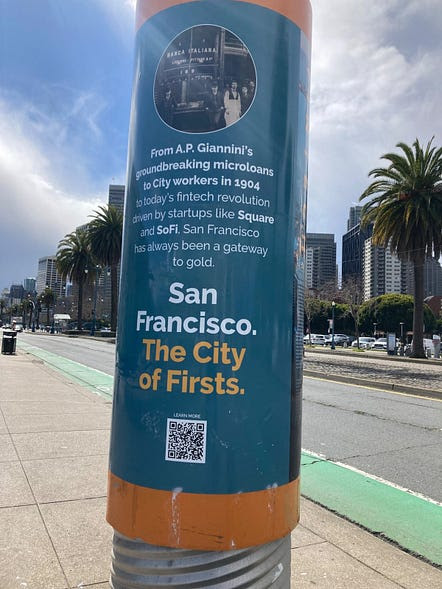
“San Francisco. The City of Firsts,” proclaimed posters wrapped around light poles. Most advertisements I passed featured artificial intelligence, or AI -- the computer programs that can now write, talk, recognize pictures, and make decisions -- visible on buses, shop windows, walls, and billboards, even banners trailing from two small planes that circled the Bay.
I was in town for SF Tech Week, 5–11 October, a citywide series of talks and gatherings, organized by a16z (Andreessen Horowitz), a venture capital firm that invests in young companies, and hosted by hundreds of companies and investors. The first day alone featured about 50 events. As an Indian who has studied in the United States of America for over two years, I was listening for where South Asia stood in these conversations.
Known for What They Build
When people talked about where the most difficult and valuable work was happening, China, Australia, and Germany repeatedly came up.
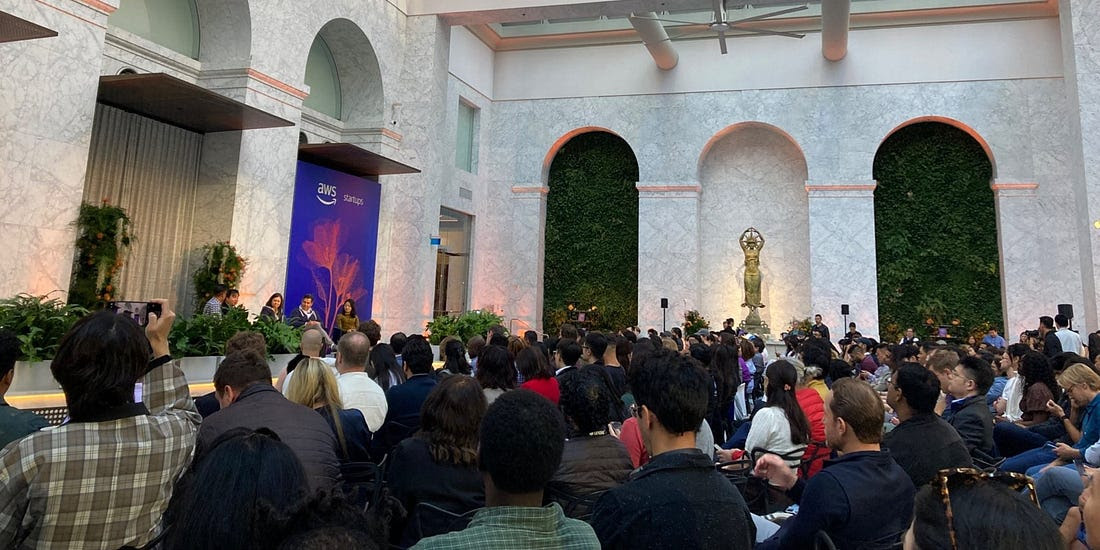
At ‘Models to Medicine Series: From AI Drug Discovery to Patient Engagement,’ hosted by AWS for Startups, Mary Rozenman, CFO of Insitro, a biotech firm, noted that much of the early testing of new drugs on patients now happens in China and Australia. The American government, she said, has started a programme to bring more of that work back to the U.S.
Speaking at the University of California, Berkeley, Danny Reidanbach, a researcher from NVIDIA, a company that makes computer chips, described AI systems that design new molecules for medicines. Those designs are then tested in laboratories, including partner labs in Germany.
Beyond the talks, delegates from some countries arrived having clearly decided what they wanted to be known for. The British government hosted events on the chips and machines that run AI. Taiwan sent a group of young companies with government support.
South Asia in the Rooms
Southasia, meanwhile, was present all week, in three ways. The first was South Asian talent that moves across borders. Reading NVIDIA’s research paper after the Berkeley talk, I noticed several South Asian names among the authors. Their profiles followed a familiar path: A first degree in India, then research in Germany.
The second was South Asian founders building startups for the U.S. market. Sripal Chittyreddy, the Consul (Technology) at the Consulate General of India, San Francisco hosted U.S.-India Corridor Founders Meetup. He spoke about the Indian government's efforts to connect Indian founders with Silicon Valley, supporting them as they grow here.
The third was official groups and communities. The Pakistan Tech Summit connected 50+ visiting Pakistani entrepreneurs and tech leaders with Silicon Valley builders and operators. TiE Mumbai, a network of Indian entrepreneurs, hosted several events on a range of topics. The American South Asian Network, hosted a panel of South Asian women who build and lead technology companies.
I found nothing in the event listings for Bangladesh, Sri Lanka, or Nepal. I also did not come across South Asians bringing an AI invention made at home for the rest of the world.
Where the Gap Begins
Why has South Asia not yet produced an AI invention the world relies on? The reasons range from funding to policy, but one I have seen firsthand is research talent leaving the region.
When I began studying biotechnology engineering at the National Institute of Technology in Warangal, India, in 2014, there were very few jobs in India for researchers and engineers outside software, in fields such as biotechnology, robotics, electronics, and communications. Software companies offered steady work and good salaries, so most of my classmates moved into software. Those who stayed in research left for the United States or Europe.
Software is a form of invention too. But most of India’s software work is services, building and running technology for companies abroad. A physicist from India told me that researchers feel more respected abroad than at home. The pull continues after university.
At the India-U.S. corridor event, Indian founder Apurv Bansal talked about working at Google in the U.S., then moving back to India to start his company. Since about 80% of his customers were American, for five years, he flew between the two countries six times a year, living in India while working on California time. It was wearing down his health. So, he made the hard decision to move to Silicon Valley with his wife and young son.
Anil Advani, founder and Managing Partner of Inventus Law, said another reason founders make the move is that American investors prefer companies registered in the U.S. In a small group discussion, a founder of Indian origin who has lived in San Jose for 25 years said that, in Silicon Valley, there is money and energy to help new ideas grow. In India, raising money is harder and more costly.
Build Original Technologies
For now, the most powerful AI systems are being built in the U.S. and China. Whoever builds the core technology decides how it works, what it costs, and whose languages and needs it understands. Everyone else becomes a customer.
South Asia does not need to win every part of this race. It just needs a few original technologies of its own, built in the region, that the rest of the world would find hard to do without.
The week offered clues about where those might come from. At Google for startups and NVIDIA event, Shai Alon, Google for Startups Global Founder Advocate, talking about application of medical imaging technology, mentioned their partnership with an Indian founder to use AI to help health workers read X-rays and other scans.
The ambition exists across the region. Young Indian companies are building rocket engines and computer chips, products India has long bought from abroad. Pakistan sent a delegation to Silicon Valley to show what its technology industry can do. And when cities in China put their scientists on billboards this August, newspapers in both India and Bangladesh asked why their countries could not do the same.
At the end of the week, I visited the Golden Gate Bridge. Work on it began in 1933, in the middle of the Great Depression, across a strait so deep, windy, and foggy that many experts said it could not be bridged. People called it “the bridge that couldn't be built.” It opened four years later, ahead of schedule and under budget.
The bridge was not built, not by people who had it easy, but by people who kept going when money was scarce and experts said no.
South Asia has never lacked that kind of grit. I saw it all week, in researchers carrying their work across borders, in founders building companies even when funding is hard to find, in entrepreneurs who crossed oceans to show what their countries can do.
What that bridge needed, and what South Asia needs is support at home: investors willing to back bold ideas, respect for the people doing the hard work, and the patience to keep going until they build something the whole world comes to rely on.
San Francisco built the bridge that couldn't be built. I left Tech Week believing that the next time the world looks for a technology it cannot do without, it may well look to South Asia.
(The author is a technology and management professional and writer from India based in Boston. She co-founded a nutrition technology company and co-authored an academic paper on AI in healthcare, published by Darden Business Publishing. By special arrangement with Sapan)







Post a Comment