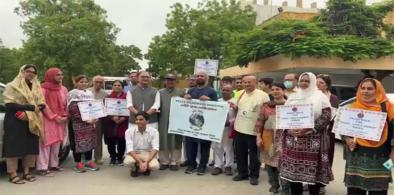
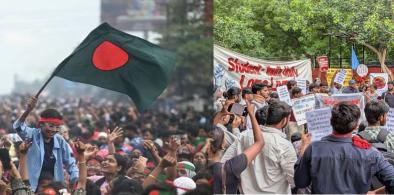
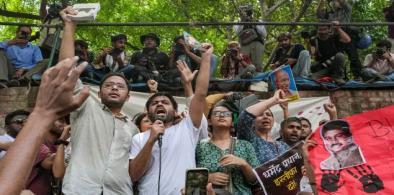

Cockroach Janata Party protest in Pune

A Mature Democracy Must be Confident Enough to Hear Youth Anger: Domestic Unrest can Become Global Politics in Hours

Democracies need dissent. Young Indians have every right to demand credible examinations, transparent recruitment, accountable institutions and a responsive government. To delegitimise all youth anger as foreign manipulation would be intellectually lazy and politically dangerous. But it is equally naive to pretend that geopolitics ends at the border of domestic protest.

Making Workplaces Safer in South Asia: Prevention Less Costly than Catastrophe

Workplace accidents impose costs far beyond the immediate loss of life and injury. Families lose breadwinners, enterprises suffer productivity losses, projects face delays and governments incur healthcare and compensation costs. The social consequences can be particularly severe for migrant and informal workers

Is Delimitation Becoming a Penalty for Good Governance for India's Southern States?

For decades, these states invested heavily in women’s education, public health, industrialisation, literacy and population control. Fertility rates in many southern states have already fallen below replacement levels. In contrast, several northern states lagged behind for years on precisely these indicators. If parliamentary representation now shifts overwhelmingly toward states with higher population growth, the message becomes deeply perverse: governance discipline weakens political power.

Denial of Voting Rights to Undertrials: Blinds Spots in India's Democracy

At its heart, the challenge to Section 62(5) is a test of constitutional sincerity, of whether the Indian Republic truly believes that citizenship endures even behind bars. Enacted in the infancy of the republic, the provision has long outlived its moral logic. It collapses the distinction between confinement and culpability

More on Public Policy and Governance

Ukraine fallout in South Asia: Now Bangladesh seeks IMF support, prepares for 'harder days'

Other countries in the region, such as Sri Lanka, Pakistan, and Nepal, are also struggling to arrest the depletion of their foreign exchange reserves as a result of high fuel prices. However, Bangladesh is still better placed and has enough time to work out a deal with the IMF. 

Pakistan’s trade deficit at a historic high: Can Islamabad bite the bullet of structural reforms?

Experts have pointed out Pakistan’s need to undergo deep structural reforms to avoid recurring cycles of loans and knocking at the IMF's doors

Sri Lanka’s fuel crisis threatens its prized tea industry; 400,000 jobs at risk

For Sri Lanka, which is in dire need of foreign exchange reserves, tea is among a few commodities offering an assured income in dollars. The industry faced immense hardship during the last year’s ban on chemical fertilisers

India establishes a tentative diplomatic presence in Taliban-ruled Afghanistan

The move isn’t a recognition of the Taliban regime which remains internationally isolated. The emphasis on people-people and civilizational connections underscores New Delhi’s attempt to retain its soft power in the country

The clock is ticking for Pakistan to secure an IMF deal

From withdrawing the fuel subsidies, hiking electricity tariffs and reducing expenditure to increasing tax rates, Prime Minister Shehbaz Sharif’s government has gone all out at the expense of its own political capital to get the IMF programme running

Nepal in a cleft stick: Another US programme stirs domestic politics with Beijing watching

Notwithstanding the Deuba’s government push to strengthen ties with the US, Nepal is still far from signing any security pact with it. Further, China, despite suffering a relative pushback in Nepal, is unlikely to take such a deal kindly

Amid ruling party infighting, a former Maldivian president waits in the wings

If Yameen returns to power in the Maldives, it would have repercussions on the present close strategic ties with India

The significance of India’s relations with Gulf and Muslim countries

India needs strong and friendly relations, be they diplomatic, economic, social or cultural, with the countries of GCC. And some of these arguments carry over for relations with members of the OIC too

Pakistan’s 5.9 % GDP growth comes with ‘landmines’, fears of ‘overheated’ economy and Imran Khan's 'biggest protest'

Challenges are compounded by the almost unaffordable prices of global commodities and fuel—factors beyond the government’s control. “I cannot control this but cannot leave people without food and fuel, either,” Ismail said.

No place in Hinduism for intolerance of other faiths

Denigration of another faith is not the act or practice of a true Hindu. Every Hindu must condemn such acts., writes Amb Sarvajit Chakravarty (retd) for South Asia Monitor 

What two WHO tales say about India's health system

While ASHAs make us proud, the state of the health management system makes us hang our heads in shame.  Is this where India should be in the 21st century?

Unchecked communal rhetoric will have implications for India’s foreign policy

Messages, and communal narratives - and even state-sanctioned actions - targeting Muslims reach audiences in the Muslim countries in real time and will produce resentment against India and its diaspora community living there. These sentiments will eventually make it a bit harder for their governments to embrace New Delhi and do business with it, at least in the open.

The Indian Navy's three-dimensional capabilities

“Today, Indian Navy is counted among the frontline navies of the world. Today, the world’s largest maritime forces are ready to work and cooperate with India,” Singh said and described INS Khanderi as a shining example of the ‘Make in India’ capabilities of the country.

A bridge over the river Padma: Bangladesh's passage to a developing nation

The decision to build the much-awaited Padma Bridge, which is set to open for traffic on June 25, through its own finances has brightened Bangladesh's image in the world, writes Dr Malika-e-Abida Khattak for South Asia Monitor. 

Boosting rail connectivity between India and Bangladesh is a win-win for both

While air remains a major mode of transportation for tourists—almost 77 percent, around 80 percent of Bangladeshi tourists used the land as the mode of transportation. Thus, an integrated, cross-border railway network as a faster mode of transport could bring enormous benefits to the region, including boosting regional trade.