

The Hidden Tax: Road Accidents Drain Over 3% of GDP From India and Sri Lanka Every Year; Generative AI Could Win it Back
The core data architecture — a national road safety data lake, AI-powered enforcement, multilingual public awareness — is replicable at any scale, in any South Asian language, in any South Asian urban or rural road environment. The technology does not need to be reinvented for Dhaka, Kathmandu or Karachi. It needs to be validated in Colombo and Delhi first.
 Jul 01, 2026

Every day, 474 Indians and seven Sri Lankans die on their nations' roads. More than 1,300 others are seriously injured in the same twenty-four hours. These numbers are so large and so recurrent that they have ceased to shock. Yet each of those tragedies carries a price tag — paid not in grief alone, but in hospital budgets, lost wages, shattered supply chains and a regional GDP that falls fractionally short of what it could have been.
Multiply those daily losses across a year and the scale of South Asia's road safety crisis becomes impossible to ignore. India loses an estimated USD 150 billion — approximately three per cent of its USD 3.7 trillion economy. Sri Lanka, with a nominal GDP of USD 78 billion, loses a further USD 2.5 billion, equivalent to 3.2 per cent of GDP. Together, the two countries absorb more than USD 152 billion in preventable economic destruction annually — a sum that dwarfs the combined health ministry budgets of both nations.
This special report puts those figures on the public record, and presents the case that Generative Artificial Intelligence offers the most powerful, most cost-effective and most rapidly deployable lever available to reverse them. The evidence is drawn from road safety data, economic modelling and early AI deployments across both countries. The argument is simple: South Asia cannot afford to wait.
A Crisis Hiding in Plain Sight
India has long acknowledged its road safety problem in humanitarian terms. The annual toll of 173,166 deaths and 443,000 serious injuries is mourned in ministerial statements and parliamentary debates. What has rarely been quantified with full clarity, however, is the simultaneous economic catastrophe — the fiscal haemorrhage that recurs, silently and ceaselessly, year after year.
The World Health Organisation and the World Bank estimate that road traffic injuries cost low- and middle-income countries between two and five per cent of GDP annually. India, with a nominal GDP of USD 3.7 trillion, sits at the lower end of that range; the composite estimate of USD 150 billion anchors road crashes as one of the single largest preventable economic losses in the nation's history.
The picture in Sri Lanka is proportionally no less alarming. The annual toll of roughly 3,200 deaths and 38,000 serious injuries may seem modest beside India's scale, but Sri Lanka's fatality rate — approximately 14.5 per 100,000 population — is marginally higher than India's 11.5, and its economic losses represent 3.2 per cent of a much smaller GDP. The human and fiscal cost per citizen is among the highest in the Asia-Pacific region.
India accounts for approximately 11 per cent of global road deaths while constituting 17 per cent of world population — a fatality rate that international comparisons consistently rank among the worst in the developing world. Across the Palk Strait, Sri Lanka's road mortality figures place it among the most dangerous road environments in South Asia relative to population. Both nations share the same core vulnerability: the two-wheeler.
"India loses the equivalent of its entire health ministry budget every year to road accidents. Sri Lanka loses more than three per cent of GDP. This is not a statistic. It is a regional emergency."
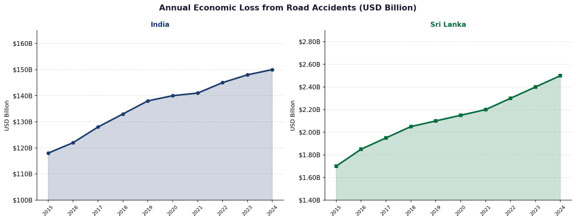
Fig. 1 — Annual Economic Loss from Road Accidents: India and Sri Lanka, 2015–2024.
Sources: WHO, World Bank, Ministry of Road Transport and Highways India, Central Bank of Sri Lanka.
Where the Money Goes
The losses are not monolithic. Across both India and Sri Lanka, they flow through six distinct economic channels, each compounding the others and creating structural weaknesses that extend far beyond the accident scene itself.
Lost productivity is by far the largest single cost category in both countries. India loses an estimated USD 58 billion per year; Sri Lanka loses USD 850 million. Road fatalities disproportionately claim workers in their peak productive years: young male motorcyclists between 18 and 35 account for the largest demographic segment of road deaths in both nations. On ILO modelling, each fatality represents an average loss of 32 productive working years. The national labour force shrinks imperceptibly with every collision — and the effect compounds across decades.
Healthcare and emergency trauma response consume a further USD 32 billion in India and USD 420 million in Sri Lanka annually, overwhelming public hospital capacity. Emergency wards at AIIMS Delhi and Colombo National Hospital alike absorb between 18 and 25 per cent of their total capacity treating road trauma — capacity that might otherwise be deployed for cancer treatment, cardiac care and maternal services.
Vehicle damage and property loss account for USD 22 billion in India and USD 380 million in Sri Lanka; congestion and logistics delays add USD 18 billion and USD 310 million respectively. Administrative and legal costs, combined with the monetised psychological burden on surviving families, complete a picture of systemic, economy-wide destruction that extends across both nations.
Beyond direct costs lie second-order macroeconomic effects that conventional accounting misses entirely. India's road fatality rate is increasingly flagged by multinational firms as a significant risk factor when assessing India as a logistics or manufacturing hub. Sri Lanka's road mortality figures are cited in international travel advisories, dampening visitor confidence and eroding per-trip spending in an economy where tourism is a critical foreign exchange earner.
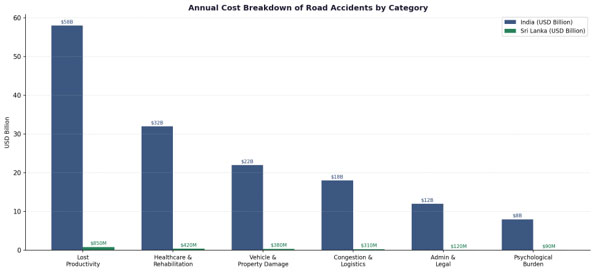
Fig. 2 — Annual Cost Breakdown of Road Accidents by Category: India and Sri Lanka (2024).
Sources: World Bank, National Health Authority India, MoRTH, Ministry of Health Sri Lanka.
A Tale of Two Neighbours
To understand what Generative AI can achieve in South Asia, it is essential to read the two countries simultaneously rather than separately. India and Sri Lanka share the same underlying epidemiology of road deaths — the two-wheeler fatality pattern, the concentration of losses among young male workers, the systemic underinvestment in road safety infrastructure. But the two nations differ profoundly in scale, institutional architecture, and the maturity of their digital public infrastructure — differences that shape both the challenge and the opportunity.
India's road safety problem is a problem of staggering scale: 1.44 billion people, 6.3 million kilometres of road network, 28 states and 8 union territories, 22 scheduled languages, and a federal governance architecture that makes inter-agency data sharing structurally complex.
Sri Lanka's challenge is one of proportionality: a compact island economy where a relatively small number of road deaths nonetheless extracts a disproportionate fiscal toll, and where the institutional and digital prerequisites for a GenAI platform are nascent but rapidly developing.
The comparison illuminates both the universality of the road safety crisis across South Asia and the potential for knowledge transfer. India's early GenAI pilots — notably the NHAI corridor deployment on the Delhi–Vadodara Expressway which demonstrated a 27 per cent reduction in secondary accidents — provide proof of concept that Sri Lanka, in a more controlled national environment, can replicate and potentially exceed. Conversely, Sri Lanka's compact geography makes it an ideal test bed for full-platform integration that India can then scale.
Table 1 — India vs Sri Lanka: Road Safety and Generative AI Readiness Comparison (2024 data).
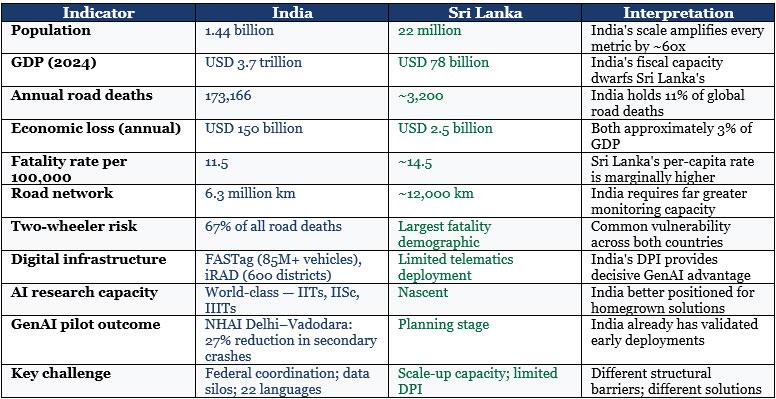
Sources: WHO, World Bank, MoRTH, Central Bank of Sri Lanka, IMF WEO 2024.
What Generative AI Actually Does
Generative Artificial Intelligence — the family of systems that includes large language models, multimodal computer vision platforms and predictive analytics engines — represents a qualitative leap beyond the rule-based traffic management tools that have dominated the sector for two decades.
For road safety, its power lies in three distinct capabilities. First, it can process and reason across heterogeneous data simultaneously — CCTV footage, weather readings, hospital occupancy, court records, GPS telemetry from ride-hailing apps — in ways that no human analyst or conventional algorithm can match. Second, it can generate actionable, human-readable outputs in multiple languages: early-warning alerts for traffic police, triage recommendations for ambulance dispatchers, personalised risk messages for young motorcyclists in their native language. Third, it can simulate counterfactual policy scenarios — giving policymakers evidence before they commit resources, not after.
India's early deployments validate the technology's potential at scale. NHAI's AI-powered incident detection system on the Delhi–Vadodara Expressway demonstrated a 27 per cent reduction in secondary accidents within the first twelve months of operation. Regional analogues from Vietnam and Thailand — where AI-integrated enforcement and awareness campaigns were piloted — demonstrated 28 and 31 per cent reductions in road fatalities respectively over five-year periods. Sri Lanka has the population density, urban concentration and institutional architecture to replicate those outcomes — and the economic imperative to do so is more urgent than anywhere else in the region.
Six Modules, One Platform
A national GenAI road-safety platform — whether deployed in India, Sri Lanka, or eventually across the broader SAARC and BIMSTEC region — would integrate six operational modules, each targeting a specific cost driver identified in the economic analysis above.
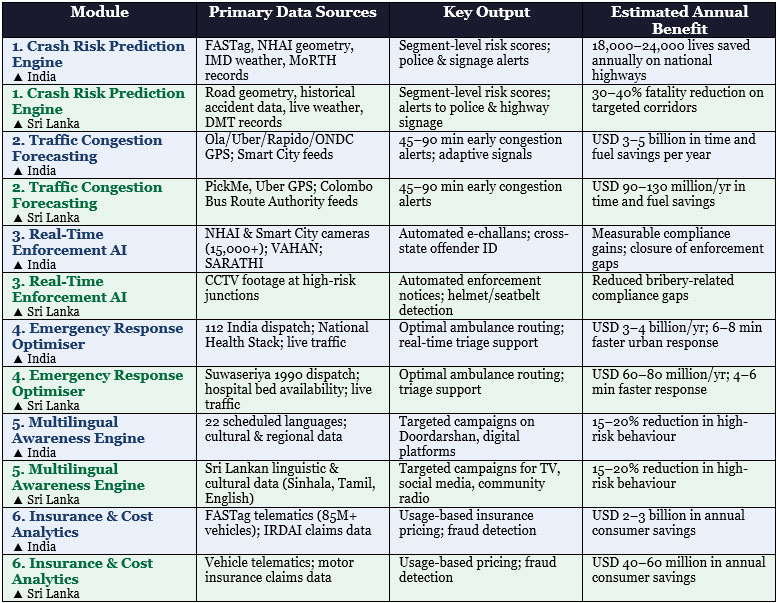
Crash Risk Prediction Engine — In India, this module fuses NHAI road geometry data, MoRTH historical accident records, live weather feeds from the India Meteorological Department, time-of-day patterns and vehicle density to generate segment-level risk scores — estimated to prevent 18,000–24,000 deaths on national highways annually. In Sri Lanka, an equivalent system drawing on Department of Motor Traffic records and highway CCTV could achieve a 30–40 per cent fatality reduction on targeted corridors.
Traffic Congestion Forecasting — Synthesising GPS data from ride-hailing platforms — Ola, Uber and Rapido in India; PickMe and Uber in Sri Lanka — alongside Smart City and city traffic feeds, this module predicts congestion 45–90 minutes ahead of formation. Estimated annual savings: USD 3–5 billion for India; USD 90–130 million for Sri Lanka, in time and fuel costs alone.
Real-Time Enforcement AI — Analysing footage from NHAI's 15,000-plus highway cameras in India and CCTV installations at high-risk junctions in Sri Lanka, this module detects speeding, lane violations and failure to wear helmets or seatbelts — auto-generating enforcement notices and, critically in Sri Lanka's context, reducing the scope for bribery-related compliance gaps that have long undermined traffic law.
Emergency Response Optimiser — Calculating optimal routing for 112 India ambulances and Suwaseriya 1990 services based on live traffic conditions, hospital bed availability and real-time triage data, this module can shave six to eight minutes off average urban response times in India and four to six minutes in Sri Lanka — margins that trauma surgeons describe as clinically decisive for severe road injuries.
Multilingual Public Awareness Engine — Fine-tuned on Indian linguistic and cultural data across all 22 scheduled languages, and on Sinhala, Tamil and English for Sri Lanka, this module produces targeted safety messaging for television, digital platforms and community radio. Comparative studies from Thailand and Vietnam demonstrated 15–20 per cent reductions in high-risk behavioural patterns among targeted demographic groups.
Insurance and Cost Analytics Platform — Applying actuarial GenAI to telematics data — FASTag installed in over 85 million Indian vehicles, and equivalent vehicle data in Sri Lanka — this module enables usage-based insurance pricing that rewards safe driving behaviour and cuts fraudulent claims: an estimated USD 2–3 billion in annual consumer savings in India, and USD 40–60 million in Sri Lanka.
"Every minute saved in ambulance response time translates directly into lives. GenAI can shave six to eight minutes off average urban response times in India and four to six minutes in Sri Lanka — a clinically decisive margin for severe trauma."
Table 2 — Proposed National GenAI Road Safety Platform: Modules, Data Inputs, Outputs and Estimated Benefits (India and Sri Lanka).
The Investment Case
The total investment required to deploy this platform nationally is estimated at USD 2.5–4.5 billion for India over the 2025–2035 decade, and USD 85–120 million for Sri Lanka over five years (2025–2030). These are, by any measure, modest sums relative to the returns they would generate.
Against cumulative GDP recovery of USD 75–150 billion by 2035 for India under moderate-to-aggressive adoption scenarios, the implied return on investment ranges from 30 to 60 times the initial outlay. For Sri Lanka, projected cumulative recovery of USD 2.4–4.6 billion by 2035 implies a 20 to 38 times return. Payback would be achieved as early as 2028 under aggressive deployment in Sri Lanka — and by 2027 under the most ambitious Indian scenario.
No conventional public infrastructure investment in either nation's recent history has offered comparable returns on comparable capital. The contrast with alternative uses of public funds is instructive: a single new expressway corridor in India typically costs USD 1–2 billion and delivers localised economic benefits; the GenAI platform, at similar cost, would operate across the entire national road network simultaneously.
"USD 2.5 billion invested in India's GenAI road safety platform. USD 75–150 billion recovered by 2035. USD 85–120 million invested in Sri Lanka's. USD 2.4–4.6 billion recovered. Payback in under two years."
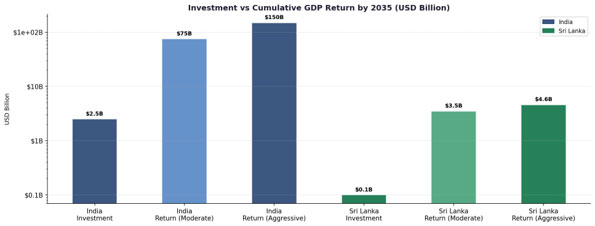
Fig. 3 — Investment vs Cumulative GDP Return by 2035: India and Sri Lanka (USD Billion).
Sources: WHO road-safety cost models, World Bank AI impact studies, IMF WEO October 2024.
Three Scenarios, One Direction
This report models GDP recovery under three adoption scenarios, differentiated by the pace of government investment, regulatory reform and private-sector participation. Across both India and Sri Lanka, all three scenarios point in the same direction — the question is only the speed of recovery.
Conservative Scenario — Phased pilot deployment in six high-fatality Indian states (Uttar Pradesh, Maharashtra, Tamil Nadu, Karnataka, Rajasthan and Madhya Pradesh) and in Sri Lanka's Western Province only. Limited inter-agency data sharing, modest enforcement digitisation. India recovers 0.75 per cent of GDP by 2035 — approximately USD 28 billion per year. Sri Lanka recovers 0.48 per cent of GDP, equivalent to approximately USD 370 million per year.
Moderate Scenario — National rollout of all six core modules by 2028, full data integration across police, health, transport and insurance sectors in both countries. Projected GDP recovery: 1.35 per cent for India (USD 50 billion per year) and 0.85 per cent for Sri Lanka (USD 660 million per year), while preventing an estimated 48,000 deaths and 121,000 serious injuries in India, and 3,920 deaths and 10,550 serious injuries in Sri Lanka, over the decade.
Aggressive Scenario — Accelerated deployment driven by strong regulatory mandates, public-private partnerships with telecommunications companies and insurers, and mandatory vehicle telematics. India recovers 2.40 per cent of GDP (USD 89 billion per year) by 2035; Sri Lanka recovers 1.20 per cent (USD 940 million per year) — a regional economic dividend, from safer roads alone, that exceeds the annual GDP of several smaller South Asian nations.
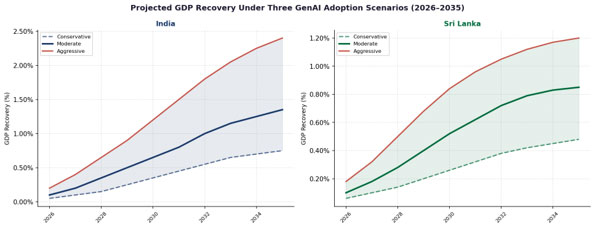
Fig. 4 — Projected GDP Recovery Under Three GenAI Adoption Scenarios: India and Sri Lanka, 2026–2035 (% of GDP).
Sources: WHO road-safety cost models, World Bank AI impact studies, IMF WEO October 2024.
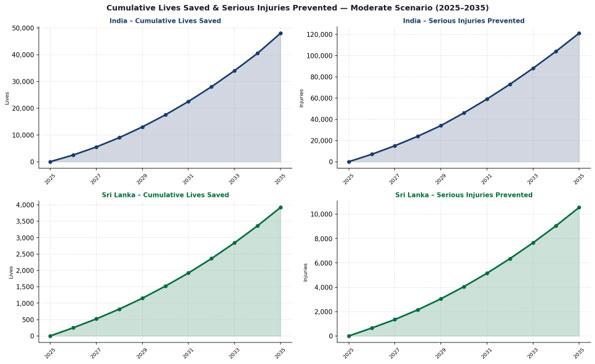
Fig. 5 — Cumulative Lives Saved and Serious Injuries Prevented Under the Moderate Scenario: India and Sri Lanka, 2025–2035.
Sources: WHO, MoRTH, Department of Motor Traffic Sri Lanka, ILO productivity methodology.
A Roadmap for Action
Phase One (2025–2026) — Building the Data Infrastructure
Establish a National Road Safety Data Lake in both countries, integrating accident records, state police FIR databases, hospital information systems, insurance claims and GPS telemetry. In India, this means integrating MoRTH accident records, iRAD district data and FASTag telematics. In Sri Lanka, it means connecting Department of Motor Traffic, Suwaseriya 1990 dispatch records and CCTV feeds from the fifty highest-risk road segments. Multilingual awareness campaigns targeting young motorcyclists are launched in parallel.
India investment: INR 8,000–12,000 crore (USD 1–1.5 billion). Sri Lanka investment: USD 18–25 million.
Phase Two (2027–2029) — Scaling to National Coverage
Real-time enforcement AI and crash prediction deployed across all state capitals and the full national highway network in India; across all provincial capitals and national highways in Sri Lanka. Predictive traffic management integrated with Smart City command centres in India and the Colombo City Traffic Command Centre in Sri Lanka. Usage-based insurance telematics programmes launched with leading motor insurers in both countries. An independent Road Safety AI Governance Board established in both nations.
India investment: INR 10,000–15,000 crore (USD 1.2–1.8 billion). Sri Lanka investment: USD 45–60 million.
Phase Three (2030–2035) — Regional Integration and Export
Full national integration of the platform across all relevant ministries and regulatory bodies. Mandatory telematics for all commercial vehicles. Critically: the potential export of the model — particularly Sri Lanka's compact, fully-integrated version — to regional SAARC and BIMSTEC partners as a diplomatic and commercial opportunity. The road safety platform becomes a South Asia digital public good.
India investment: INR 5,000–8,000 crore (USD 600 million–1 billion). Sri Lanka investment: USD 22–35 million.
FIVE THINGS GOVERNMENTS MUST DO NOW
1. Classify road crash losses as a fiscal risk. Both the Union Cabinet in India and the Cabinet of Ministers in Sri Lanka must formally require their Ministries of Finance to publish an annual Road Safety Economic Impact Statement alongside the national budget. Visibility is prerequisite to accountability.
2. Commit the capital. India must earmark INR 25,000–35,000 crore (approximately USD 3 billion) from the 2026–2030 Union and state budgets, supplemented by multilateral development bank financing. Sri Lanka must earmark LKR 12–15 billion (approximately USD 40 million) from 2026–2028 budgets, supplemented by World Bank and Asian Development Bank concessional lending. The returns justify the investment many times over.
3. Enact national road safety data integration legislation. All government agencies holding road-safety-relevant data — police, health, insurance, transport, and judiciary — must be mandated to contribute to national data lakes under standardised, privacy-preserving protocols. Without data integration, no AI platform can function.
4. Establish independent AI Governance Boards. Algorithmic tools deployed in traffic enforcement carry genuine risks of discriminatory application and privacy violation. An independent AI Governance Board — statutory in both countries, with civil society and academic representation — is not a bureaucratic luxury. It is a prerequisite for public trust.
5. Anchor strategy to the UN Decade of Action. Both India and Sri Lanka must formally commit their national road safety strategies to the United Nations target of halving road deaths by 2030 under the Decade of Action, and must use the GenAI platform's modelled outputs as the primary progress-tracking mechanism for international reporting.
A South Asia Regional Outlook
The road safety crisis is not unique to India and Sri Lanka. Across South Asia — Bangladesh, Nepal, Pakistan, the Maldives — the pattern repeats: high fatality rates among young male motorcyclists, chronically underfunded emergency response systems, fragmented traffic enforcement, and road death tolls that extract between two and five per cent of GDP from economies that can ill afford the loss.
India and Sri Lanka, precisely because they differ so sharply in scale and institutional architecture, offer the region's most instructive comparative case. If India's deployment validates the platform at mass scale — 173,000 deaths, 6.3 million kilometres of road, 22 languages — and if Sri Lanka's compact integration demonstrates full-system deployment in a controlled national environment, the two nations together will have built the South Asian proof of concept that SAARC and BIMSTEC partners are waiting for.
The regional transferability of the model is not theoretical. The core data architecture — a national road safety data lake, AI-powered enforcement, multilingual public awareness — is replicable at any scale, in any South Asian language, in any South Asian urban or rural road environment. The technology does not need to be reinvented for Dhaka, Kathmandu or Karachi. It needs to be validated in Colombo and Delhi first.
There is a diplomatic dimension here as well. Sri Lanka, as a small nation with demonstrated GenAI road safety capacity, becomes a regional knowledge exporter rather than merely a recipient of international development assistance. India, positioning its digital public infrastructure as a global model through the G20 and the Global South dialogue, can use its road safety platform as a centrepiece of that soft-power offer. South Asia's road safety crisis is a shared problem. Generative AI, deployed intelligently across the region, is a shared solution.
The Cost of Inaction
The argument against action is familiar: limited fiscal space, competing priorities, implementation capacity challenges across federal or unitary systems. Each objection is real. None of them survives contact with the arithmetic.
Every year India delays, it absorbs another USD 150 billion in preventable losses and loses another 173,000 citizens in their productive years. Every year Sri Lanka delays, it absorbs another USD 2.5 billion in preventable losses and loses another 3,200 citizens. Cumulatively, the two nations are bleeding more than USD 152 billion annually — a regional economic catastrophe hiding in plain sight, normalised by repetition into invisibility.
Vietnam reduced road fatalities by 28 per cent over five years using AI-integrated enforcement. Thailand cut highway deaths by 31 per cent through data-driven infrastructure targeting. The technology works. The evidence is not contested. The only variable is political will.
Generative AI is not a silver bullet. It will not replace rigorous traffic law enforcement, road engineering investment or sustained public education. But in combination with those foundations, it is the most powerful, most cost-effective and most rapidly deployable lever available to South Asia today. India has the data infrastructure: FASTag installed in over 85 million vehicles, iRAD covering 600 districts, 112 India operating nationally, the world's largest digital public infrastructure stack in Aadhaar and UPI. Sri Lanka has the scale advantage: a compact, integrated national environment where a well-designed GenAI platform can achieve full penetration within years, not decades.
The road to recovery for both nations starts with the same decision: to treat road deaths not as an intractable social problem but as a solvable fiscal one. To invest the data infrastructure, the regulatory architecture and the political capital that the scale of the emergency demands. The technology is ready. The evidence is clear. South Asia cannot afford to wait.
Data & Methodology: All cost figures in USD at 2024 constant prices. GDP projections use IMF WEO October 2024 baseline. India accident statistics sourced from the Ministry of Road Transport and Highways Annual Report 2023–24. Sri Lanka accident statistics sourced from the Department of Motor Traffic and Central Bank of Sri Lanka. Scenario modelling based on WHO road-safety cost models, World Bank AI impact studies and ILO productivity methodology. This report is prepared for policy use and public information. © The South Asia Economic Review, 2026.
(The author is an Associate Professor in Generative AI and Machine Learning and leader of the AI for Climate & Disaster Resilience Research Group (AICDRG) at York St John University, UK. He is at the forefront of South Asia's regional transformation in AI research and application. The views expressed are personal. He can contacted at n.somasiri@yorksj.ac.uk )







Post a Comment