

Russia’s Bid for a Larger Asian Role; Will Be Closely Watched by Beijing
Russia wants to use the Far East to diversify away from the West, but it risks becoming excessively dependent on China. That is why Southeast Asia, India, Japan and other Asian partners matter to Moscow as they provide Russia with a wider Asian field and fallback and reduces the risk that Russia’s entire eastern pivot becomes a one-way dependence on Beijing.
 Aug 08, 2026
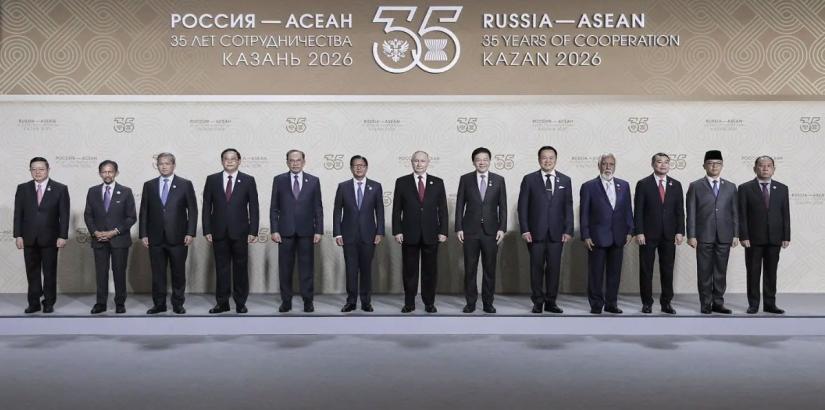
The ASEAN-Russia Commemorative Summit held in Kazan, Russia on 17-18 June was not merely a ceremonial gathering, but a strategic intent to showcase presence and mark decades of relations, reflecting Moscow’s quest to strengthen fallback options and show resilience and defiance despite the Ukraine war.
Moscow is aware that Southeast Asia is not keen to be trapped in the binary Washington-Beijing rivalry and sees an opening to extend its sphere of influence in a region that is now actively searching for alternative options. It also senses that the region’s current vulnerabilities - particularly in energy, food, and security - create the means for Russia to reposition itself as a third strategic provider, away from the conventional choices.
In context, Russia’s strategic relevance to Southeast Asia has long been limited when measured against the predominant and historical roles of China, the United States, Japan, the European Union and other established partners.
The latest State of Southeast Asia survey still ranks Russia only ninth among ASEAN Dialogue Partners in strategic relevance. This suggests that Moscow remains a peripheral player in ASEAN’s wider strategic calculus over the years. However, this looks set to change.
Russia is now increasingly becoming a functional fallback partner in practice. Its relevance is now no longer framed only by Cold War nostalgia, defence links with certain countries like Vietnam, or residual ties with Myanmar and Laos. It is being shaped by a broader set of regional anxieties that reflect the region’s growing vulnerabilities: energy insecurity, supply-chain disruption, food vulnerability, uncertainty over US policy, fear of overdependence on China, and the need for strategic redundancy in a more volatile and unpredictable international order.
This signals a new shift where Russia does not need to dominate ASEAN to become relevant.
Russia is not about to displace other powers in economic, defence or geopolitical weight. Instead, it only needs to become an useful partner in areas where regional states feel exposed, and this is where Russia’s strategic opening lies.
Energy as Immediate Opening
Energy is now Russia’s most important window of opportunity in Southeast Asia. For decades, Southeast Asian countries have depended heavily on access to Middle Eastern crude and secure global maritime routes. The Hormuz crisis exposed the fragility of this dependence. In this context, Russia’s offer of crude, LNG, LPG, and nuclear energy becomes strategically attractive, even if it is politically sensitive.
Apart from crude support, nuclear-related deals involving Vietnam and Laos show that Russia is positioning itself in the diversification of energy support, connecting its energy diplomacy to ASEAN’s transition needs.
As Southeast Asia is not able to transition away from fossil fuels overnight, Russia is trying to present itself as a provider across a strategic spectrum of phased transition: oil and gas for today, nuclear energy for stability, and possibly advanced technologies for future energy systems.
Sanctions have never been enough to deter or block the path of Russian energy, at least towards Asian states. Regional players have shown that, during crisis conditions, energy security often takes precedence over geopolitical signalling. For ASEAN, engagement with Russa will not be framed as alignment but as diversification.
The Arctic and the Northern Sea Route
Russia’s energy strategy also has an Arctic dimension that Southeast Asia cannot ignore. The Northern Sea Route (NSR) and the Arctic now remain at the forefront of the next strategic global route and frontier. Although the NSR remains constrained by weather, insurance risk, infrastructure gaps, sanctions, environmental risks and specialised vessel requirements, its long-term strategic significance is growing.
For Russia, the NSR is part of a broader effort to redirect energy and trade flows towards Asia as alternative options, sas access to Western markets narrows due to sanctions and the Ukraine war. It is also part of Moscow’s larger attempt to revive Russia’s position as an energy bank for Asia, and this position relies on the Arctic LNG, Siberian resources, Far Eastern ports, icebreaker capacity, and the eventual integration of rail, maritime and energy corridors across the Eurasian landmass.
This strategic opening holds high potential. It is not only about shorter shipping distance, but also about strategic optionality. Having traditional maritime routes become increasingly vulnerable, alternative northern routes gain greater strategic attention. For Southeast and East, the NSR introduces a new layer of strategic opening.
The Arctic is gaining strategic importance for Asian economies because it may open shorter routes between parts of Europe and Asia, expand access to Arctic LNG and minerals, and create new logistical options outside traditional chokepoints.
The NSR will not replace the Malacca Strait or South China Sea for now, but it could diversify Eurasian trade flows and reduce the monopoly of existing southern routes for certain cargoes. This also will change ASEAN’s energy future. The more Russia can move Arctic and Siberian energy eastward, the more Moscow can present itself as a resilient supplier beyond the Middle East.Therefore, the NSR strengthens Russia’s long-term narrative that it is not only a continental Eurasian power, but also an energy, logistics and resource gateway to Asia.
Russia’s Wider Indo-Pacific Repositioning
Russia’s renewed push toward Southeast Asia should also be seen through the lens of its Far East strategy. The Russian Far East is no longer just a distant peripheral region in Moscow’s domestic geography, but is now adjusted as the strategic front door of Russia’s pivot to Asia.
Strategic assets such as Vladivostok, Sakhalin, Primorye, Kamchatka, the Kuril chain, the Pacific Fleet, Far Eastern ports, Arctic logistics and eastern rail corridors have become central to Russia’s geopolitical reorientation toward Asia. Moscow sees the Far East as a new asset to serve multiple purposes at once: an energy export base, a defence frontier, a maritime gateway, a logistics hub, a mineral and resource platform, and a diplomatic bridge to Northeast and Southeast Asia.
The Far East allows Russia to project itself as an Asian power, not merely a European power under pressure. Initiatives including the Eastern Economic Forum, port development, rail modernisation and energy projects also reflect this objective.
No Limits but Persistent Wariness
This ambition, however, faces real constraints. Russia wants to use the Far East to diversify away from the West, but it risks becoming excessively dependent on China. That is why Southeast Asia, India, Japan and other Asian partners matter to Moscow as they provide Russia with a wider Asian field and fallback and reduces the risk that Russia’s entire eastern pivot becomes a one-way dependence on Beijing.
Despite the "No Limits Ties[SS1]" , Russia and China are not identical actors. Both have overlapping ambitions and intent in Central Asia, the Arctic, energy corridors, minerals, logistics and influence across Eurasia, and excessive Chinese dominance could reduce Russia’s strategic autonomy along its own eastern frontier.
Russia’s outreach to Southeast Asia is not only about ASEAN but also part of a broader effort to make the Russian Far East more internationally connected and less dependent on China alone. ASEAN offers markets, diplomatic legitimacy, energy demand, and a broader Asian audience at a time when Russia is seeking to demonstrate that China alone is not its only strategic future.
China will watch these developments carefully. While Beijing may welcome Russian influence that helps reduceing Western influence in the region, it will remain cautious if Moscow gains ground in areas that will challenge China’s long-established regional position. Russia’s Southeast Asian strategy is therefore not only about Russia versus the West; it is also about navigating an Asia where China is both a partner and a competitor.
The Japan Factor: A Possible Future Reset
Russian-Japanese ties have been strained since the Ukraine war. Tokyo joined Western sanctions and maintained a hard political line against Moscow. The unresolved territorial dispute over the Southern Kurils/Northern Territories still remains a barrier to any rapprochement
Yet Japan has not fully severed its ties with Russian, with energy being the main Reason. Although Tokyo aligns with the G7’s position on Ukraine, it has sought to preserve Russian energy channels as this resource remains a core national security priority. This creates a pragmatic dilemma: politically, Tokyo must oppose Moscow’s actions in Ukraine, while strategically and economically, it cannot fully disregard the Russian energy equation.
This is where Russia sees an opportunity for future recalibration. Moscow is aware that Japan cannot easily replace all Russian energy supplies without incurring costs in the short term. It also knows that Japan remains ultimately concerned about China and North Korea’s threats, as well as the broader balance of power in Northeast Asia.
For Russia, improving ties with Japan would bring several beneficial outcomes. It would reduce overdependence on China in the Far East, reopen channels for technology, capital, maritime cooperation and energy investment, and strengthen Moscow’s claim that it remains a serious regional power rather than a junior partner to Beijing. Japan, meanwhile, could preserve energy access, maintain communication in Northeast Asia, and prevent Russia from moving even more tightly into China’s strategic orbit.
Defence and Food Security
Food security is another area in which Russia holds advantages. Conflicts, climate shocks, disruptions to fertilizer supplies and maritime insecurity have exposed deep vulnerabilities in global food systems. As one of the world’s leading suppliers of wheat, fertilisers and agricultural inputs , Russia retains a degree of practical leverage. Its offer to ASEAN rests on three interconnected pillars: energy, food and security. Energy supports supply resilience, food helps manage inflation pressure, and security provides defence fallback and strategic hedging.
Defence has traditionally been Russia’s strongest anchor in Southeast Asia, especially through ties with Vietnam, Laos and Myanmar. Moscow is now trying to expand into maritime Southeast Asia, but its position is weaker than before. Arms exports have fallen because of the Ukraine war and regional states also worry about sanctions exposure.
Russia hopes to give ASEAN another option: a non-Western partner and source of cooperation in energy, food, nuclear technology, defence maintenance and minerals, but still faces serious limitations. Distance and geography constrain its regional presence. The Ukraine war and sanctions further drain resources, and competition is intense from traditional powers that have established a historical presence in the region. In many sectors, Russia remains a secondary option rather than the partner of first choice.
For now, ASEAN’s relationship with Moscow is largely one of strategic convenience. However, if Russia continues its pivot towards Asia, Arctic routes become more viable, energy instability persists and ASEAN continues to be trapped in the binary US-China pressure, Moscow’s relevance and reach could grow as the region continues to gain greater autonomy. Even so, dislodging the commanding presence of traditional powers in the Indo-Pacific will remain a challenge
(The author is a Kuala Lumpur-based strategic and security analyst. The views expressed are personal. He can be contacted at collins@um.edu.my.)





Post a Comment