

The Reopening of Nathu La and a Pragmatic India-China Compact: Opportunity for Both Countries to Move Beyond Symbolism
India and China need not share identical geopolitical visions to agree that a stable border, prosperous border communities and transparent rules are preferable to uncertainty. The most useful measure of Nathu La’s success may therefore be not how many tonnes cross the pass, but how routinely two neighbouring systems learn to work together.
 Aug 10, 2026
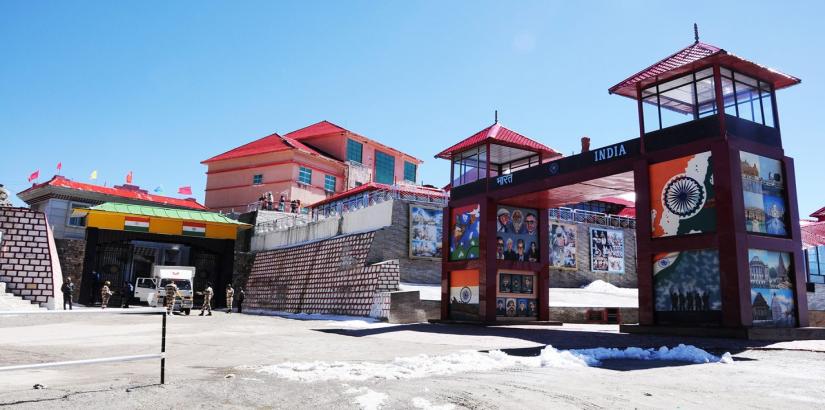
If India and China are seeking a place to test whether cautious normalisation can evolve into durable cooperation, Nathu La is almost perfectly suited to the experiment. Reopened for border trade on August 1 after a six-year suspension, the pass high in the eastern Himalayas will not transform the economics of a relationship already worth more than $150 billion a year. Its significance is different. It can test whether two powerful neighbours can turn a sensitive frontier into a predictable space for regulated, reciprocal and locally useful exchange.
The macroeconomic paradox is evident. According to India’s Department of Commerce, bilateral goods trade is valued at $151.10 billion for 2025-26, with Indian exports to China at $19.47 billion, imports at $131.63 billion, and a deficit of $112.16 billion. Meanwhile, China’s General Administration of Customs reports $155.62 billion in India-China trade for 2025, based on the calendar year, consisting of $135.87 billion of Chinese exports to India and $19.75 billion of imports from India. Although the data cover different periods, they both highlight the same reality: economic interdependence has grown, yet political trust remains fragile, and the trade imbalance has become a significant concern for India.
Nathu La is at the opposite end of that spectrum. According to Xinhua, quoting local authorities, the pass facilitated over 73 million yuan, roughly $10.8 million, in imports and exports in 2019. A field study conducted in November 2025 by Shiv Nadar University, using data from Indian and Sikkim government sources, reveals more than just absolute figures: total trade at Nathu La plummeted nearly 90 per cent during the Doklam crisis, falling from Rs 82.68 crore in 2016 to Rs 8.86 crore in 2017, with a rebound in 2018. By 2020, over 600 Sikkimese traders had registered for trade. While this represents marginal commerce at the national level, at the border it sustains livelihoods and serves as an important indicator of the political climate.
A Geopolitical Reset
That is why the reopening matters now. In August 2025, India and China agreed to reopen trade through Nathu La, Shipki La and Lipulekh. By July 2026, their foreign ministers were publicly discussing fair market access, the trade imbalance, supply-chain predictability and the restoration of institutional exchanges.
On August 6, the two sides held the 36th meeting of their border consultation mechanism in New Delhi to discuss border management, mechanism-building and trans-border cooperation, and again underlined that peace and tranquillity are essential to the broader relationship. Nathu La is therefore not a geopolitical reset. It is a practical component of a cautious normalisation that both sides have an interest in making durable.
Learning from Nepal Experience
China’s experience elsewhere across the Himalayas with Nepal suggests what is possible and what must be avoided. Lhasa Customs reported that Xizang’s total goods trade reached 8.479 billion yuan in 2025 [roughly $1.2 billion at contemporaneous exchange rates], with private enterprises accounting for 85.7 per cent.
In the first two months of 2026, Xizang’s trade with South Asian countries rose 43 per cent year-on-year. Xinhua also reports that the region plans to open 12 additional border-trade sites in 2026 alongside its 14 traditional ones. Gyirong, on the China-Nepal border, handled about $604 million in trade in 2024. Yet a July 2025 flood severed the Gyirong-Rasuwa connection for months.
Need to Review Trading Basket
The lesson is not that Nathu La should imitate another border port. It is that mountain commerce succeeds when customs, roads, logistics and markets work together; and remains vulnerable unless resilience is built into the system.
For Nathu La, ambition should therefore be disciplined. A working border is not an open border; it is one whose rules are clear, reciprocal and reliably implemented. The current trading basket is a logical place to begin. Recent field research notes that parts of the permitted import list (such as goat and sheep skins, horses and yak hair) have little current demand, while traders report demand for goods outside the formal basket. An annual India-China review could gradually admit high-value, low-volume products suited to mountain transport and local economies, while retaining full customs, quarantine and security controls.
The same principle should guide infrastructure. Nathu La does not need a Himalayan mega corridor. It needs reliable roads, modest warehousing and cold-chain capacity, banking and insurance services, testing and quarantine facilities, and digital procedures that reduce waiting without compromising sovereignty.
Advance declarations, electronic trader accreditation, scheduled inspections and interoperable documents could speed compliance while keeping sensitive databases separate. Given the ecology and weather, success should be measured as much by reliability and environmental impact as by trade volume.
There is also a strong case for something surprisingly basic: a common statistical protocol. Indian-side studies and Chinese reporting do not always yield directly comparable historical totals for Nathu La. Rather than allowing such differences to fuel competing narratives, customs authorities could publish a short annual bulletin using agreed definitions: trade value, product categories, number of active traders, average clearance time, days lost to weather, and locally generated employment. Shared statistics would improve policy and make confidence measurable.
Local voices should be embedded in that architecture. Traders in Sikkim and their counterparts across the pass know which goods are in demand, where time is lost, and how closures damage working capital. A small consultative forum bringing together customs officials, local administrations, trader associations and environmental specialists could resolve operational problems before they acquire political weight. This would make Nathu La a laboratory of managed interdependence: cooperation substantial enough to create benefits, yet bounded enough to keep risks controllable.
A Low-Risk Opportunity for Reset
None of this assumes that commerce can settle the boundary question. It cannot. Nor will Nathu La correct India’s $112 billion trade deficit with China. But precisely because the pass is economically modest and strategically sensitive, it offers a low-risk opportunity to rebuild habits of predictability. If the model works, elements of it could inform the other designated border trading points without either country having to surrender caution or sovereignty.
India and China need not share identical geopolitical visions to agree that a stable border, prosperous border communities and transparent rules are preferable to uncertainty. The most useful measure of Nathu La’s success may therefore be not how many tonnes cross the pass, but how routinely two neighbouring systems learn to work together.
A working border will not erase disagreement. It can, however, make disagreement easier to manage. For India and China, that would be a modest achievement with consequences far larger than the trade figures at Nathu La suggest.
The reopening of Nathu La offers India and China an opportunity to move beyond symbolism and to test a practical model of managed interdependence at the border.
(The author, a journalist-turned-interdisciplinary academic with two decades of experience in broadcast and digital media and research across Asia and Europe, is a Ph.D. scholar at Hong Kong Baptist University who is currently in China. The views expressed are personal. He can be reached at arjunchatt@gmail.com/ WeChat: ARJUN13717687208/ https://www.linkedin.com/in/arjun-c-276a8065/).





Post a Comment