

India-China Ties: Modi-Xi Meeting Signals Limited Thaw
The bilateral discussion between Prime Minister Narendra Modi and Chinese President Xi Jinping on the sidelines of the 18th BRICS Summit indicates surge in mutual ties, particularly by way of trade. However, little can be expected by way of full settlement of the boundary dispute.
 Sep 13, 2026
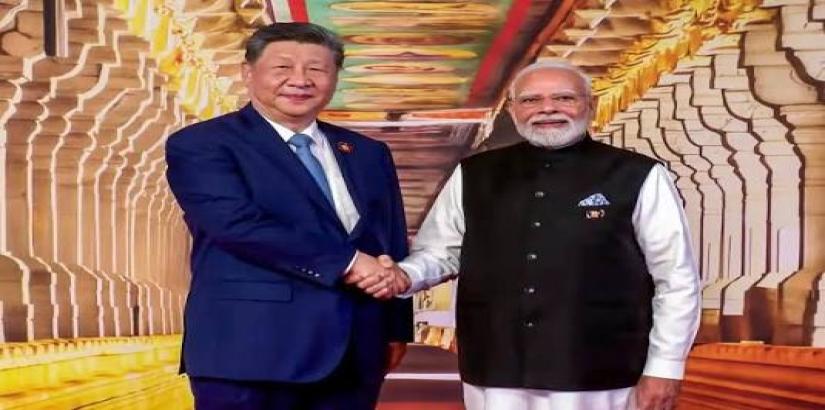
Chinese President Xi Jinping's visit to India after seven years and his discussion with Prime Minister Narendra Modi on September 12, on the sidelines of the 18th BRICS Summit, had a different setting from Modi-Xi's official bilateral discussions at Hyderabad House, New Delhi, on September 18, 2014, while dozens of Tibetan activists protested outside Hyderabad House.
However, the Modi-Xi discussion in the instant case was against the following backdrop:
- China's 2020 aggression in Eastern Ladakh, no return to pre-April-May 2020 positions, and continuing standoff along the entire Line of Actual Control (LAC).
- Reports of PLA ingress in Arunachal Pradesh (https://www.thestrategicperspective.org/arunachal-calling/) and recent satellite images showing China advancing into contested areas (https://www.facebook.com/photo/?fbid=1660207096135277&set=a.395690795920253).
- Chinese analysts and state media warning that India's USD 9 billion Great Nicobar project is a deliberate military move aimed at dominating the Strait of Malacca and exploiting Beijing's Malacca Dilemma.
- The India-China Special Representatives Talks on August 25, 2026, allowed two additional meeting points and two additional hotlines, but the 'Package Deal' for total resolution of the boundary dispute will remain a chimera for India, notwithstanding continuing diplomatic whitewashing (https://www.thestrategicperspective.org/india-china-25-sr-talks/).
- India signalled deepening military ties with Quad members before Xi's visit (China always criticises the Quad as an "anti-China front" and "mini NATO"). The armies of India and America began the three-week Exercise 'Yudh Abhyas' on September 9; the Air Forces of India and Japan began Exercise 'Veer Guardian' at Jodhpur; and Navy Chief Admiral Krishna Swaminathan began his Australia visit on September 9, focusing on operational interoperability, information-sharing and training.
- By withdrawing the draconian UAPA (Unlawful Activities (Prevention_ Act_ against American mercenary Matthew Aaron VanDyke and the six Ukrainians captured by the National Investigation Agency (NIA) in March 2026, and dropping all terror charges just before the 18th BRICS Summit, India signalled that it is firmly in the US camp.
Xi's Message and India's Response
During the bilateral discussion, Xi called for: one, maintaining an objective and rational strategic understanding of the relationship – seeing each other as partners (not rivals) and viewing development as an opportunity; two, win-win cooperation, with development serving as the greatest common denominator – people-to-people exchanges, more direct flights and a balanced approach to economic and trade concerns; three, mutual respect and understanding in dealing with differences – parallel development of bilateral relations and addressing the boundary issue while maintaining peace and tranquillity in border areas; and four, open and inclusive multilateral cooperation – in BRICS, SCO, the UN and G20.
The Ministry of External Affairs (MEA) readout outlined key takeaways from the bilateral discussion, the gist of which includes: both welcomed progress in bilateral relations, agreeing to view the relationship for the long term; both reaffirmed that differences shouldn't turn into disputes; Modi stressed that the relationship should be driven by mutual respect, mutual sensitivity and mutual interest; Modi said maintaining peace and tranquillity in border areas is necessary for growing bilateral relations – both sides must stick to border agreements; both committed to reaching a "fair, reasonable, and mutually acceptable" solution to the boundary dispute; both agreed to fix structural trade imbalances and supply chain bottlenecks; both noted progress in interpersonal ties and underscored the need to push for better cross-border mobility, direct flights and cultural exchanges; and both agreed to expand common ground on regional and global problems.
The MEA readout skipped mention of the 'not rivals' formulation by Xi.
Where the Relationship Stands
A dispassionate analysis of the India-China relationship would draw the following conclusions: China holds all the cards with respect to boundary settlement – the semantics used in the instant case are not new; China has repeatedly broken agreements and has no compunctions about doing so, especially when its intrusions/salami slicing occur in what it claims is its own territory; drawing India's immediate neighbours into its strategic sphere gives Beijing leverage over India; India may diversify trade to minimise economic and supply chain dependence on China, however, diversification to an extent that gives leverage over China could take multiple decades, if at all; China gained India's renewed commitments on Taiwan and Tibet, and a pathway to expand economic trade and supply chain cooperation with India.
The Delhi Declaration recommends a bigger role for India and Brazil in the United Nations, especially in the UNSC. Does this imply a permanent UNSC seat with/without veto power? China's erstwhile stance was that if India is to be given a UNSC seat, so should Pakistan.
On the issue of stopping conflicts through diplomacy and dialogue, the following is relevant: whether the US-Israel war on Iran or the war in Ukraine, US President Donald Trump's sincerity in stopping the wars is highly suspect; Trump's choice of mediation in the Iran war is Pakistan, not India; Xi and Putin reportedly welcomed Modi to mediate a ceasefire in the Ukraine war, but Putin has already said he won't talk to "terrorist" Volodymyr Zelensky (Ukrainian President), while Zelensky remains the favourite of the US-led NATO and the EU.
Limited Thaw, No Border Breakthrough
Finally, China has been professing that the 'Elephant and Dragon' should dance together. Xi even wrote a letter to India's President Droupadi Murmu about this. Some Indian media are now feeling happy, terming it the 'Tiger and Dragon' dance.
The Modi-Xi tête-à-tête will progress bilateral relations by way of enhancing cooperation in economy, trade, people-to-people contacts, more direct flights and the like. However, as for a complete boundary settlement, this is unlikely in the foreseeable future. Therefore, a complete thaw in India-China relations remains a work in progress.
(The author is an Indian Army veteran and a strategic affairs commentator. The views expressed are personal}





Post a Comment