

Making India a Space Power: Not Less Privatisation, but Better-Designed Privatisation
The last thing India needs is a debate in which concerns over public intellectual property become an argument against private participation. The country is already playing catch-up with the major space powers. We cannot afford to let a legitimate debate over ownership and sharing of value become an impediment to the much-needed privatisation of the space sector.
 Sep 07, 2026

There is a controversy brewing over the Indian space programme and its increasing movement towards the private sector. In some ways, this transition had begun several years ago, with the gradual opening up of the space sector to private participation and the creation of an ecosystem in which private companies could develop, manufacture and eventually operate space assets.
The immediate trigger for the present controversy appears to have been a statement by an ISRO (Indian Space Research Organisation) official on the growing role envisaged for the private sector. Employee unions have raised their hackles, reportedly writing to the management and raising concerns about job vulnerability and the future role of ISRO's workforce.
But their letter raises a larger and more fundamental issue. It reportedly points out that much of the technology and intellectual property developed by ISRO has been created using public funds and therefore constitutes a public asset.
The question, consequently, is not merely whether private companies should be allowed to participate in India's space programme. It is how publicly developed technology and intellectual property should be transferred, licensed or made available to private entities, and on what terms.
The Global Space Ecosystem
Let us first examine the global space ecosystem and India's place in it.
USA, China, Russia and India - Satellites in Orbit
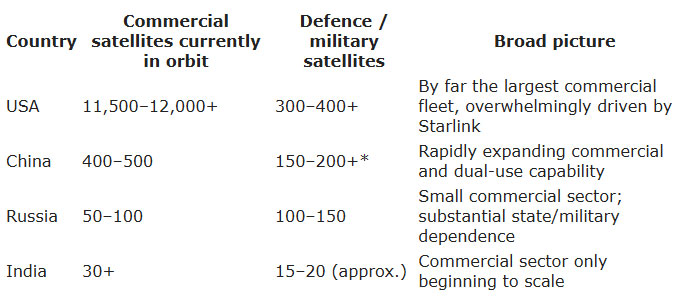
*Military satellite numbers are particularly difficult to establish because of classified systems and differences in the way dual-use satellites are categorised.
The Indian commercial figure is much better grounded than the military estimate. The Government stated in July 2026 that Indian non-government entities had placed more than 30 satellites in orbit.
For comparison, ISRO's latest Indian Space Situational Assessment Report says that, by the end of 2025, 144 Indian spacecraft had been launched, including those of private operators and academic institutions. It also reported 53 operational Government of India satellites - 22 in LEO and 31 in GEO - plus active deep-space missions.
India's Commercial Space Sector
India's 30+ private satellites should not be interpreted as 30+ large commercial constellations. They include relatively small satellites and technology-demonstration missions.
The commercial satellite industry is now, however, moving into a different phase. For example, the Pixxel-led consortium of Pixxel, Dhruva Space, SatSure and PierSight is developing a 12-satellite fully commercial Earth-observation constellation, to be deployed over the coming years.
The broad picture is therefore:
USA → commercial space already industrialised
China → commercial space rapidly industrialising
Russia → predominantly state/military space capability
India → government-dominated, but with a rapidly emerging private sector
There is, however, an important caveat to the comparison. I would not put too much weight on the 15–20 figure for India's military satellites, because military ownership is not the whole story.
India has several satellites whose capabilities are highly relevant to defence even when they are not formally classified as military satellites. Similarly, India's RISAT, Cartosat, EOS, GSAT and NavIC systems have varying degrees of strategic and military utility.
This leads to a more meaningful way of looking at the four countries: The last column in the table above, is arguably the most important one if the objective is to compare the actual space capability of these countries in a conflict.
Far Behind the Space Powers
And there is a fascinating strategic difference. America's commercial satellite industry itself has become an important military asset. China is increasingly moving in the same direction, whereas India is only now building that commercial ecosystem.
Seen against this global picture, India's position is still far behind the world's leading space powers. This is not merely a question of prestige. Space is rapidly becoming an integral part of communications, navigation, surveillance, intelligence, disaster management, commerce and warfare.
If India does not build a much larger and more competitive space ecosystem, it risks becoming increasingly dependent on others for technologies and capabilities that have a direct bearing on its national security and strategic sovereignty.
This is therefore not the time to slow down the movement towards private participation. India needs more satellites, more launch capacity, more innovation and, above all, a much larger industrial base in space.
Public Property and Private Enterprise
There is a perfectly valid case for private participation. Space technology today is no longer the exclusive preserve of government agencies. Private capital, innovation, specialised capabilities and commercial competition can accelerate the development of the sector and create an entirely new space economy.
At the same time, opening the sector to private enterprise should not mean that publicly funded intellectual property becomes private property by default.
But this need not become an obstacle to privatisation.
There are many ways of sharing the value of publicly developed intellectual property between the public institution and private enterprise - through licensing fees, royalties, technology-transfer agreements, equity participation, revenue sharing or other appropriate commercial arrangements. The precise model can vary depending on the technology, its strategic importance and the nature of the private enterprise.
The important principle is that the public should not lose the value of intellectual property merely because the private sector is being allowed to commercialise it.
At the same time, the framework must be commercially attractive enough for private companies to invest their own capital, assume risk and innovate. If the terms are excessively restrictive, private participation will remain superficial.
Privatisation Should Have Framework
The issue, therefore, is not government versus private sector. It is about creating a framework in which public investment creates national wealth, private enterprise multiplies that wealth, and both the strategic interests of the nation and the legitimate interests of the private investor are protected.
The last thing India needs is a debate in which concerns over public intellectual property become an argument against private participation. The country is already playing catch-up with the major space powers. We cannot afford to let a legitimate debate over ownership and sharing of value become an impediment to the much-needed privatisation of the space sector.
What India needs is not less privatisation, but better-designed privatisation. The objective should be clear: retain the value of public investment, unleash private enterprise, build indigenous capability and rapidly close the gap with the rest of the world.
That is not a choice between the public and private sectors. It is how the two can work together to build India's space power.
(The author is an Indian Army veteran and a contemporary affairs commentator. The views are personal. He can be reached at kl.viswanathan@gmail.com )







Post a Comment