

The Race for the Moon: How the Artemis-ILRS Cold War Impacts Global South Nations
The numerical divide between the two camps is widening significantly, in favour of the West. The Artemis Accords added 19 nations in 2024, and 7 in 2025; and has already added 12 signatories in 2026 so far. By contrast, the ILRS has expanded at a much slower, tightly controlled pace. It counts 13 sovereign nations as members.
 Sep 05, 2026
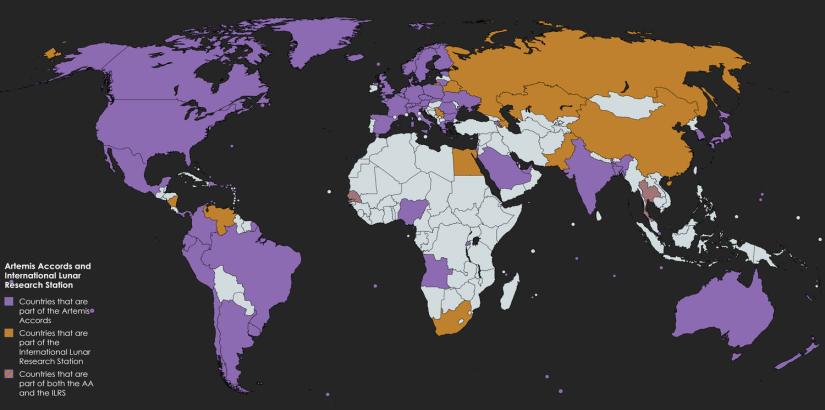
Instead of being a single UN-led consensus, space exploration is increasingly bipolar. The erstwhile cooperation related to the International Space Station (ISS) has evaporated. Both geopolitical blocs are now actively competing for the best lunar landing sites and resources.
The inclusion of Türkiye as the 71st signatory to the U.S.-led Artemis Accords on 31 August 2026 represents a crystallization of this bloc-based astro-politics. Ankara has chosen to embed its rapidly growing national space program within the Western technological ecosystem.
This alignment sidelines the competing Sino-Russian International Lunar Research Station (ILRS) framework. As an established spacefaring power and an early (2023) signatory to the Artemis Accords, India must carefully analyse this development.
For South Asian countries such as India, this signing is a reminder that celestial non-alignment is becoming difficult to sustain. Space exploration is no longer just a scientific pursuit; it is now an arena for securing terrestrial diplomatic and technical leverage.
The accord’s name invokes Artemis (Apollo’s mythological twin sister), the Greek goddess of the Moon. So, this initiative is the poetic twin of the 1960s Apollo missions. It is a 21st-century return, one that pledges to land the first woman on the moon.
Strategic Implications for Near Frontier
Technological integration and supply chain interoperability. Joining the Artemis Accords integrates the Turkish Space Agency (TUA) directly into NASA’s lunar logistics initiative. This guarantees critical data access for Türkiye’s upcoming hybrid-propelled AYAP-1 lunar mission in early 2027.
Normative standardisation. By embracing American-defined bilateral rules on safety zones and commercial resource extraction, Türkiye helps legalise a Western framework that bypasses traditional UN consensus-building mechanism channels.
Pragmatically, entering this alliance reinforces Ankara's leverage with Washington, injecting some stability into an otherwise volatile bilateral security relationship.
Global visibility. This move elevates Türkiye’s diplomatic prestige right before it hosts the prestigious International Astronautical Congress in Antalya next month (5-9 Oct).
The Sino-Russian Response to Artemis
To neutralise the expanding Western coalition, Beijing and Moscow are attracting Global-South countries to the ILRS by offering full hardware data sharing and heavy financial underwriting. Thus positioning the ILRS as a sovereign alternative, free from American commercial hegemony.
Operating as a traditional swing-state between NATO and Eurasia is a highly successful model; but astro-politics increasingly demands binary allegiances. China and Russia will view Türkiye’s accession as a concession to American legal unilateralism. In response, Moscow and Beijing could deliberately throttle Türkiye’s existing industrial / military dependencies.
Russia could quietly deprioritise future joint satellite launch assistance for Türkiye. This would mimic how Moscow uses industrial leverage and imposes military-industrial delays.
The numerical divide between the two camps is widening significantly, in favour of the West. The Artemis Accords added 19 nations in 2024, and 7 in 2025; and has already added 12 signatories in 2026 so far. By contrast, the ILRS has expanded at a much slower, tightly controlled pace. It counts 13 sovereign nations as members.
The India-Centric Lessons
ISRO-NASA ties are currently deepening, as exemplified by the NASA invitation last month, to collaborate on the Moon Base program. India now faces a challenge as the Artemis club rapidly expands.
Recent accessions, such as Mauritius and Serbia in July 2026; Botswana in June; Paraguay, Ireland, Malta in May 2026; and Morocco, Jordan, Latvia in April 2026 show that the Western alliance is scaling up rapidly. As NASA extends formal invitations to partners to co-develop its flagship Moon Base program, New Delhi no longer enjoys an exclusive monopoly on cost-effective, high-tier engineering partnerships within the alliance. Now Türkiye would also vie for the same auxiliary aerospace supply chains and tech-sharing opportunities.
Beyond that, does Türkiye joining the Artemis Accords actually affect India? No, not directly, nor urgently. Physically and operationally, Türkiye's upcoming hybrid-propelled lunar mission (AYAP-1) does not overlap with India's heavily independent Chandrayaan pipeline. However, with mid-tier powers like Türkiye constantly flooding the gates, India loses that specific boutique diplomatic leverage within the alliance.
More importantly, terrestrial rivalries often overshadow celestial pacts. Recall Türkiye's overt defense and drone alignment with Pakistan. India must now reconcile sharing a non-binding legal Artemis regime with a geopolitical adversary, and ensure that its sensitive aerospace supply chains remain fully insulated from industrial espionage or secondary leakage.
Interestingly, Pakistan chose the opposite camp; it joined the China-led ILRS initiative in October 2023. Despite recent increased U.S.-Pakistan diplomatic engagement, Islamabad's high financial and technological dependence on China's space program leaves it little room to covertly seek American aerospace data or play both sides in orbit.
The New Shape of Sovereign Power
The under-publicised legal reality of the Artemis Accords is their reliance on bilateral Memorandums of Understanding (MoUs) rather than formal, ratified treaties. By embedding undisputed, historic United Nations text, such as the 1967 Outer Space Treaty and the 1975 Registration Convention into the framework, the U.S. tries to normalise newer, highly debated commercial concepts like safety zones for resource extraction.
Artemis’ calculated framework normalises a first-come, first-served approach to lunar mining, outside traditional UN frameworks, presenting non-signatories with a fait accompli, before formal global debates even commence.
The underlying reality of the Artemis-ILRS cold war is that space is no longer an isolated scientific laboratory. It has become the primary test of alignment. The expansion of the Artemis Accords proves that 21st-century sovereign power is no longer measured by a nation's territorial boundaries, but by the depth and exclusivity of its technological alliances.
(The author, an Indian Army veteran, is a strategic affairs commentator and former Security Advisor, Ministry of Home Affairs, Government of India and former Advisor, Government of Seychelles. The views expressed are personal. He can be reached at sanjayaggy1@gmail.com/ https://www.linkedin.com/in/brigsanjayagarwal/recent-activity/all/







Post a Comment