

Downturn in India-Bangladesh Relations Needs Deft Handling: Dhaka's Alienation Has Security Fallouts for India
Rather than relying solely on high-level political rhetoric, India can employ a combination of economic diplomacy, institutional de-escalation, water-sharing agreements, and people-to-people engagement to rebuild trust and stabilize relations with Bangladesh.
 Aug 29, 2026
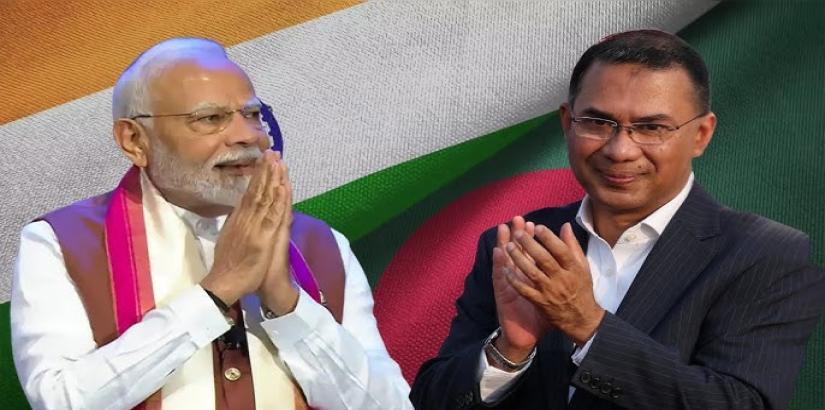
Prime Minister Narendra Modi congratulated Prime Minister Tarique Rahman when he assumed the premiership of Bangladesh and invited him to visit India. While that invite is pending, Rahman’s attendance at the BRICS Summit in India in September 2026 remains uncertain,
This bilateral friction is primarily fuelled by political fallout from former Prime Minister Sheikh Hasina's ouster in August 2024, combined with deep-seated strategic, water-sharing, and border security grievances. Sheikh Hasina faces multiple criminal charges in Bangladesh, culminating in a death sentence by Bangladesh’s International Crimes Tribunal. Bangladesh activated its 2013 Extradition Treaty with India, asserting she should be handed over.
Speaking to an international audience via virtual link hosted by the Foreign Correspondents' Club (FCC) of South Asia on August 5, 2026, Sheikh Hasina called her conviction a political assassination, criticizing the current administration for failing to protect minorities, and vowing to return to Bangladesh by December 2026. She said the uprising was not a peaceful student movement but an orchestrated, foreign-backed campaign for regime change.
India has explicitly positioned Sheikh Hasina’s continued presence and recent public statements as her own personal decisions. External Affairs Minister S Jaishankar publicly stated the Indian government will not dictate Sheikh Hasina’s next steps or political actions. New Delhi maintains that only Sheikh Hasina can determine her own next move and that she remains in the country under her own volition while navigating her political future.
Friction Points
However, the Bangladesh Ministry of Foreign Affairs released a harsh statement calling her address an "affront to the sovereignty of Bangladesh and a grievous insult to the martyrs of the July Revolution." Bangladesh says it will not compromise on its national interests regarding the extradition of Sheikh Hasina.
Sharing of the Teesta River waters remains a friction point; the issue has remained stalled due to political opposition within India - primarily from West Bengal. The 1996 Ganga Water Treaty is also set to expire in late 2026, with negotiations for its renewal stalled due to the ongoing diplomatic deadlock, threatening long-term water and agricultural security for both nations.
Deepening Ties With China
Bangladesh has rapidly deepened infrastructure and military ties with Beijing. China's involvement in reviving the Lalmonirhat airbase and funding the Teesta project near the highly sensitive Siliguri Corridor (Chicken's Neck) has direct security fallouts for India. Dhaka has now confirmed plans to procure 24 China’s J-10C fighter aircraft attack helicopters after combat success against India.
While the US is seeking transactional defence agreements with Bangladesh, Dhaka has aggressively pursued diplomatic outreach and strategic realignments with both Pakistan and Turkey. This shifts the regional balance away from New Delhi's traditional sphere of influence. Bangladesh’s defence agreements with Turkey for long-range air systems and co-produced drones creates a complex, multipolar web on India's eastern flank.
The porous 4,096 km international border remains a hotspot for illegal crossings, smuggling, and cattle trafficking. Recent diplomatic friction has arisen from India's push-ins of undocumented migrants, which Dhaka views as an aggressive violation of its sovereignty. The border remains tense. On August 25 there was a scuffle between the Border Security Forcre (BSF) and Bangladeshis who alleged that the BSF crossed into Bangladesh territory at the Hatibandha border in Lalmonirhat. Following the incident, a flag meeting between battalion commanders of the Border Guard Bangladesh (BGB) and BSF took place near the border to resolve the issue.
India has repeatedly voiced deep concerns over the vulnerability, safety, and political standing of Hindu communities and other minorities in Bangladesh who face increased risks from rising religious extremism and radicalization. Speeches by Islamic radicals in Bangladesh against Hindus and India have vitiated the atmosphere and escalated regional tensions. One example is the speech by Islamist radical Harun Izhar in Chittagong (https://www.youtube.com/shorts/zOV-HPamyMs). From the Indian side, inflammatory remarks by politicians during elections in Assam and West Bengal have also alienated opinions in Bangladesh.
Will Bangladesh Join Mecca Accord?
Bangladesh is actively considering joining the Mecca Joint Defence Agreement. Notably, Pakistan’s military assistance to Saudi Arabia after signing the SMDA included 8,000 troops, pledging to scale this up to 80,000 troops if an extreme security emergency arises; 16 JF-17 Thunder fighter jets and two squadrons of UAVs; China-supplied HQ-9 long-range SAM system; personnel to operate hardware supplied to Saudi Arabia.
Bangladesh joining the Mecca Defence Pact will enable Islamabad to rebuild defence, intelligence-sharing, and military footprint capabilities right on India’s eastern flank directly threatening India’s security, establishing a hostile strategic triangle.
In an India-Pakistan conflict, the pact has the possibility of opening a simultaneous active front via Bangladesh. The pact would also facilitate deployment of advanced Turkish military hardware, radar systems, and surveillance drones within Bangladesh, effectively giving India’s adversaries a direct line of sight into sensitive border zones.
Bangladesh is heavily dependent on Chinese military hardware and infrastructure investments. Overlaying China's economic influence with the Mecca Joint Defence Agreement military framework creates a deeply complex security challenge where Turkey's defence tech, Saudi money, and Pakistan’s military apparatus converge on India’s border. India will need to re-evaluate its Middle East diplomacy as it must counter a defence collective where a close economic partner (Riyadh) is legally tied to defending regional actors that may act against Indian national interests.
The Mecca Accord has also united the signatories in cyber crime. A group of Turkish hackers under silent trace and associated with Pakistanis, Indonesians and even Bangladeshis, have started attacking and hacking into Indian government websites; operating under the title "Cyber Jih@d Operations". Bangladeshis have developed their own Kali Linux type system which can be installed even in android or IOS phones/tablets. They have developed a tool box named Black Box and Red Hat tool Operator, using which they can randomly hack into computers, cell-phones and websites.
Remove Bottlenecks to Trade
India-Bangladesh bilateral trade currently stands at approximately USD 13 billion, making India Bangladesh’s second-largest trading partner. It has slowed down and faced a decline over the past year due to emerging diplomatic, political, and trade-related tensions.
Lengthy customs procedures, high transit fees, bureaucratic red tape, and non-tariff barriers continue to bottleneck economic cooperation, slowing down potential negotiations for a Comprehensive Economic Partnership Agreement (CEPA).
Need to Rebuild Trust
Rather than relying solely on high-level political rhetoric, India can employ a combination of economic diplomacy, institutional de-escalation, water-sharing agreements, and people-to-people engagement to rebuild trust and stabilize relations with Bangladesh.
Some of the measures could include:
·Activate ministerial-level Joint Rivers Commission meetings to share real-time hydrological data, especially flash-flood management.
·Propose interim, data-driven agreement on the Teesta River.
·Institutionalise early weather and water discharge warnings to prevent cross-border humanitarian crises.
·Mandate regular, low-level flag meetings between BSF and BGB to resolve localized disputes before they escalate.
·Increase border markets (haats) to formalize local economies, benefiting border communities and reducing l smuggling.
·Examine rescinding port limitations that bar Bangladeshi garments from land borders.
·Fast-track digitization of integrated check posts (ICPs) and remove arbitrary non-tariff barriers.
·Revive CEPA dialogue.
·Streamline visa processing centres in Dhaka, Chittagong, and Sylhet. specifically for medical emergencies and academic admissions.
·Encourage non-governmental dialogues involving think tanks, journalists, and university faculties to rebuild cultural ties.
(The author is an Indian Army veteran. The views expressed are personal. He can be reached at prakashkatoch7@gmail.com)
Post a Comment