

Bangladesh's Bid to Clear a US-Wanted Terror Fugitive Raises Troubling Questions
Although the Yunus administration was replaced by an elected government in February 2026, the influence of Islamist groups, jihadist organizations, and religious extremists has reportedly remained largely unchanged. As a result, several prominent leaders of Islamist organizations and militant groups continue to gain strength.
 Aug 06, 2026
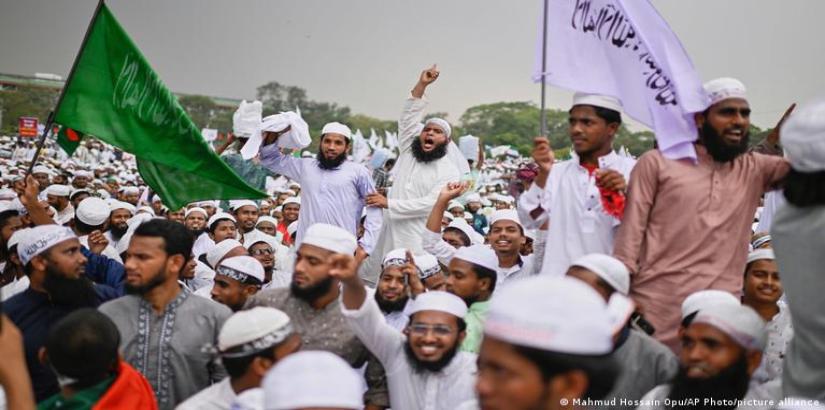
The United States has spent more than two decades building an international coalition against jihadist terrorism, investing billions of dollars in intelligence sharing, law enforcement cooperation, and judicial assistance with allies around the world. When Washington publicly places a suspected terrorist on its Rewards for Justice list and offers millions of dollars for information leading to his arrest or conviction, the expectation is that partner nations will strengthen—not weaken—the pursuit of justice.
Murder of American Citizen
Developments now unfolding in Bangladesh, however, are raising serious questions about whether that principle is being quietly tested. Efforts reportedly underway to secure legal relief for Syed Ziaul Haque, a fugitive convicted in absentia for his role in the murder of American citizen Avijit Roy and wanted by the US State Department, have prompted concerns about the future of counterterrorism cooperation between Dhaka and Washington.
On May 1, 2022, the US State Department announced a US$5 million reward for information leading to the arrest or conviction of Syed Ziaul Haque (aka Major Zia) and Akram Hussain for their roles in the terrorist attack in Bangladesh that left US citizen Avijit Roy dead and his wife, Rafida Bonya Ahmed, seriously injured.
However, some retired military officers in Bangladesh are now reportedly advancing efforts to have Syed Ziaul Haque cleared of all charges and sentences.
It may be recalled that on February 26, 2015, Avijit Roy and his wife, Rafida Bonya Ahmed, both Bangladesh-born US citizens, were visiting Dhaka to attend a book fair when they were attacked by assailants armed with machetes. Roy was killed, while Ahmed survived with critical injuries. A total of six individuals were charged, tried, and convicted in Bangladesh. Two of the convicted conspirators, Syed Ziaul Haque (aka Major Zia) and Akram Hussain, were tried in absentia and remain at large.
Two related groups claimed responsibility for the attack. Ansarullah Bangla Team, an Al-Qaeda-inspired terrorist organization based in Bangladesh, claimed responsibility shortly after the incident. Subsequently, Asim Umar, the now-deceased leader of Al-Qaeda in the Indian Subcontinent (AQIS), released a widely circulated video claiming that AQIS followers were responsible for the attack on Roy and Ahmed.
The Ansarullah Bangla Team originated around 2007 as Jama'atul Muslemin before rebranding and emerging as ABT in 2013. Following government crackdowns and leadership changes, the group reorganized and began operating under the name Ansar al-Islam.
Specially Designated Global Terrorist
In 2016, the US Department of State designated AQIS as a Foreign Terrorist Organization under Section 219 of the Immigration and Nationality Act and as a Specially Designated Global Terrorist under Executive Order 13224, which authorizes sanctions against terrorists and those who support terrorist organizations or acts.
According to the Jamestown Foundation, during various investigations, Bangladeshi police uncovered information regarding Ziaul Haque's involvement in numerous targeted attacks and killings that took place between January 2013 and April 2016.
After evading arrest following the failed coup plot and remaining underground for several years, Ziaul Haque's name resurfaced as the military wing chief of Ansar al-Islam Bangladesh. An affiliate of Al-Qaeda in the Indian Subcontinent (AQIS), Ansar al-Islam Bangladesh has been responsible for a number of targeted attacks against secular writers, intellectuals, bloggers, gay rights activists, and free speech advocates.
A June 2016 report by the European Strategic Intelligence and Security Center stated: "Challenged not only by the presence of already existing local radical Islamist groups but also by the recently declared expansion of activities within the country by 'international' terrorist organizations, Bangladesh is becoming another arena of competition between the Islamic State and Al-Qaeda, reflecting a broader global trend".
Since the August 2024 coup in Bangladesh, which ousted a 15-year-old government, the situation in the country has steadily deteriorated as the interim regime led by Muhammad Yunus granted what critics describe as a free pass to Islamist forces and militant outfits advancing the agenda of turning Bangladesh into a Caliphate.
Although the Yunus administration was replaced by an elected government in February 2026, the influence of Islamist groups, jihadist organizations, and religious extremists has reportedly remained largely unchanged. As a result, several prominent leaders of Islamist organizations and militant groups continue to gain strength.
Campaign by Former Military Officers
The most disturbing development recently reported in local media is that former military officers have launched a coordinated effort to secure legal relief for dismissed Bangladesh Army Major Syed Ziaul Haque (Major Zia), whom authorities have identified as a key figure in Ansar al-Islam.
According to the report, the initiative, led by members of the Armed Forces Retired Officers Welfare Association (RAWA), includes appeals to government ministries, applications seeking suspension of death sentences, and efforts to withdraw pending criminal cases. According to documents and statements from RAWA leaders, the organization has been working with relevant government authorities to create a legal pathway that could eventually allow Ziaul Haque to return to the country, challenge his convictions, and seek reinstatement in military service.
The retired officers argue that the criminal cases against Zia were politically motivated and that significant irregularities occurred during both the investigations and the judicial proceedings.
As part of the initiative, applications have been submitted to the Ministry of Home Affairs under Section 401 of the Criminal Procedure Code, seeking suspension of the death sentences imposed in three separate murder cases.
At the same time, separate applications have been filed requesting that the remaining criminal cases be reviewed by the government's Political Cases Review Committee.
According to RAWA Joint General Secretary, retired Lieutenant Colonel Abu Nowroz Khurshid Alam, the organization has already met senior government officials, including the Law Minister, to seek cooperation.
Khurshid told the media that the Home Ministry initially advised the organization to consult the Law Ministry regarding possible legal procedures. He said that during a meeting with the Law Minister earlier this year, RAWA representatives discussed the ongoing legal proceedings involving Zia and submitted relevant documents supporting their position.
According to Khurshid, the discussions focused on the appointment of a state defense lawyer for the High Court death reference hearings and on monitoring the progress of the cases. He further claimed that the Law Minister assured them that the remaining criminal cases considered politically motivated would be reviewed through the appropriate government committee.
While Home Minister Salahuddin Ahmed confirmed that RAWA representatives had met him and that he advised them to consult the Law Ministry, Law Minister Md. Asaduzzaman reportedly declined to comment publicly on the matter.
Withdrawal of Cases Sought
The legal campaign extends beyond seeking suspension of the death sentences. Applications have also been submitted requesting the withdrawal of the remaining criminal cases through the government's Political Cases Review Committee.
According to the petitions, the Dhaka Metropolitan Public Prosecutor has already recommended removing Zia's name from the nine pending cases.
The petitions further state that although the District Review Committee recommended the withdrawal of 61 cases to the Ministry of Home Affairs, Zia's nine cases were not included in that recommendation.
Separate applications have also been submitted to the Inspector General of Police requesting withdrawal of the Tk 2 million reward previously announced for Zia's arrest. The petitions argue that allegations linking Zia to extremist organizations were deliberately fabricated.
According to media reports cited in the source material, Supreme Court lawyer Barrister M. Sarwar Hossain has also submitted petitions on Zia's behalf to Prime Minister Tarique Rahman and the Prime Minister's Defense Adviser, retired Brigadier General AKM Shamsul Islam.
The petitions request administrative intervention to facilitate the withdrawal of what they describe as politically motivated cases and, ultimately, to restore Zia to military service. Copies of the petitions were also reportedly sent to the Home Ministry's Legal Adviser, the Attorney General's Office, the Inspector General of Police, and the Office of the Army Chief.
Whether the legal initiatives on behalf of Syed Ziaul Haque ultimately succeed remains to be seen. Yet the very existence of such efforts has implications that extend far beyond Bangladesh's domestic politics. The case touches on the credibility of judicial verdicts in terrorism prosecutions, the integrity of international counterterrorism cooperation, and the confidence that allies place in one another's commitment to combating violent extremism.
For Washington, the issue is likely to be viewed not merely through the prism of Bangladesh's internal legal processes but also as a measure of whether a key regional partner remains committed to the principles that have underpinned global counterterrorism efforts since the attacks of September 11, 2001.
(The writer is an award-winning journalist, columnist, editor and publisher of the Bangladesh-based publication Blitz, and a commentator on Islamist extremism, terrorism and South Asian geopolitics. The views expressed represent the author's views and have not been independently verified. He can be reached at noman14@gmail.com and on X: @Salah_Shoaib.)





Post a Comment