

How Sri Lanka Missed the Opportunity to Become a 200-billion dollar economy
Policy instability during the 2015-2024 likely pushed back Sri Lanka’s path towards becoming South Asia’s first High-Income Country. The 2022 financial crisis would never have happened as stable growth during the first half of 2015–2024 would have built enough buffer to weather impact of the Covid pandemic
 Aug 03, 2026

For the first time in history, Sri Lankan economy surpassed the hundred billion dollar mark in 2025. Gross Domestic Product (GDP) and GDP per capita reached USD 109 billion, and USD 5,003 respectively in 2025. Interestingly, Sri Lanka was an 85 billion economy way back in 2015, and it took a decade to surpass the hundred billion dollar benchmark. This suggests a decade of slow economic progress.
Economists agree that a stable policy environment is necessary for sustainable long-term economic expansion. It is believed that “frequent economic policy changes” during the 2015 – 2025 caused slow economic expansion. However this argument is valid only if we can find empirical evidence to support “periods with relatively stable policy environment resulted in higher economic expansion” in the past.
Identifying Long-Term Time Blocks
In order to identify meaningful time slabs to compare “economic expansion patterns” and “policy stability”, it is essential to select appropriate time blocks from the past. In selecting appropriate time blocks we need to select longer time blocks to remove short term effects, and also select appropriate time blocks to incorporate policy shifts associated with political regime changes.
The 30-year period from 1994 to 2024 provides three (3) appropriate time blocks. Interestingly these three time blocks or “Economic Chapters” can be easily assigned with relative policy stability ratings. Table below explains these three Economic Chapters (“EC”) along with Policy Stability rating applicable for each EC.
Table 1: Sri Lanka’s Economic Growth Chapters During 1994 and 2024
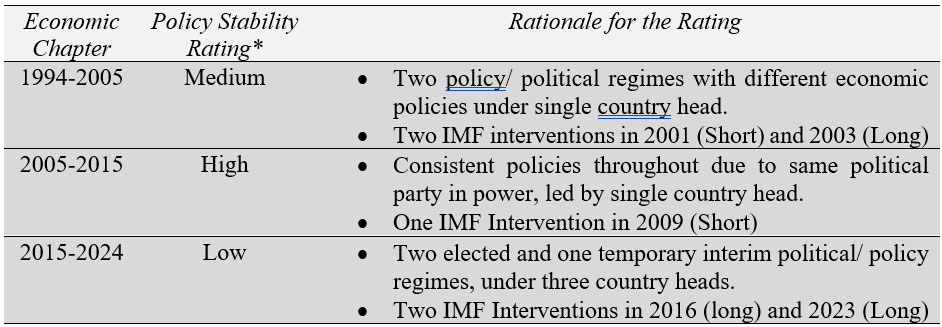
*Stability Rating is assigned based on the total count of policy/ regime changes, and IMF interventions. Lower the policy/regime changes and IMF interventions, higher the stability.
Policy Stability and Economic Expansion.
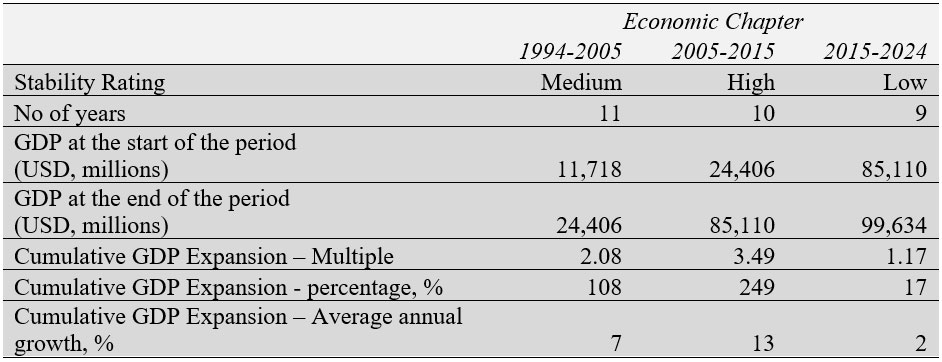
Table 2 below provides a comparison of how the economy performed during each of the ECs. As evident from this table, there is a marked difference in how the GDP expanded during each EC.
Table 2: Comparison of Performance of Three Economic Chapters
Data Source: CBSL
Above table shows that high policy stability during the 2005-2015 EC caused the size of the economy to expand by 250 percent. The EC between 1994 and 2005, with medium stability, had a moderate 108 percent economic expansion. The EC between 1995 and 2024 stands out as a very low stability period resulting in a mere 17 percent expansion.
Above analysis clearly shows that Sri Lanka’s economic expansion is closely associated with policy stability.
Political Instability and Growth
It is clear that the policy instability during the 2015 - 2024 EC caused the economy to grow at a slower rate. The political regime change in 2015 led to a major overhaul of economic policies along with change in the country's political priorities. This resulted in complete disruption of the economic expansion achieved throughout the 2005-2015 EC
However, we can make a high level estimate of “what could Sri Lanka have achieved if Sri Lanka had a stable policy environment during 2015 – 2024?” Such a scenario would have involved continuation of economic policies and practices similar to 2005 – 2015 EC. Table 3 below shows high level estimates of potential GDP in 2024. Estimates for 2024 are provided under three sub-scenarios.
Table 3: Estimate of GDP and GDP per Capita in 2024 if 2005 - 2015 Policy FRAMEWORK CONTINUED until 2024
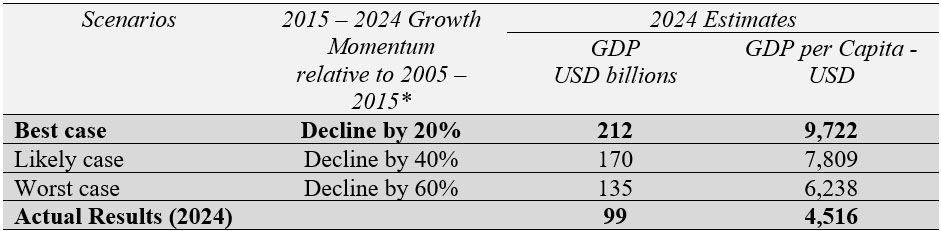
*Growth Momentum adjusted downward for all scenarios to incorporate the impact of Covid Pandemic and natural slow down following high expansion.
Above scenario analysis shows that Sri Lanka had some chance of reaching a 200-billion dollar economy by 2024. This would have placed Sri Lanka among the world's top 60 economies.
Besides, an estimated USD 9,722 GDP per capita would have placed Sri Lanka in par with countries like Malaysia (USD 11,874) and Thailand (USD 7,347). Even under the worst case scenario, Sri Lankan economy could have been over 36 percent large in size.
Hence it is fair to assert that the policy instability during the 2015-2024 likely pushed back Sri Lanka’s path towards being South Asia’s first High-Income Country. Also the 2022 financial crisis would have never happened under such a scenario, as stable growth during the first half of 2015 – 2024 period would have built enough buffer to weather the impact of Covid pandemic during the second half.
What Makes 2015 a Historic Year
Economic historians often highlight the beginning of the civil conflict in the early 1980s as a major turning point in Sri Lanka’s economic expansion. Civil conflict effectively blocked Sri Lanka from reaping benefits from early economic liberalization in the late 1970s. Three decades later, after the civil conflict was over, Sri Lanka faced another economic blockade. This time the blockade prevented Sri Lanka reaping the long term economic benefit from ending the civil conflict in 2009. Both these blockages created a long term dampening effect on economic expansion.
It is widely believed that both civil conflict and political regime change in 2015 are linked to broader global and regional geopolitical dynamics prevailed during respective time periods. Hence we can argue that Sri Lanka’s economic progress is also highly susceptible to external influences.
Need for 'Carefully' Crafted International Policy
The start of civil conflict in the 1980s had a long term dampening effect on the Sri Lankan economy over several decades. The political regime change in 2015 created a similar impact by “dismantling” the traditional political landscape. It is unclear when Sri Lanka will be able to achieve a stable political regime – a regime that can last a decade with the approval of people. Only a stable political regime can ensure a stable policy environment leading to stable economic expansion.
It goes without saying, even if Sri Lanka achieve policy stability through political stability, Sri Lanka needs a “carefully” crafted international policy and strategy. An effective plan to weather fast changing regional and global geopolitical dynamics has become a necessity for Sri Lanka to achieve any economic expansion plan.
(The writer is an Investment, Strategy and Policy Advisory professional. He has a master’s degree in Economics (Colombo), an undergraduate degree in Business (Wisconsin, USA), and also obtained CFA charter (USA). He is contactable on indika.h@jupitercapitalpartners.com © 2026, Indika Hettiarachchi)





Post a Comment