

Beyond Earth Overshoot Day: Why Humanity Needs an Earth Budget Framework
If Earth Overshoot Day falls on 30 July in 2026 , humanity is currently effectively requiring nearly one and three-quarter Earths to sustain its present patterns of production and consumption.
 Jul 30, 2026

Every year, finance ministers present national budgets. Companies publish balance sheets. Families carefully plan their annual income and expenditure. We instinctively understand a simple truth: if expenditure consistently exceeds income, bankruptcy is inevitable.
Yet humanity has never applied this same discipline to the only form of capital upon which every economy ultimately depends - Nature.
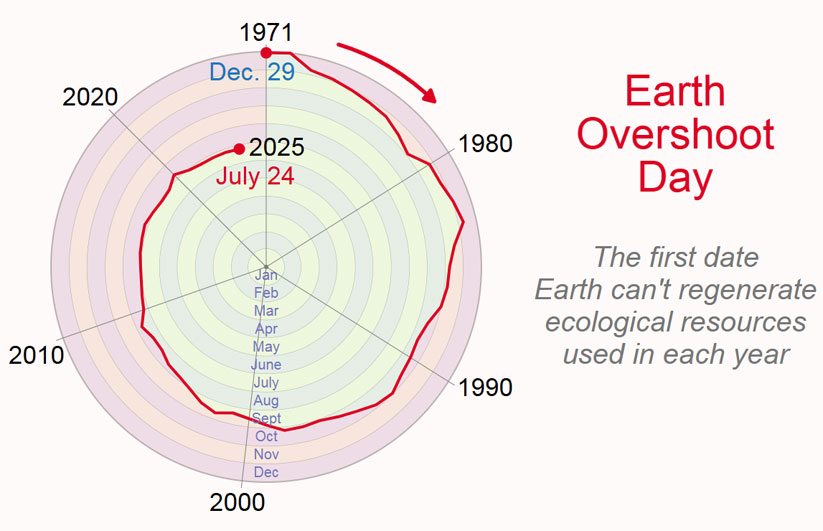
On 30 July this year, the world is observing Earth Overshoot Day, the date when humanity is expected to have consumed all the biological resources that the Earth can regenerate during the entire year. From 1 August until 31 December, we are no longer living on Nature's annual ‘ salary’ or income. We are going to borrow from its accumulated capital.
No economic theory advocates, no responsible government celebrates spending beyond its means. No prudent business would regard consuming its capital instead of its income as a sign of success. Yet this is precisely how humanity has been treating the planet for decades.
Earth Overshoot Day is therefore much more than another environmental observance. It is the world's annual ecological balance sheet. It tells us, with uncomfortable clarity, that our economic system is steadily liquidating the natural capital upon which civilisation itself depends. The challenge before humanity is no longer to understand this reality. The challenge is to govern it. Nature has, thankfully, not yet organised the IMF to deal with such a situation.
That is why the next evolution of sustainable development should not begin with another UN or regional treaty or another awareness campaign by a burgeoning army of so-called ‘ environmentalists’ . It should begin with a far simpler and more familiar instrument : An Earth Budget.
Nature: The World's First Economist
Economics is commonly defined as the science of allocating scarce resources. Yet long before humanity invented economics, Nature had already perfected it. For 4.5 billion years, Earth's ecosystems have operated on a remarkably simple principle. Every year Nature generates a finite amount of fresh water, fertile soil, forests, fisheries, biodiversity, clean air and the capacity to absorb carbon. Every ecosystem survives by living within this annual regenerative income. Nature never consumes its capital. Only humans do.
Modern civilisation has mastered the art of increasing financial wealth while steadily diminishing natural wealth. We measure Gross Domestic Product with extraordinary precision, yet we possess no equivalent discipline for managing the Earth's annual regenerative capacity. This disconnect explains why economic growth and ecological decline have too often progressed together.
The economy is frequently described as if it were separate from Nature. It is not. Every currency, every industry and every technological breakthrough ultimately depends upon natural capital. Agriculture depends on healthy soils. Manufacturing depends on minerals, energy and water. Digital technologies depend on electricity, rare earth elements and increasingly vast quantities of cooling water. Even Artificial Intelligence ultimately runs on ecosystems that provide the resources and stability upon which modern infrastructure depends.
Nature is not one sector of the economy. Nature is the foundation of every economy. The wealth it generates is meant to travel to the ecosystem for next year's regeneration, without using the Strait of Hormuz and Panama or Suez Canal.
More Than an Environmental Symbol
The concept of Earth Overshoot Day emerged from the scientific work on Ecological Footprint developed by Professor William Rees and Dr. Mathis Wackernagel, and has since been advanced through the Global Footprint Network. By comparing humanity's ecological demand with the Earth's annual biocapacity, it identifies the date each year when global consumption exceeds annual regeneration. Science is important. The message is even more important.
If Earth Overshoot Day falls on 30 July in 2026 , humanity is currently effectively requiring nearly one and three-quarter Earths to sustain its present patterns of production and consumption. Since we possess only one planet, the deficit is met by depleting forests faster than they regenerate, extracting groundwater faster than aquifers recharge, harvesting fisheries beyond sustainable levels and releasing more carbon dioxide than ecosystems can safely absorb. This is ecological debt. Unlike financial debt, however, Nature cannot negotiate repayment schedules.
Every year the ecological debt accumulates, it appears somewhere else, as biodiversity loss, degraded soils, declining freshwater, more frequent climate extremes of heat waves, floods, droughts or increasing economic vulnerability. Nature always attempts to balance its books, to the extent . The only uncertainty is who ultimately pays the bill.
Humans suffer by making noise, by overlooking the corrective paths. The other living beings and ecosystem suffer silently. Or, maybe, they are quietly finding their own ways through evolutionary methods the way nature and ecosystem survived 5 extinctions!
The Successes are Rare
When science provides clear evidence, governments build trust, industries innovate and societies cooperate, humanity is capable of restoring damaged planetary systems. The recovery of the ozone layer is proof that global environmental governance can succeed. Yet the climate crisis reminds us that success in protecting one component of the Earth system does not automatically ensure the sustainability of the whole system.
Climate change, biodiversity loss, land degradation, freshwater stress and unsustainable consumption are not isolated crises. They are different expressions of the same underlying problem. Humanity has never learned to live within the Earth's annual ecological budget.
That is why Earth Overshoot Day deserves to become much more than an annual reminder and not just a few passionate non-governmental organisations like Global Footprint Network declaring the overshoot date. It should become the starting point for the next generation of global environmental governance by engaging the United Nations agencies .
Urgency of engagement of UN
Some may ask why Earth Overshoot Day has never become an official United Nations observance. The answer lies in its history. Unlike World Environment Day, Earth Overshoot Day did not emerge through diplomatic negotiations. It emerged through independent scientific innovation. That independence has been one of its greatest strengths, protecting methodological integrity while allowing continuous scientific refinement. Today, however, the concept has matured. Its relevance now extends beyond environmental education into economic planning, sustainable development and public policy.
The time may therefore be right—not for the United Nations to take ownership of Earth Overshoot Day—but to become a trusted convener of a broader scientific partnership that holds the countries accountable Such a partnership could bring together the Global Footprint Network, UNEP, FAO, UNESCO, WMO, the UN Statistics Division, the International Resource Panel, IPBES, universities and national academies of science.
While science would remain independent, the way it has been under the ‘ single most successful international agreement so far’ of the Montreal Protocol that prevented the sixth extinction, the United Nations would provide legitimacy, coordination and global reach. The relationship would resemble that between governments and the IPCC: scientific credibility supported by multilateral cooperation rather than political control.
AI Must Become Ecological Intelligence
Humanity’s entry into the age of Artificial Intelligence is now hailed as, ‘panacea’ for 21st century. AI is indeed is transforming finance, medicine, manufacturing, transport and education. It should now help transform our relationship with Nature.
Imagine AI systems continuously integrating satellite observations, hydrological data, biodiversity indicators, agricultural productivity, atmospheric measurements, forest regeneration and urban development into dynamic Earth Budget dashboards. Such systems could provide governments, businesses and communities with near real-time ecological intelligence, enabling preventive action rather than delayed reaction.
The next frontier is therefore not simply Artificial Intelligence. It is Ecological Intelligence, using AI to optimise not only economic productivity but also the Earth's regenerative capacity. Earth Budgeting simply translates that timeless wisdom into the practical vocabulary of governance.
The twentieth century will be remembered for creating institutions capable of managing financial capital. The twenty-first century will be judged by whether it created institutions capable of managing the Earth's natural capital.
Earth Overshoot Day has already given humanity an annual ecological mirror. The next step is to transform that mirror into a management system.
Humanity has learned to live within financial budgets. The defining challenge of our century is to learn to live within the Earth's ecological budget.
(The author is a noted environmentalist, former Director of UNEP, Coordinating Lead Author, IPCC 2007 (Nobel Peace Prize laureate), IIT alumnus, and Founder of the Green TERRE Foundation, Pune. Views are personal.)





Post a Comment