

Sri Lanka’s TEPES and PEC share many similarities with China’s whole-process democracy. Both nations are working closely to exchange experiences and collaborate on the implementation of these systems in Sri Lanka.
India’s rise coincides with China’s structural slowdown, reshaping Asia’s strategic landscape. For Malaysia, the choice is not between India and others—but between preparing early for India’s ascent or adjusting late. Prime Minister Modi’s visit represents a strategic inflection point. Deepening ties in defence, technology, semiconductors, energy, food security, education, and culture is not merely prudent—it is foundational to Malaysia’s long-term prosperity, security, and strategic autonomy.
But in NSS 2025 the specific reference to the “Quad” appears less central as compared to its 2022 prominence. The document emphasized the allies assuming primary responsibility for their own region even as it identified the Indo-Pacific as a key economic and geopolitical battleground. It reiterates that alliances and strengthening partnerships “will be the bedrock of security and prosperity long into the future”
It’s heartening to see that China has resumed the pilgrimage of Indian pilgrims to the sacred Mount Kailash and Lake Manasarovar in Southwest China’s Xizang Autonomous Region this year after a five-year break, and India has restarted the issuance of tourist visas to Chinese citizens suspended since 2020. Recently, several direct flights between the two countries have been restored. This development is expected to strengthen exchanges in people-to-people fields, as well as in trade, culture, and other areas.
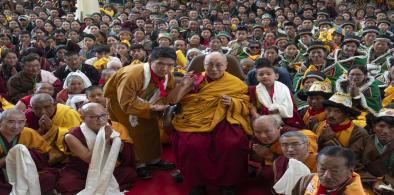
Despite China's might and backing, Gyeltsen Norbu has lacked legitimacy and following among Tibetans and Tibetan Buddhists elsewhere, and many suspect the 15th Dalai Lama appointed by Beijing will suffer the same fate. The Dalai Lama has emphasised that China must reach a resolution on the Tibetan question during his lifetime, and many fear that without his moral authority, no solution will have widespread acceptance among the Tibetan people.
Sri Lanka’s TEPES and PEC share many similarities with China’s whole-process democracy. Both nations are working closely to exchange experiences and collaborate on the implementation of these systems in Sri Lanka.
First, Russia is engaged in a war that marks Putin's point of no return in his effort to undermine NATO and the West—particularly the U.S.—pursuing a long-term confrontation. To better position Moscow for this conflict, Putin has effectively doubled down on relations with like-minded partners - China, Iran, and North Korea.
China-based Hubei Huachangda Intelligent Equipment Company, Universal Enterprise Limited, and Xi’an Longde Technology Development Company Limited (also known as Lontek) are sanctioned for having “knowingly transferred equipment and technology” to Pakistan, which is not a member of the Missile Technology Control Regime (MTCR) group, Miller said.
The intensification of geopolitical competition in the Bay of Bengal region may affect the healthy interaction between China and Bangladesh. Bangladesh, strategically located at the crossroads of South Asia and Southeast Asia, is a significant factor in the geopolitical and geoeconomic landscape of the Bay of Bengal.
The historical manipulation of Tibet's relations with Monyul is a front that China plays against India on the China-India border dispute over the Indo-Tibet border. China has misinterpreted the history of Tibet's relations with Monyul to assert its territorial claim in the region.
“One of the hardest things to keep in mind is that India is also a great power and it has its own beliefs, its own interests”, he said.
Recalling the 26/11 Mumbai and the 2016 Pathankot terrorist attacks. they called for “bringing the perpetrators of these attacks to justice without delay”. This explicit mention of terror attacks on India, purported to be engineered from Pakistani soil, is seen as a strong backing by Quad partners of India's stand on cross-border terrorism which New Delhi says is promoted and supported by the Pakistani State.
China's rising military and economic involvement in the region provides India with a strategic challenge to formulate a foreign and security policy blueprint for the Indo-Pacific.
The participation of Indo-Pacific partners in the NATO summit epitomizes the breaking of traditional geopolitical barriers, ushering in what is often referred to as "the new geometry" of international relations.
India introduced the Agnipath system of recruitment in its military, denying regular recruitment to thousands of Nepalese Gurkhas into the Indian Army, not only aggravating unemployment in Nepal, but more importantly, shattering the strong bond between the Indian and Nepalese armies.
From the Indian standpoint Prime Minister Modi may like to keep the Tibetan issue on the foreign policy agenda of his third term while dealing with a recalcitrant China. Its particular reference to the Tibetan issue remaining unresolved in accordance with international law may provide some opening to New Delhi to work on given the historical sensitivities of India's border dispute with China.
If NDA 3.0 wanted to show assertiveness to China, why were representatives of the Central Tibet Administration not invited for the osth-taking ceremony at Rashtrapati Bhavan on June 9, as they were invited in 2014 for the swearing-in of the then new NDA government.
New power tools being used by China to expand regional dominance have heightened regional security dilemmas and sparked arms races. They have also caused systemic wariness among nations of the Indo-Pacific who will long for the status quo of a stable rules-based order.
The potential implications of recent protests in New Caledonia are best understood in the context of a broader framework of China’s increasing presence in the South Pacific island countries.
This new bloc is vital for both the US and regional players, especially the Philippines which is not part of the original Quad. For Australia and Japan, this new partnership represents a more focused security arrangement with greater on-the-ground ease of conducting military activities as compared to the more bureaucratic Quad.